
Introduction
Modern brands no longer compete only through products or services—they compete through consistency, speed, visibility, and audience engagement across digital channels. Social media has evolved into a continuous operational function that demands research, content creation, approvals, publishing coordination, and performance optimization.
For many businesses, maintaining a strong social presence becomes increasingly difficult as teams grow, channels multiply, and content expectations accelerate.
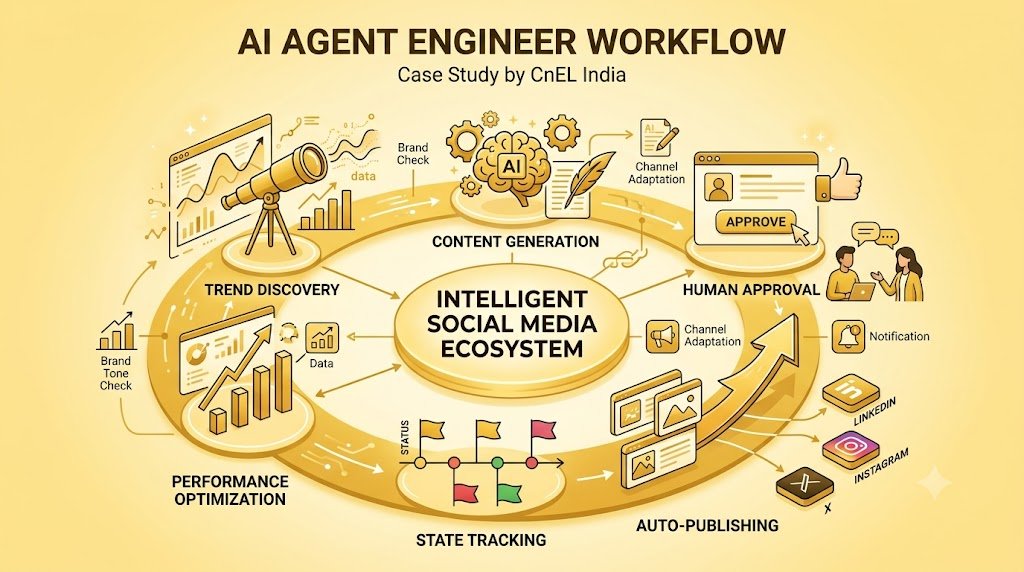
This case study explains how CnEL India can design and implement an intelligent social media automation ecosystem that supports end-to-end content operations while maintaining strategic human oversight.
The objective is not replacing creative teams. Instead, the goal is to build an intelligent operational layer that reduces repetitive effort, accelerates publishing cycles, and creates a scalable content engine.
This solution combines:
- Trend discovery
- Content planning
- Multi-platform content generation
- Human approval workflows
- Publishing orchestration
- State tracking
- Operational reporting
- Continuous optimization
CnEL India approaches this project as a business automation and digital operations transformation initiative.
Understanding the Business Requirement
The requirement is to create an autonomous but supervised content workflow capable of managing the complete publishing lifecycle.
The expected system should:
- Discover relevant content opportunities
- Generate platform-specific content drafts
- Pause for approval
- Publish automatically after approval
- Track status across the entire lifecycle
The business also requires flexibility, control, and maintainable operations.
CnEL India focuses on building a structured publishing ecosystem rather than isolated automations.
The Challenge with Traditional Social Media Operations
Most social media workflows suffer from operational inefficiencies.
Teams often experience:
- Manual topic research
- Delayed approvals
- Repetitive content preparation
- Publishing bottlenecks
- Inconsistent messaging
- Fragmented workflows
As content volume grows, these problems scale.
CnEL India addresses these limitations through intelligent orchestration.
Defining the Autonomous Content Lifecycle
The system is designed around a controlled content lifecycle.
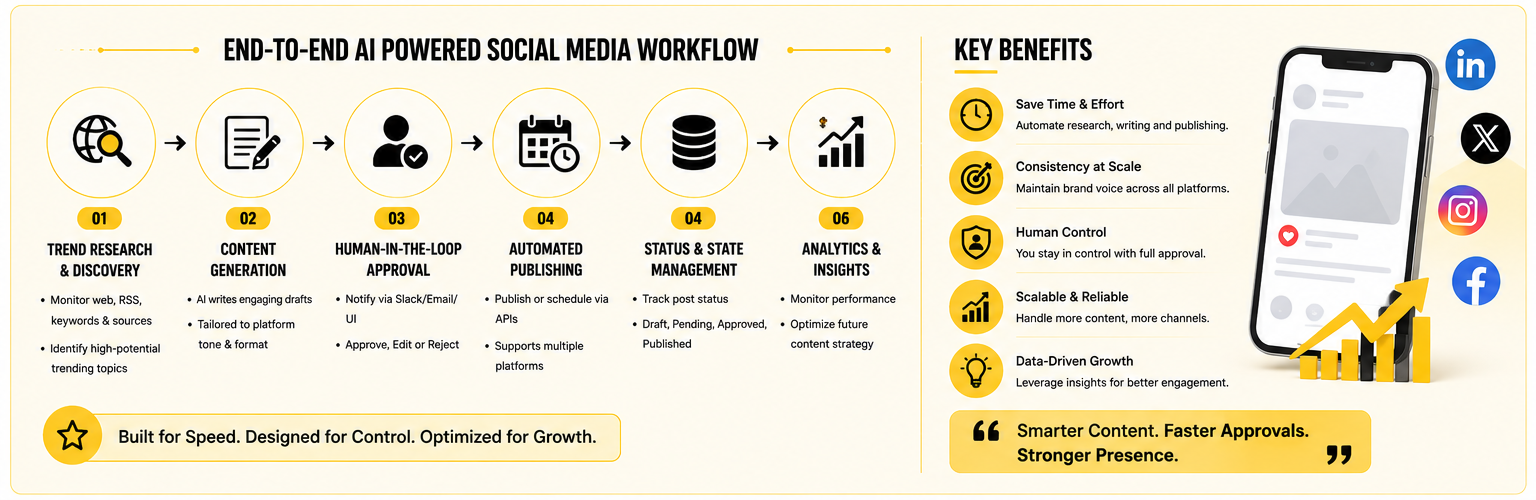
The complete journey includes:
Discovery
Identify valuable opportunities.
Generation
Produce content drafts.
Review
Enable approval decisions.
Publishing
Deliver approved content.
Tracking
Monitor content states.
Optimization
Improve future performance.
Each stage contributes to a connected operational environment.
Intelligent Trend Discovery Framework
Effective content begins with selecting the right topic.
CnEL India creates discovery systems capable of evaluating:
- Emerging discussions
- Industry relevance
- Audience behavior
- Content momentum
- Market timing
The objective is generating opportunities before competitors.
Building Topic Qualification Logic
Not every trend deserves publication.
CnEL India introduces qualification rules that evaluate:
- Strategic fit
- Audience alignment
- Brand consistency
- Engagement potential
- Content feasibility
This prevents unnecessary content production.
Multi-Platform Content Generation Strategy
Every platform behaves differently.
CnEL India structures content generation to support:
Professional channels
More structured messaging.
Short-form platforms
Faster engagement formats.
Visual-first environments
High-impact presentation.
Community-driven platforms
Conversational experiences.
Each output adapts to channel expectations.
Maintaining Brand Identity at Scale
One challenge of automated operations is consistency.
CnEL India designs systems that preserve:
- Tone consistency
- Messaging structure
- Visual expectations
- Brand positioning
This ensures content feels unified.
Human-in-the-Loop Approval Architecture
Automation should support decision-making, not replace it.
CnEL India introduces controlled approval layers.
Operators receive content and can:
- Approve
- Modify
- Reject
Publishing proceeds only after authorization.
This balances efficiency with control.
Designing Approval Workflows
Approval systems are built to reduce friction.
The process includes:
Draft Notification
Content becomes available.
Review Queue
Operators prioritize work.
Decision Actions
Approve, edit, reject.
Publishing Trigger
Approved content proceeds.
This creates predictable operations.
Intelligent Publishing Orchestration
After approval, content enters automated publishing flows.
CnEL India supports:
- Scheduled publishing
- Sequential posting
- Channel coordination
- Timing optimization
This eliminates repetitive manual execution.
State Management Across Content Operations
Tracking becomes essential as scale increases.
CnEL India organizes lifecycle states such as:
- Draft Created
- Awaiting Review
- Under Revision
- Approved
- Scheduled
- Published
- Archived
This improves visibility.
Content Repository and Historical Tracking
Published content becomes reusable knowledge.
CnEL India supports:
- Historical storage
- Performance analysis
- Reuse opportunities
- Campaign continuity
Knowledge compounds over time.
Workflow Monitoring and Operational Visibility
Businesses need to understand system activity.
CnEL India provides visibility into:
- Content progress
- Approval bottlenecks
- Publishing activity
- Operational efficiency
This improves management decisions.
Scalable Content Production
As social operations expand, scale becomes critical.
CnEL India structures the environment to support:
- Higher publishing frequency
- More channels
- Larger content libraries
- Increased approval volume
Growth should not require rebuilding.
Content Quality Assurance Framework
Automation without quality control creates risk.
CnEL India introduces validation checks including:
- Structural review
- Tone verification
- Formatting standards
- Platform alignment
Quality remains consistent.
Notification and Collaboration Systems
Operational communication keeps teams aligned.
CnEL India enables:
- Content alerts
- Approval requests
- Publishing confirmations
- Exception notifications
Communication becomes centralized.
Operational Analytics and Reporting
Long-term improvement depends on measurement.
CnEL India supports reporting across:
- Publishing frequency
- Approval duration
- Content throughput
- Operational trends
Data enables continuous improvement.
Security and Access Governance
Publishing systems require controlled access.
CnEL India implements:
- Permission structures
- Approval ownership
- Workflow separation
- Protected operational controls
Governance supports reliability.
Modular Architecture for Future Expansion
Business requirements evolve.
CnEL India designs modular environments that support:
- Additional channels
- New approval layers
- Expanded content formats
- Campaign extensions
Adaptability becomes a built-in advantage.
Delivery Methodology
The project follows structured execution.
Phase 1 – Discovery
Define business objectives.
Phase 2 – Workflow Design
Build operational logic.
Phase 3 – Approval Modeling
Configure decision processes.
Phase 4 – Publishing Integration
Connect delivery systems.
Phase 5 – Validation
Test reliability.
Phase 6 – Launch
Enable production operations.
Challenges Solved by CnEL India
Organizations commonly face:
- Slow content production
- Publishing inconsistency
- Approval delays
- Manual execution overload
- Limited scalability
CnEL India transforms these constraints into automated operations.
Business Outcomes Delivered
This implementation creates measurable advantages:
- Faster content cycles
- Higher operational efficiency
- Improved publishing consistency
- Reduced manual effort
- Greater strategic control
Content operations become predictable and scalable.
Why CnEL India
CnEL India combines:
- Workflow architecture expertise
- Content operations understanding
- Automation strategy
- Scalable implementation thinking
- Long-term operational planning
The focus is creating systems that remain practical for real business environments.
Long-Term Vision
Social media operations should become intelligent business infrastructure.
Over time, organizations gain:
- Faster execution
- Better decision-making
- Stronger audience engagement
- Sustainable growth
Automation becomes a strategic capability rather than a collection of disconnected tasks.
Conclusion
This case study demonstrates how CnEL India can design and implement an intelligent social media content and publishing ecosystem that automates discovery, generation, approvals, publishing, and lifecycle tracking while maintaining full human oversight.
Rather than treating content creation as isolated tasks, the approach establishes a scalable operational framework that improves efficiency, preserves quality, and supports long-term digital growth.
By combining structured workflows, approval architecture, publishing intelligence, and scalable content operations, CnEL India enables businesses to transform social media from a manual process into a high-performing growth engine.