
Case Study by CnEL India
Introduction
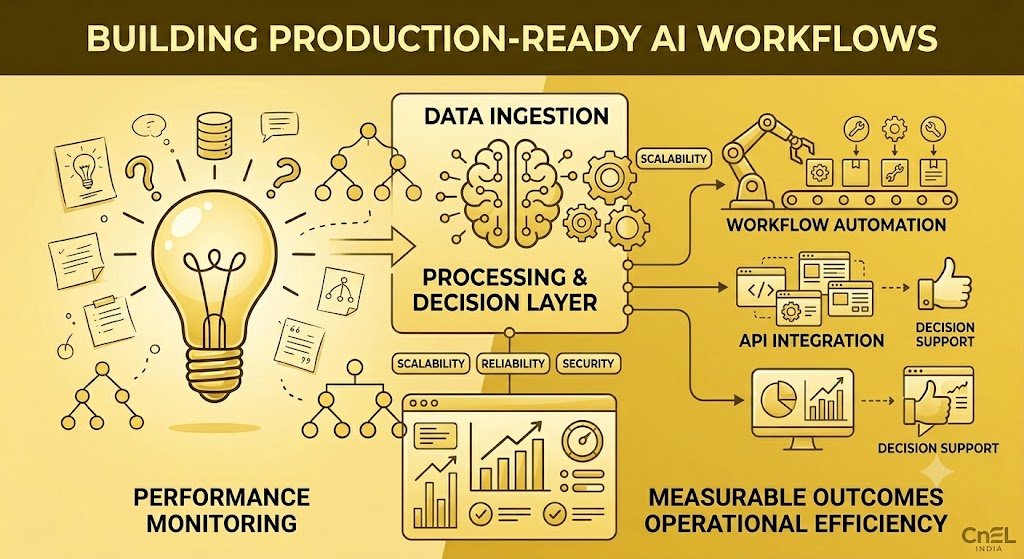
Artificial intelligence has moved beyond experimentation and entered a stage where businesses increasingly expect measurable outcomes, operational efficiency, and real-world deployment. Organizations are no longer searching for isolated prototypes or research demonstrations—they need production-grade AI systems capable of solving business problems at scale.
As industries accelerate digital transformation, the role of an AI Engineer has become increasingly important. Businesses require professionals who can bridge the gap between innovative ideas and reliable production environments while ensuring scalability, performance, maintainability, and business value.
This case study explains how CnEL India can deliver end-to-end AI engineering capabilities for organizations seeking to design, build, deploy, and optimize intelligent digital products.
The project focuses on supporting companies that want to transform AI concepts into production-ready systems through strong architecture, deployment strategy, workflow design, and scalable implementation.
The role requires expertise across:
- AI-powered product development
- Intelligent workflow engineering
- Production deployment strategy
- Data architecture planning
- API integration
- Model operationalization
- System scalability
- Remote collaboration
CnEL India specializes in:
- Enterprise AI implementation
- Production AI systems
- Intelligent automation
- AI architecture design
- Digital transformation solutions
- Scalable deployment planning
- Workflow optimization
The objective is not simply creating AI features but building intelligent infrastructure that delivers long-term business value.
Understanding the Business Requirement
The company is seeking an AI Engineer capable of turning ideas into production-ready solutions.
The role goes far beyond experimentation.
Expected outcomes include:
- Designing AI-powered features
- Building reliable production systems
- Defining scalable workflows
- Integrating intelligent capabilities into products
- Supporting deployment processes
- Driving measurable business outcomes
The organization values engineers who think like builders rather than researchers.
The expectation is ownership from concept through implementation.
CnEL India’s Product-Oriented AI Approach
CnEL India approaches AI development through product thinking.
Every solution begins with understanding:
- Business goals
- User requirements
- Operational constraints
- Technical feasibility
- Scalability expectations
The company focuses on creating systems that remain usable, maintainable, and commercially valuable.
This approach minimizes technical debt while maximizing adoption.
Discovery and Problem Definition
Successful AI systems begin with clear problem identification.
CnEL India works closely with stakeholders to define:
- Business objectives
- Success metrics
- Workflow challenges
- Data requirements
- Operational priorities
Rather than introducing AI for its own sake, the objective is solving meaningful business problems.
Designing AI-Powered Product Features
The project requires creating intelligent functionality that becomes part of existing products.
CnEL India develops solutions capable of supporting:
- Predictive experiences
- Intelligent recommendations
- Workflow automation
- Content generation
- Process optimization
- Decision support systems
Each feature is designed around measurable outcomes.
From Prototype to Production
One of the biggest challenges organizations face is transitioning from promising prototypes to stable production environments.
CnEL India specializes in:
- Architecture validation
- Production readiness planning
- Scalability assessment
- Performance optimization
- Reliability engineering
The focus remains on delivering systems that perform consistently under real-world conditions.
Workflow and System Architecture Design
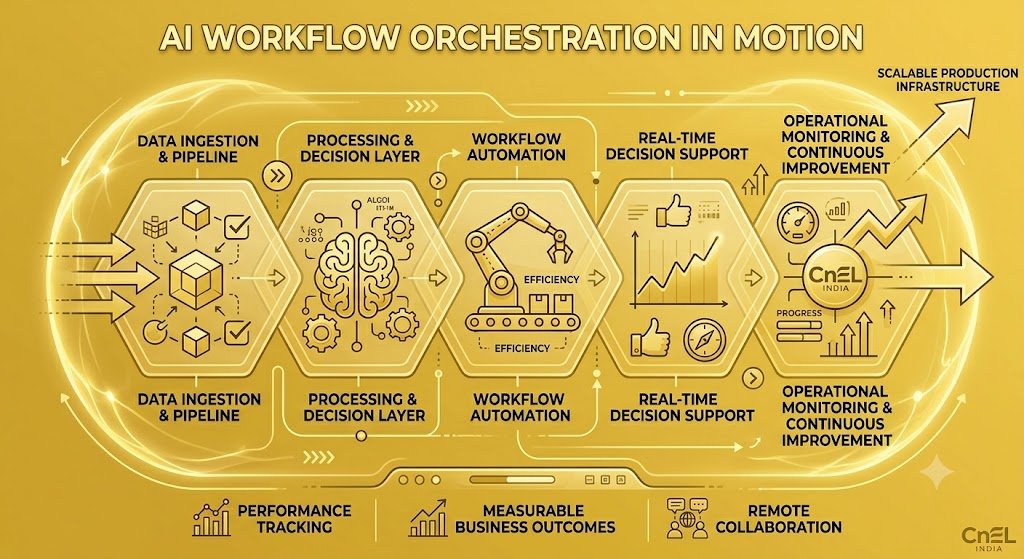
AI systems require carefully structured workflows.
CnEL India designs architecture that supports:
- Data ingestion
- Processing pipelines
- Decision layers
- Output generation
- Monitoring mechanisms
Every component is documented and optimized for maintainability.
Intelligent Data Pipeline Engineering
Data forms the foundation of every AI implementation.
CnEL India builds structured pipelines that support:
- Data collection
- Data preparation
- Transformation workflows
- Validation processes
- Storage optimization
Reliable pipelines improve model quality and operational stability.
Production Integration Strategy
The project requires AI to function inside real products and platforms.
CnEL India ensures smooth integration across:
- Business applications
- Digital services
- Internal systems
- Customer-facing products
Integration planning focuses on minimizing disruption while maximizing usability.
Scalable Deployment Architecture
Production AI environments must support growth.
CnEL India designs infrastructure capable of handling:
- Increased traffic
- Larger datasets
- Multiple workflows
- Business expansion
Scalable architecture ensures systems remain efficient over time.
API and Platform Connectivity
Modern intelligent products rarely operate independently.
CnEL India enables systems to connect across environments and exchange information efficiently.
This supports:
- Workflow orchestration
- Cross-platform experiences
- Unified operations
- Improved automation
The result is stronger operational connectivity.
Real-Time Decision Systems
Many AI use cases require immediate responses.
CnEL India develops intelligent systems that support:
- Fast inference
- Dynamic recommendations
- Live processing
- Responsive interactions
Real-time performance improves customer experience and operational efficiency.
Operational Monitoring and Optimization
Deployment is only the beginning.
CnEL India implements operational processes for:
- Performance monitoring
- Quality evaluation
- Reliability assessment
- Continuous improvement
This ensures systems remain effective after launch.
Remote Collaboration and Communication
The role requires fully remote execution.
CnEL India supports distributed collaboration through:
- Transparent communication
- Structured planning
- Clear documentation
- Progress reporting
Strong communication ensures smooth project execution across locations.
Production Reliability Standards
Organizations require AI systems they can trust.
CnEL India prioritizes:
- Consistent outputs
- Error handling
- Stability controls
- Operational resilience
Reliability becomes a central design principle.
AI Strategy and Decision Support
Beyond engineering, the project also requires strategic input.
CnEL India helps define:
- Adoption roadmaps
- Workflow priorities
- Operational planning
- Long-term scaling strategies
This aligns technical execution with business growth.
Security and Responsible Implementation
Intelligent systems often interact with sensitive business data.
CnEL India incorporates:
- Access management
- Data protection
- Operational safeguards
- Controlled environments
Security planning supports long-term platform reliability.
Industry Adaptability
The company values experience across industries such as healthcare and financial services.
CnEL India develops adaptable solutions capable of supporting:
- Regulated industries
- Consumer applications
- SaaS environments
- Enterprise operations
This flexibility improves project versatility.
Measuring Success
AI initiatives must demonstrate value.
CnEL India defines success metrics around:
- Efficiency gains
- User adoption
- Workflow improvement
- Accuracy enhancement
- Business outcomes
Measurement frameworks support continuous optimization.
Continuous Improvement Model
Production systems evolve.
CnEL India establishes improvement processes that support:
- Performance tuning
- Feature expansion
- Operational learning
- Workflow refinement
Continuous enhancement ensures systems remain competitive.
Future Expansion Opportunities
Once the initial implementation is successful, organizations can expand into:
- Advanced automation
- Personalized experiences
- Intelligent assistants
- Workflow intelligence
- Cross-platform orchestration
The architecture remains prepared for future innovation.
Challenges Solved by CnEL India
Organizations implementing AI frequently struggle with:
- Prototype limitations
- Scaling challenges
- Deployment complexity
- Workflow fragmentation
- Integration difficulties
CnEL India solves these challenges through structured engineering and production planning.
Business Value Delivered by CnEL India
Through this engagement, CnEL India helps organizations achieve:
- Faster innovation cycles
- Production-ready AI solutions
- Improved operational efficiency
- Better scalability
- Stronger technical foundations
- Long-term maintainability
The result is AI that delivers measurable business outcomes.
Why CnEL India for AI Engineering
CnEL India combines:
- AI engineering expertise
- Production system design
- Enterprise architecture experience
- Workflow optimization capability
- Scalable implementation strategy
- Business-focused execution
The company focuses on delivering intelligent systems that work reliably in real-world environments.
Conclusion
This case study demonstrates how CnEL India can successfully design, develop, deploy, and optimize production-grade AI solutions that transform ideas into scalable business systems.
Rather than limiting AI to experimentation, the project emphasizes practical implementation where intelligent capabilities become part of real products, workflows, and operational processes.
By combining architecture planning, deployment readiness, workflow engineering, scalable infrastructure, operational monitoring, and continuous optimization, CnEL India helps organizations build the next generation of intelligent digital products with confidence and long-term sustainability.