
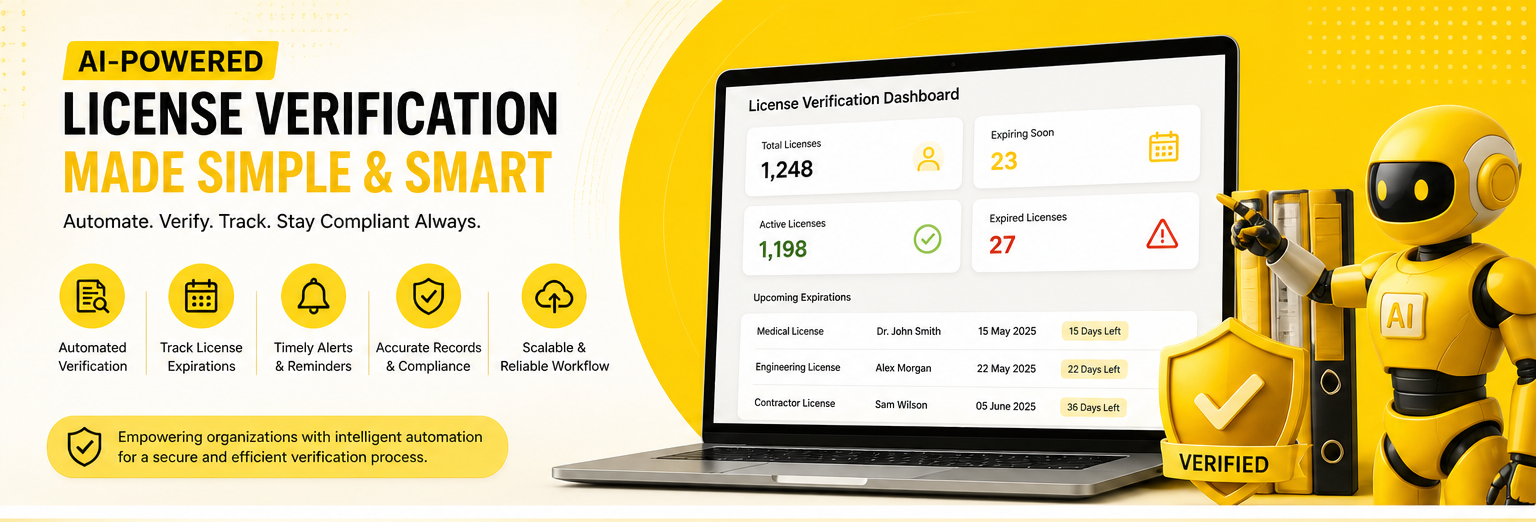
The Problem Nobody Wants to Manage—But Everyone Must
In regulated industries, license verification is not optional. Whether it’s healthcare professionals, contractors, financial advisors, or certified specialists—organizations must ensure that every individual holds a valid, active license issued by the appropriate authority.
But here’s the reality:
Most companies still handle this process manually.
Spreadsheets, emails, reminders, repeated website checks, and human follow-ups dominate the workflow. It’s time-consuming, error-prone, and difficult to scale.
Our client was facing exactly this challenge.
They managed a growing network of licensed professionals and needed to continuously verify:
- License validity
- Expiration dates
- Renewal status
- Compliance requirements
The manual process was becoming a bottleneck.
Missed expirations could lead to compliance risks. Delayed verifications slowed operations. And the lack of centralized tracking created confusion.
They needed a smarter system.
Not just automation—but intelligent automation.
That’s where CnEl India stepped in.
Understanding the Real Issue
At first glance, the requirement sounded simple:
“Automate license verification.”
But when we analyzed the workflow deeply, we realized the complexity.
The process involved:
- Multiple issuing organizations
- Different verification methods
- Varying website structures
- Manual data entry
- No standardized format
- Constant tracking of expiration timelines
It wasn’t just about checking a license.
It was about building a system that could adapt to different sources, maintain accuracy, and operate continuously without failure.
The Vision: From Manual Tracking to Intelligent Monitoring
Our goal was to replace a reactive system with a proactive one.
Instead of:
“Check licenses when needed”
We built a system that:
“Continuously monitors, verifies, and alerts automatically”
The solution needed to:
- Track licenses in real time
- Send alerts before expiration
- Verify status across external sources
- Maintain structured records
- Support long-term scalability
This was Phase 1—but it had to be strong enough to support future expansion.
Designing the System Like a Living Process
We approached the project as a dynamic workflow—not a static tool.
The system was designed to behave like an intelligent assistant that:
- Remembers every license
- Knows when action is needed
- Communicates updates
- Keeps records organized
- Reduces human dependency
This mindset changed everything.
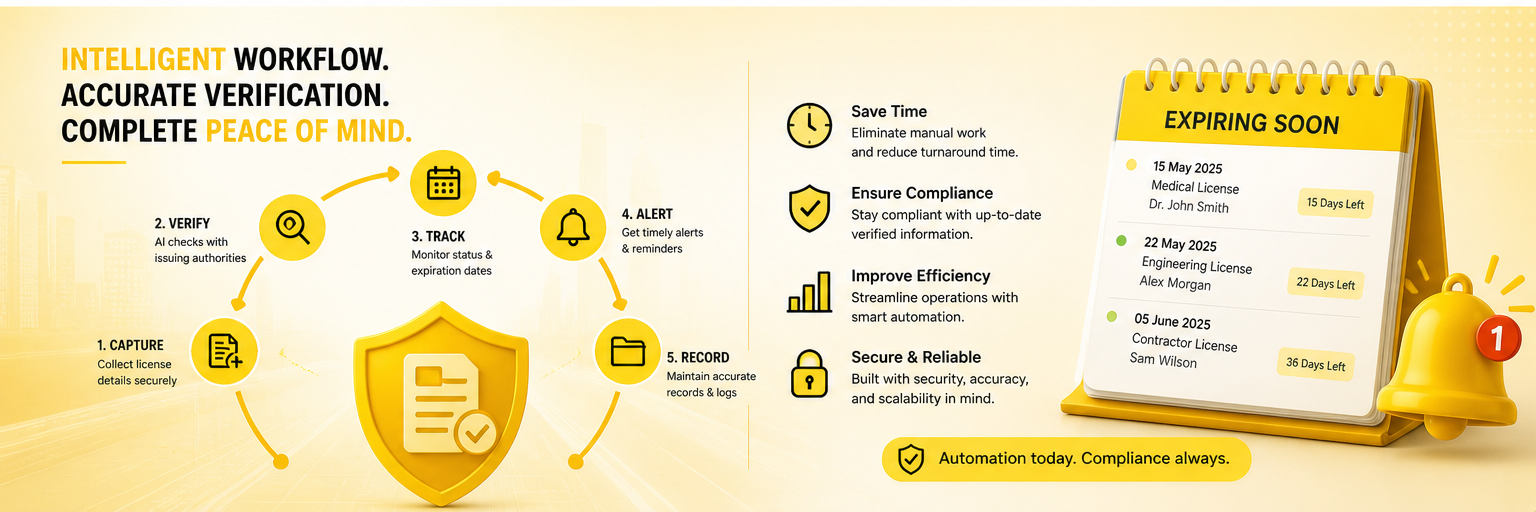
Step 1: Centralized License Database
The first transformation was eliminating scattered data.
We created a centralized system where all license information could be stored, including:
- License holder details
- License numbers
- Issuing authority
- Expiration dates
- Verification status
- Historical activity
This became the foundation of the entire workflow.
No more spreadsheets.
No more lost information.
Everything in one place.
Step 2: Intelligent Expiration Tracking
Tracking expiration dates manually is one of the biggest risks in compliance workflows.
We built a system that continuously monitors every license and understands:
- When it is about to expire
- How urgent the action is
- Which licenses need immediate attention
Instead of waiting for deadlines to pass, the system acts early.
Step 3: Automated Alerts & Reminders
The next step was communication.
The system was designed to send timely alerts based on predefined timelines.
For example:
- Reminder before expiration
- Urgent alert near deadline
- Notification after expiration
- Follow-up alerts if action is pending
This ensured that nothing slipped through the cracks.
No more missed deadlines.
Step 4: External Verification Integration
This was one of the most technically complex parts.
Licenses needed to be verified from different issuing organizations, each with its own system.
We designed a mechanism that could:
- Interact with external platforms
- Extract verification data
- Validate license status
- Update records automatically
The system adapted to different formats and structures, making it flexible and reliable.
Step 5: Record Keeping & Audit Trail
Compliance is not just about verification—it’s about proof.
We ensured that every action was recorded, including:
- Verification attempts
- Status updates
- Timestamped logs
- Changes in license status
This created a complete audit trail.
If needed, the client could easily demonstrate compliance with documented evidence.
Step 6: Workflow Automation
The real power of the system came from workflow automation.
Instead of manual steps, the system handled:
- Tracking
- Checking
- Updating
- Notifying
All in a continuous loop.
This reduced human involvement significantly while improving efficiency.
Step 7: Scalability for Future Growth
Since this was Phase 1, scalability was critical.
We designed the system to support:
- Additional license types
- More issuing organizations
- Increased data volume
- Advanced integrations
- Future automation layers
The system was not just built for today—but for long-term growth.
The Transformation
Before implementation, the client’s process looked like this:
- Manual tracking
- Repeated checks
- High risk of errors
- Delayed updates
- No centralized visibility
After implementation, the workflow became:
- Automated tracking
- Real-time monitoring
- Instant alerts
- Accurate verification
- Organized records
The difference was not incremental.
It was transformational.
Results That Mattered
The impact of the system was immediate and measurable.
1. Time Savings
Manual effort reduced drastically.
Teams could focus on higher-value tasks instead of repetitive checks.
2. Improved Accuracy
Automation eliminated human errors.
Verification became more reliable.
3. Zero Missed Expirations
Alerts ensured that every license was tracked proactively.
4. Strong Compliance
Complete records and audit trails improved regulatory confidence.
5. Better Visibility
Managers could now see the status of all licenses in one place.
6. Scalable Operations
The system could handle growth without additional workload.
What Made This Project Stand Out
Many systems automate tasks.
This system automated responsibility.
What made CnEl India different:
- Deep understanding of compliance workflows
- Focus on real business problems
- Flexible and adaptive system design
- Strong emphasis on accuracy and reliability
- Future-ready architecture
We didn’t just digitize the process.
We made it intelligent.
Key Insight
One powerful lesson from this project:
“Automation is not about doing tasks faster—it’s about removing the need to do them at all.”
The best systems don’t just assist.
They operate independently.
The Road Ahead
Phase 1 successfully laid the foundation.
Future phases can include:
- Advanced analytics
- Predictive insights
- Integration with internal systems
- Expanded verification capabilities
- Enhanced reporting dashboards
The system is ready to evolve.
Conclusion
License verification may seem like a routine task—but when done manually, it becomes a major operational burden.
Through intelligent design and workflow automation, CnEl India Private Limited transformed a complex, time-consuming process into a seamless, reliable system.
The result was not just efficiency.
It was control, visibility, and confidence.
Because in compliance-driven environments, accuracy is everything.
And now, accuracy runs automatically. 🚀