
A New Era of Learning in Mental Health Education
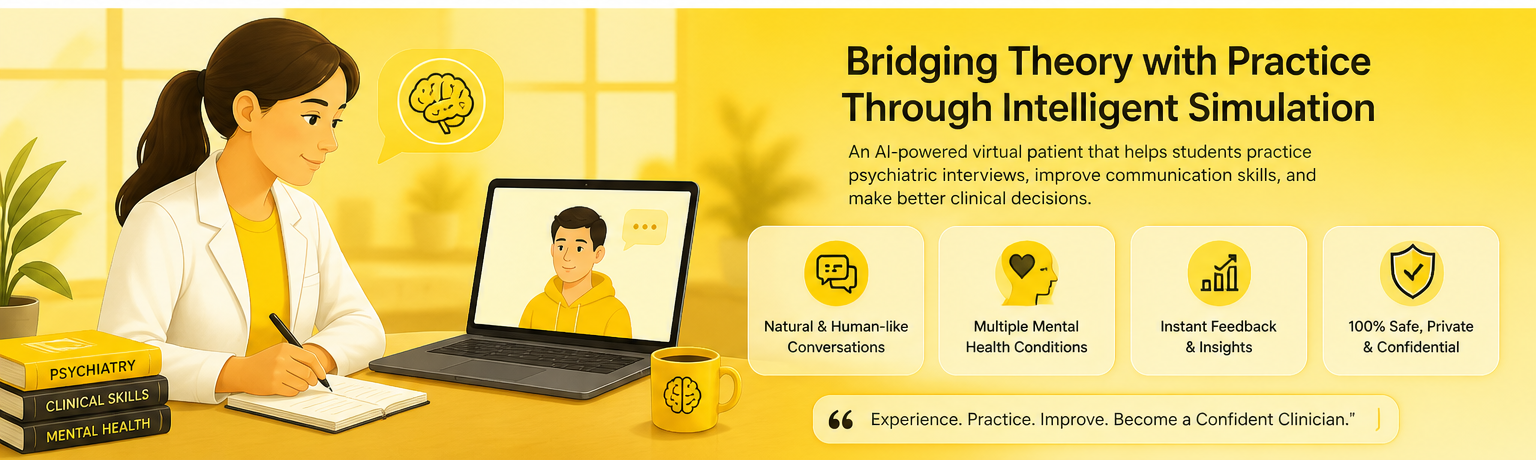
In modern education, especially in fields like mental health and psychiatry, traditional learning methods are no longer enough. Reading textbooks and attending lectures can build theoretical knowledge, but they often fail to prepare students for real-world clinical interactions.
Psychiatric evaluation, in particular, is a skill that requires:
- Observation
- Communication
- Emotional intelligence
- Decision-making under uncertainty
However, giving students access to real patients for practice is not always feasible due to ethical concerns, privacy regulations, and limited availability.
This gap between theory and real-world experience led our client—an academic professional in mental health education—to explore a more innovative solution.
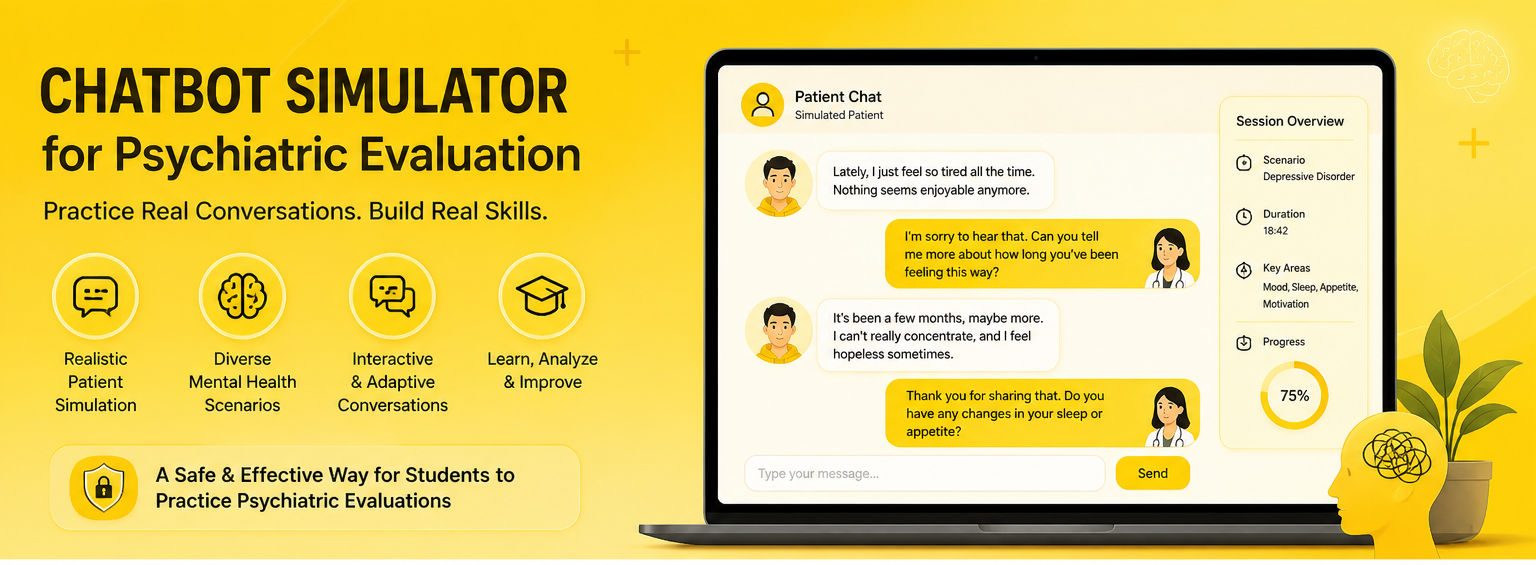
They wanted to create a chatbot simulator that behaves like a psychiatric patient, allowing students to practice interviews, ask questions, and develop diagnostic thinking in a safe, controlled environment.
This is where CnEl India stepped in to transform this vision into a powerful, interactive learning tool.
The Real Challenge: Simulating Human Behavior
At first glance, building a chatbot may seem like a straightforward task. But this project was fundamentally different.
This was not a customer support bot or a simple Q&A system.
This chatbot needed to:
- Mimic real human emotions
- Respond unpredictably (like real patients)
- Reflect different psychiatric conditions
- Adapt to student questioning styles
- Maintain conversational realism
In simple terms, the challenge was not just technical.
It was psychological.
We were not building a chatbot.
We were simulating human behavior.
Understanding the Objective
The client’s primary goal was to create a system that allows students to:
- Practice psychiatric interviews
- Ask open-ended and diagnostic questions
- Analyze responses
- Identify symptoms and patterns
- Improve communication skills
- Gain confidence before real patient interactions
The system needed to feel realistic enough that students would treat it like an actual patient.
At the same time, it had to remain safe, controlled, and educational.
Our Strategic Approach
To build an effective simulator, we focused on three core pillars:
1. Realism
2. Interactivity
3. Educational Value
Every feature and design decision was aligned with these principles.
Designing the “Digital Patient”
The most critical part of the project was defining how the chatbot would behave.
We created structured “patient personas” that represented different mental health conditions.
Each persona included:
- Background story
- Behavioral traits
- Emotional tone
- Communication style
- Symptom patterns
- Response variations
For example, one persona might respond with anxiety-driven hesitation, while another might show confusion or emotional withdrawal.
This ensured that each interaction felt unique and realistic.
Making Conversations Feel Human
One of the biggest mistakes in chatbot design is making conversations feel robotic.
We avoided this by designing responses that:
- Were not overly structured
- Included emotional variation
- Reflected hesitation, confusion, or clarity
- Allowed for incomplete or indirect answers
Real patients do not always give clear or direct responses.
The chatbot was designed to reflect this unpredictability.
This forced students to think critically and ask better questions.
Adaptive Interaction System
A key feature of the simulator was its ability to adapt based on student input.
Instead of fixed responses, the chatbot could:
- Interpret different types of questions
- Adjust tone based on conversation flow
- Provide deeper or limited answers depending on questioning quality
For example:
- A vague question would lead to a vague answer
- A detailed question would unlock more specific responses
This encouraged students to improve their interviewing techniques.
Creating a Safe Learning Environment
Working with real psychiatric patients involves risks and ethical responsibilities.
This simulator removed those risks while maintaining educational value.
Students could:
- Make mistakes without consequences
- Experiment with different approaches
- Repeat sessions for improvement
- Learn at their own pace
This created a stress-free environment where learning could happen naturally.
User Experience: Keeping It Simple and Engaging
Even the most advanced system fails if it is difficult to use.
We designed the interface to be:
- Clean and distraction-free
- Easy to navigate
- Focused on conversation flow
- Accessible for all users
Students could start interacting with the chatbot immediately without needing technical training.
The focus remained on learning—not on understanding the system.
Feedback and Learning Enhancement
To maximize educational impact, we integrated feedback mechanisms.
After each session, students could:
- Review conversation history
- Identify missed questions
- Analyze response patterns
- Improve future interactions
This turned each session into a learning loop.
Practice → Review → Improve → Repeat
Performance and Scalability
The system was designed to handle:
- Multiple users simultaneously
- Continuous interactions without delay
- Expansion into more patient scenarios
- Future integration with educational platforms
This ensured long-term usability and growth potential.
Results and Impact
The chatbot simulator delivered significant benefits for both students and educators.
1. Improved Student Confidence
Students felt more prepared before interacting with real patients.
2. Better Communication Skills
Practice sessions helped students ask more structured and meaningful questions.
3. Enhanced Diagnostic Thinking
Students learned to identify patterns and symptoms more effectively.
4. Increased Engagement
Interactive learning proved far more engaging than traditional methods.
5. Safe Practice Environment
Students could experiment and learn without risk.
6. Scalable Training Solution
The institution could train more students without dependency on real patient availability.
What Made This Project Unique
This project stood out because it combined:
- Technology
- Psychology
- Education
What made CnEl India Private Limited different:
- Deep understanding of user behavior
- Focus on realism over automation
- Adaptive conversation design
- Education-first development approach
- Scalable and future-ready system
We did not just build a chatbot.
We built a learning experience.
Key Insights from the Project
Realism Drives Engagement
The more human-like the system, the better the learning outcome.
Interaction Beats Passive Learning
Students learn more by doing than by reading.
Safe Environments Improve Confidence
Mistake-friendly systems encourage experimentation.
Adaptability Enhances Skill Development
Dynamic responses push users to think critically.
Future Scope
The system can be expanded to include:
- More psychiatric conditions
- Voice-based interaction
- Emotion detection features
- Real-time instructor monitoring
- Integration with academic evaluation systems
This opens doors to a new standard in mental health education.
Conclusion
The future of education lies in immersive and interactive learning experiences.
Through this project, CnEl India successfully transformed a complex educational challenge into a practical, scalable, and engaging solution.
The psychiatric chatbot simulator bridged the gap between theory and real-world practice, giving students the opportunity to learn, adapt, and grow in a safe environment.
Because in fields like mental health, knowledge alone is not enough.
Experience is what truly makes the difference.
And now, that experience is just one conversation away. 🚀