
Introduction
In the floral business, speed, accuracy, and customer experience are everything. Customers expect timely updates, beautiful product presentation, and smooth communication from the moment they place an order until final delivery. For business owners, managing florist assignments, bouquet approvals, and customer communication manually can quickly become overwhelming—especially when order volumes increase.
Our client operated a growing florist business using an online ordering platform where bouquet preparation, team coordination, and customer communication were handled manually. This process created delays, confusion, and unnecessary operational pressure for managers and florists.
The business needed a smarter workflow.
Their goal was to create an automated communication system where florists could receive order details instantly, upload bouquet completion photos directly from their mobile devices, and ensure customers received final bouquet previews in their preferred language before delivery.
This case study explains how CnEl India successfully designed and implemented a complete florist workflow automation system that improved order handling, reduced manual coordination, and strengthened customer satisfaction.
This was not just automation.
It was operational transformation through intelligent workflow design.
Client Background
The client managed a florist business where orders were placed through an online store and then assigned internally to florists for bouquet preparation.
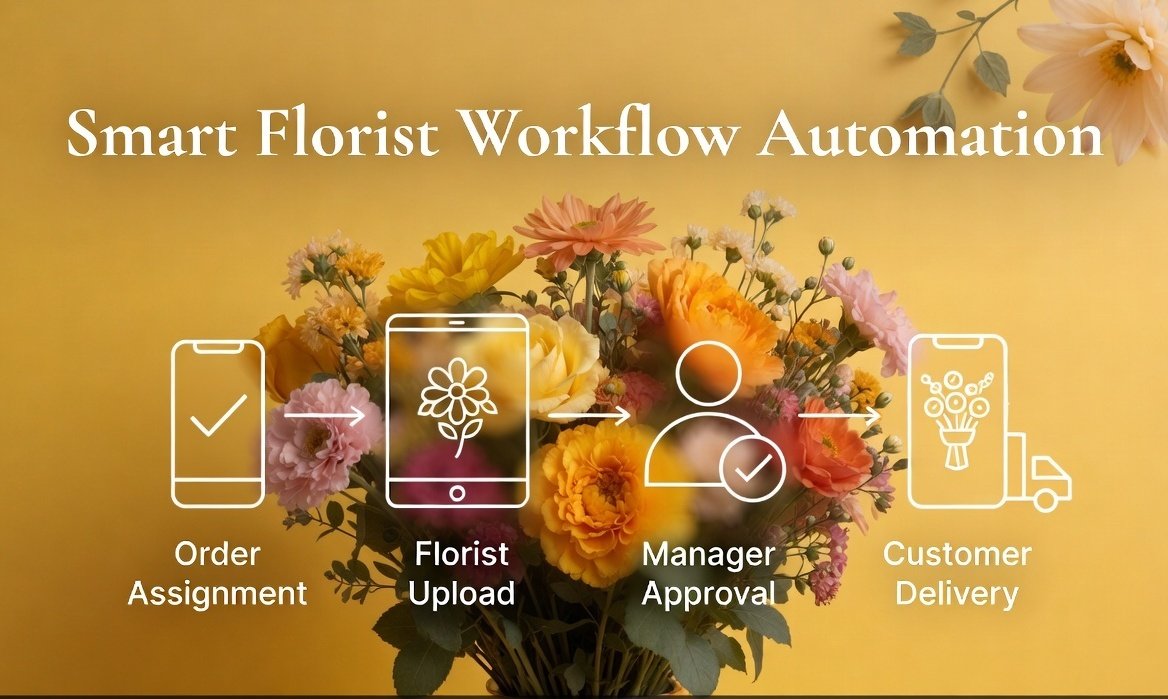
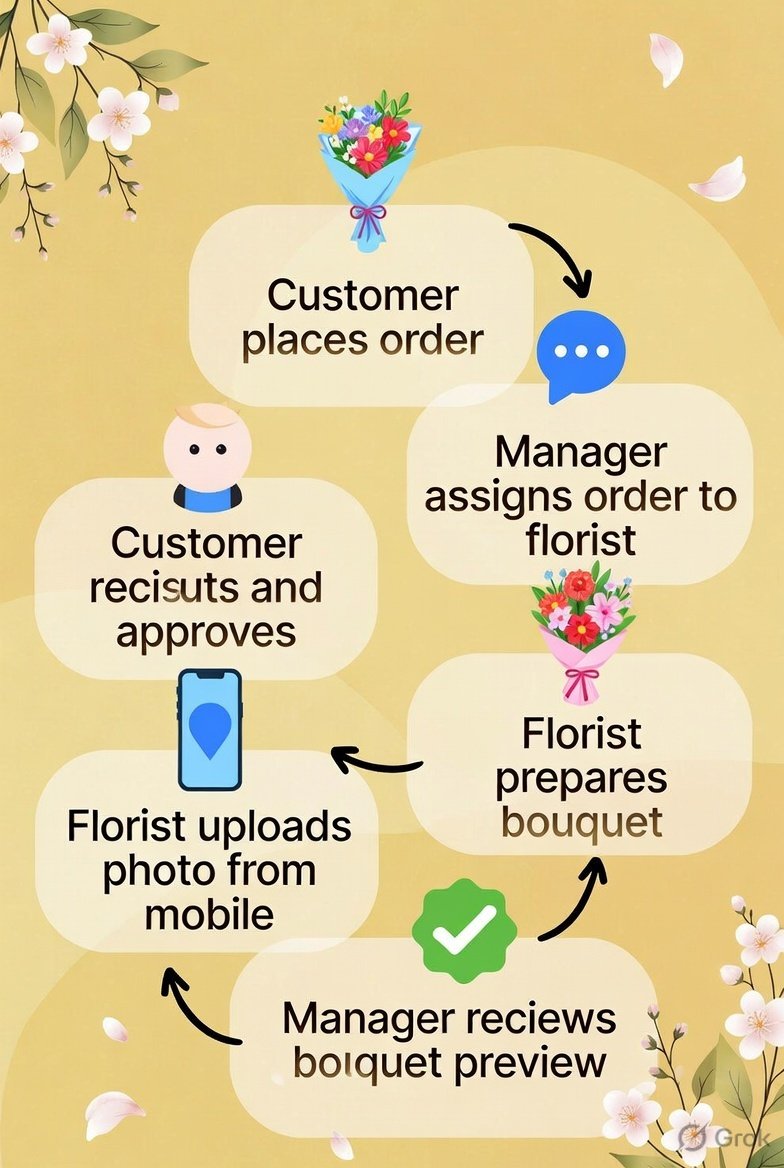
The business process included:
- Customer places an order
- Manager assigns the order to a florist
- Florist prepares the bouquet
- Florist sends bouquet completion proof
- Manager reviews the bouquet
- Customer receives bouquet preview before delivery
Although the business model was strong, the workflow relied heavily on manual messaging, repeated follow-ups, and delayed updates.
Managers spent too much time coordinating between florists and customers instead of focusing on business growth.
The company needed a centralized, automated process that could simplify operations while maintaining service quality.
The Core Challenges
The client faced multiple operational problems:
1. Manual Florist Assignment Communication
Managers had to manually message florists every time a new order was assigned.
This caused delays and missed instructions.
2. Missing or Delayed Bouquet Proof
Florists often sent bouquet completion photos late or through unorganized channels, making approval difficult.
3. Order Status Confusion
Without a structured workflow, order progress tracking became unclear for both managers and teams.
4. Customer Communication Delays
Customers often waited too long for bouquet previews and updates, reducing trust and satisfaction.
5. Multi-Language Communication Complexity
The business served customers speaking Georgian, English, and Russian, making manual communication difficult and inconsistent.
6. Lack of Centralized Workflow
Information was scattered across multiple chats, making operations difficult to monitor and scale.
The client needed a professional workflow system that connected internal teams and customers seamlessly.
Project Objective
Our mission was to create a fully automated florist communication workflow that would:
- Instantly notify florists when orders were assigned
- Send complete order details and product reference images
- Allow florists to upload bouquet completion photos easily
- Attach florist-submitted photos directly to the order record
- Update order status automatically
- Allow manager approval before customer communication
- Send bouquet previews to customers in their preferred language
- Reduce manual coordination and improve operational speed
The goal was not just automation.
It was creating a reliable and scalable business process.
Our Strategic Approach
At CnEl India Private Limited, we designed the project around real business flow rather than technical complexity.
Our implementation followed five major stages:
Assignment Automation
Florist Response Workflow
Approval and Status Management
Customer Communication Automation
Language-Based Personalization
This created a complete order lifecycle system from assignment to final customer confirmation.
Phase 1: Instant Florist Assignment Automation
The first step was removing manual florist communication.
When a manager assigned a florist to an order, the system automatically triggered an instant message containing:
- Customer order details
- Delivery instructions
- Product information
- Bouquet reference image
- Special notes if required
This ensured florists received everything immediately without waiting for manual follow-up.
The result:
Faster response time and fewer operational delays.
The florist could start work instantly.
Phase 2: Simple Bouquet Completion Submission
Once the bouquet was prepared, the florist needed a simple way to send proof of completion.
Instead of separate calls, manual uploads, or scattered messages, the florist could simply reply with a bouquet photo directly from their mobile device.
This photo was automatically connected to the correct order.
No manual upload.
No confusion.
No missing references.
This improved accountability and speed significantly.
The process became simple enough for daily high-volume operations.
Phase 3: Automatic Order Update and Internal Visibility
After receiving the bouquet completion photo, the system automatically updated the order workflow.
This allowed:
- Better order tracking
- Clear progress visibility
- Reduced manager confusion
- Faster approval decisions
- Organized operational records
Managers could instantly see which bouquets were ready for review and which orders were still in progress.
This improved internal control across the entire team.
Visibility improves decision-making.
Phase 4: Manager Review Before Customer Delivery
Before sending the bouquet preview to the customer, management approval remained important.
The manager reviewed the florist-submitted bouquet image and confirmed whether the final arrangement met quality expectations.
This ensured:
- Product quality control
- Brand consistency
- Customer satisfaction protection
- Reduced complaint risk
Only approved bouquets moved forward to customer communication.
Automation should support quality—not remove it.
Phase 5: Customer Preview in Preferred Language
One of the most valuable parts of the project was customer communication personalization.
Once approved, the final bouquet image was automatically sent to the customer along with a professional update message.
The message was delivered in the customer’s preferred language:
- Georgian
- English
- Russian
This created a highly personalized customer experience.
Instead of generic updates, customers received meaningful communication in a language they understood comfortably.
This increased trust and improved overall satisfaction.
Personalization creates stronger business relationships.
Phase 6: Workflow Centralization
Before the project, communication was scattered across multiple channels.
After implementation, everything became connected within one structured process.
This included:
- Assignment tracking
- Florist updates
- Bouquet image records
- Approval history
- Customer communication logs
- Order progress visibility
This created operational clarity and made future scaling much easier.
A business grows faster when processes become visible.
Business Results Achieved
The final solution delivered major operational improvements.
1. Faster Order Processing
Florists received assignments instantly, reducing preparation delays significantly.
2. Better Team Coordination
Managers no longer needed constant manual follow-ups.
The workflow became self-moving.
3. Stronger Quality Control
Bouquet approval before customer delivery improved service reliability.
4. Improved Customer Satisfaction
Customers received bouquet previews quickly and in their preferred language.
Trust increased significantly.
5. Reduced Operational Stress
The florist team and managers experienced smoother daily operations with less confusion.
6. Scalable Business Workflow
The system prepared the business for handling larger order volumes without operational breakdown.
Why This Project Was Different
Many businesses try to automate notifications.
This project automated trust.
What made CnEl India Private Limited different:
- Business-first workflow design
- Mobile-friendly florist interaction
- Approval-based automation structure
- Multi-language customer personalization
- Full order lifecycle integration
- Long-term operational scalability
We did not just improve messaging.
We improved how the business operated.
Key Learnings from the Project
This project reinforced several important lessons:
Automation Must Reduce Human Friction
Good systems remove unnecessary effort.
Speed Improves Customer Confidence
Fast updates create stronger trust.
Approval Systems Protect Quality
Automation should support control, not remove it.
Language Personalization Builds Loyalty
Customers respond better when communication feels personal.
Centralized Workflows Improve Growth
Businesses scale faster when processes are organized.
Conclusion
A successful florist business depends on more than beautiful bouquets.
It depends on communication, speed, coordination, and trust.
Through intelligent workflow automation and customer-focused process design, CnEl India Private Limited transformed a manual florist operation into a structured, scalable, and highly efficient order management system.
The project proved that automation is not about replacing people.
It is about helping people work better.
Because when operations become smoother, customer experience becomes stronger—and that is where real business growth begins.