

Introduction
In the modern software development landscape, developers increasingly rely on AI-assisted development workflows to write code, debug applications, review changes, and maintain complex repositories. As software projects grow in size and complexity, understanding an existing codebase, identifying potential vulnerabilities, detecting bugs, and improving code quality become important parts of daily development. While intelligent development solutions can help streamline these activities, their effectiveness depends not only on their technical capabilities but also on how easily developers understand, adopt, and integrate them into their workflows.
CnEL India recognizes the importance of building software experiences that are practical, intuitive, and aligned with real-world developer needs. In the development of modern software solutions, usability testing, user feedback, and workflow evaluation play an important role in determining whether a product delivers meaningful value. A technically capable application may still face adoption challenges if its features are difficult to understand, its setup process is confusing, or its results do not align with developers’ expectations.
This case study explores an approach to evaluating a developer-focused software platform through a structured user experience study. The study focuses on how developers interact with a new application for codebase exploration, bug investigation, vulnerability identification, refactoring suggestions, and pull request reviews. The objective is to understand the product from the perspective of developers who are experiencing it for the first time, identify usability challenges, and collect practical feedback that can guide improvements.
The project highlights how CnEL India approaches software testing, user experience evaluation, product feedback collection, and development workflow assessment to support the improvement of digital products.
The Challenge: Understanding Real Developer Expectations
Software developers often work with multiple repositories, programming languages, development environments, and collaborative workflows. As applications become more sophisticated, developers need efficient ways to navigate unfamiliar code, investigate errors, evaluate code changes, and identify opportunities for improvement.
However, introducing a new software platform into an existing development workflow presents several challenges. Developers may have different expectations based on their experience, preferred coding environments, project structures, and working habits. A solution that appears straightforward to one developer may feel unfamiliar or difficult to another.
The platform being evaluated in this study was designed to help developers understand codebases, investigate bugs, review pull requests, and improve code quality. Despite its intended benefits, the team needed to understand how users would perceive and interact with its features without prior experience.
Several important challenges were identified.
1. First-Time User Experience
The first interaction with a software application can significantly influence a user’s perception of its value. Developers often evaluate a product quickly based on its interface, available information, navigation, and setup instructions.
The study needed to determine whether first-time visitors could understand the application’s purpose, identify its core capabilities, and recognize how it might fit into their existing development practices.
The evaluation focused on whether the homepage and application information clearly communicated the intended benefits. Participants were encouraged to share their expectations, identify unclear information, and describe what they believed the application could accomplish before installing or connecting it.
This initial feedback was particularly important because it reflected the natural reactions of users without the influence of prior experience or detailed instructions.
2. Integration with Existing Development Workflows
Developers generally prefer solutions that fit naturally into their existing work rather than requiring them to completely change how they develop software.
The platform needed to be evaluated in the context of developers’ actual working environments. This included assessing how they connected the application to their development assistants, whether the setup process was understandable, and whether the integration provided a useful experience.
The challenge was to identify potential friction during configuration and integration. Participants needed to understand the steps involved, complete the setup, and use the application alongside their regular development activities.
The feedback would help determine whether the integration experience was intuitive, efficient, and sufficiently explained.
3. Codebase Analysis and Practical Functionality
Developers require meaningful information when working with unfamiliar or complex codebases. They may need to understand the overall structure of a project, locate potential weaknesses, investigate bugs, or identify areas that could benefit from refactoring.
The study aimed to evaluate how the application supported these activities using actual repositories. Participants were expected to explore the platform’s analytical capabilities and compare its observations with their own understanding of the code.
The challenge was to assess whether the generated insights were understandable, relevant, and actionable rather than simply presenting technical information without sufficient context.
4. Pull Request Review Reliability
Pull request reviews are a critical component of collaborative software development. They help teams identify problems before changes become part of a larger application.
Automated review systems can provide additional assistance, but developers need to trust the results. Incorrect suggestions, overlooked issues, confusing explanations, or inconsistent review behavior may reduce confidence in the system.
The study therefore included an evaluation of how the platform handled a test pull request containing a known issue. Participants could compare the application’s findings with the expected problem and assess the clarity of its feedback.
This approach helped evaluate whether the review experience was useful in a realistic development scenario.
Project Objectives
The primary objective of the study was to collect honest, practical feedback from developers who had never previously used the application.
Rather than relying exclusively on internal testing or assumptions about user behavior, the project sought to observe real developers interacting with the product in their own environments.
The key objectives included:
- Understanding first-time impressions and user expectations.
- Evaluating the clarity of product information and setup instructions.
- Assessing integration with existing development workflows.
- Testing codebase analysis and debugging-related capabilities.
- Evaluating bug detection and code improvement suggestions.
- Assessing pull request review functionality.
- Identifying configuration and usability issues.
- Comparing review results across different interfaces.
- Collecting written feedback and recorded observations.
- Identifying opportunities for product improvements.
The study was designed to include developers with different levels of experience, working styles, and project backgrounds. This diversity could help the product team better understand how different users approach the same software experience.
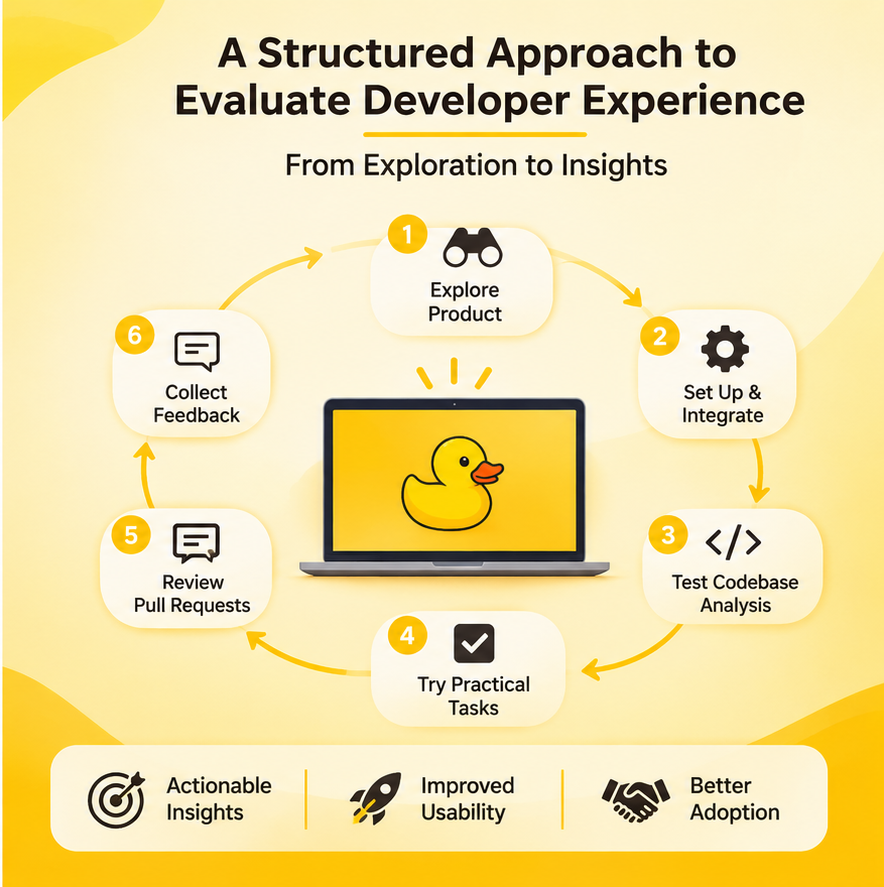
The Approach: Structured User Experience Testing
CnEL India approached the evaluation as a structured testing process that combined observation, practical experimentation, and feedback documentation.
The testing process was divided into several stages to ensure that participants could evaluate different aspects of the application while maintaining a clear understanding of the activities they were expected to perform.
Stage 1: Initial Product Exploration
The first stage involved exploring the product’s public-facing information before creating an account or installing any application components.
Participants were asked to examine the homepage and the information associated with its development integration and review functionality. They were encouraged to record their screens and speak aloud while exploring.
The objective was to capture their immediate reactions and expectations.
During this stage, participants could comment on:
- Whether the product’s purpose was clear.
- Whether its features were easy to understand.
- Whether the presented information answered their questions.
- Whether the installation or setup process appeared straightforward.
- Whether they could identify the product’s potential value.
- What information they expected to find next.
- Which parts of the interface appeared confusing.
The think-aloud approach helped capture observations that might otherwise be missed in a conventional feedback form. Developers could explain why they clicked a particular section, what they expected to see, and what confused them while navigating the interface.
These observations provided useful information about how product communication and interface design could be improved.
Stage 2: Account Setup and Integration
After the initial exploration, participants proceeded with account creation and integration with their existing development environment.
The goal was to understand how easily developers could complete the setup process and begin using the application.
Participants evaluated the configuration experience, the instructions provided, and the overall usability of the integration.
The testing considered several aspects of the experience, including:
- Account creation and onboarding.
- Understanding configuration requirements.
- Connecting the application to a development environment.
- Following setup instructions.
- Identifying errors or missing information.
- Understanding how the integrated functionality worked.
The integration stage was particularly useful for identifying situations in which developers might need additional guidance, clearer instructions, or more accessible configuration information.
A successful onboarding experience should minimize unnecessary complexity and help users move quickly from setup to practical use.
Stage 3: Testing Codebase Analysis and Development Assistance
The next stage focused on evaluating the platform’s capabilities using repositories that participants were authorized to access.
Participants used one public and one private repository, allowing them to explore the application across different project environments. The private repository was kept confidential, and participants were instructed not to expose sensitive information during the testing or recording process.
The evaluation covered three primary areas.
Codebase Understanding
Participants examined the platform’s ability to provide an overview of project structure, identify relevant components, and help them understand how different parts of the application worked together.
The objective was to determine whether the information provided was helpful when navigating a project and whether the analysis improved their understanding of the codebase.
Developers could compare the platform’s explanations with their existing knowledge and identify areas where the information was accurate, incomplete, or unclear.
Bug and Vulnerability Investigation
Participants explored the platform’s ability to identify potential bugs, weaknesses, and security-related concerns.
They evaluated whether the findings were relevant to the repository, whether the explanations were understandable, and whether the suggested actions could help them investigate the issues further.
The study encouraged participants to assess the quality of the findings rather than assuming that every suggestion was correct.
This distinction was important because automated analysis should support developers’ judgment instead of replacing it. A useful system should help developers understand potential problems, explain why they matter, and provide practical guidance for addressing them.
Refactoring and Code Improvement
The refactoring evaluation focused on identifying opportunities to improve code structure, maintainability, readability, and overall quality.
Participants reviewed the suggested improvements and considered whether the recommendations were appropriate for their projects.
They were encouraged to assess the suggestions based on their practical usefulness, implementation effort, clarity, and potential impact.
This helped identify whether the platform could contribute to improving existing software without introducing unnecessary complexity.
Stage 4: Practical Development Tasks
Beyond reviewing analytical reports, participants were encouraged to use the application for a practical task within their development environment.
This step helped evaluate whether the platform could support real working activities rather than only producing interesting reports.
Developers could explore the application’s conversational functionality, investigate an issue, seek clarification about code, and use its suggestions during a development task.
The practical evaluation focused on:
- The usefulness of the assistance provided.
- The relevance of responses to the development task.
- The clarity of explanations.
- The ease of accessing information.
- The usefulness of the interaction within the developer’s workflow.
- Whether the assistance saved time or simplified a task.
This stage provided a more realistic understanding of the application’s value because developers were interacting with their own projects and working toward practical outcomes.
Stage 5: Pull Request Review Testing
The pull request review stage evaluated the application’s ability to assist with collaborative development and code quality checks.
Participants installed the application on an agreed test repository and created a test pull request containing a small, known bug. The pull request remained unmerged throughout the evaluation to avoid unintended changes to the project’s main development branch.
The testing process included examining the review results, exploring relevant commands, evaluating suggested fixes, and reviewing configuration options.
Review Quality
Participants examined whether the application identified the known issue and whether the review comments accurately described the problem.
They assessed the usefulness of the explanations, the clarity of the recommendations, and whether the findings provided enough context for developers to understand the issue.
Suggested Fixes
Participants also evaluated the proposed fixes and considered whether the recommendations were appropriate for the code involved.
The assessment included examining whether the suggestions were easy to understand, whether they addressed the identified problem, and whether they could be implemented without creating additional issues.
Configuration and Review Customization
The study also explored configuration options available for individual repositories.
Participants changed an agreed setting and compared the resulting review preview with the review posted on the repository. This helped evaluate whether the configuration process was understandable and whether the expected changes were reflected in the final review.
Review Dashboard and Analytics
Participants examined the review dashboard to locate their test review and compare the displayed information with the results they had observed on the repository.
The objective was to assess the consistency of the information, ease of navigation, and clarity of the dashboard.
This stage helped identify potential differences between the review experience and the reporting interface, providing useful feedback for improving the overall product experience.
Stage 6: Feedback Collection and Documentation
The final testing stage involved documenting observations and preparing feedback for the product team.
Participants submitted a screen recording containing spoken commentary and a written report describing their experience. The recording captured their interactions, observations, and reactions throughout the testing process.
The written report focused on several important areas:
- Activities completed during the testing.
- Features that worked as expected.
- Areas that were difficult to understand.
- Issues encountered during configuration.
- Findings that appeared inaccurate or incomplete.
- Suggestions for improving the interface.
- Feedback about the overall experience.
- Problems that prevented successful completion of a task.
The feedback was intended to provide actionable information rather than general opinions. Participants were encouraged to explain what happened, why a particular experience was confusing, and how it could potentially be improved.
After the testing submission was reviewed, participants also took part in a separate one-hour interview. This interview provided an opportunity to discuss their observations in greater detail, clarify findings, and explore additional suggestions.
Results and Expected Product Improvements
The study was structured to generate qualitative insights rather than predefined performance metrics. Its value depended on identifying meaningful usability issues, understanding developer expectations, and uncovering opportunities for improvement.
The findings could help the product team prioritize changes across several areas.
Improved Onboarding and Product Communication
First-time user observations could reveal whether product information was sufficiently clear and whether developers understood the purpose of different features.
Feedback from the initial exploration could help improve descriptions, navigation, setup instructions, and onboarding guidance.
More Effective Code Analysis
Feedback from codebase exploration, bug investigation, and refactoring activities could help refine how findings were presented.
Improvement opportunities could include clearer explanations, better contextual information, more practical recommendations, and improved prioritization of findings.
Better Integration Experiences
The integration evaluation could reveal configuration challenges or unnecessary steps.
These findings could guide improvements to the onboarding process, installation instructions, and integration workflow, helping developers begin using the application more efficiently.
Greater Confidence in Pull Request Reviews
Testing with known issues could provide useful information about review accuracy, explanation quality, and suggested fixes.
The feedback could help the product team identify areas requiring refinement and improve the reliability and consistency of review experiences.
Consistent Reporting and Configuration
Comparing review previews, repository results, and dashboard information could help identify inconsistencies in how information was presented.
Improving the consistency of these experiences could make the platform easier to use and more reliable for developers working on collaborative projects.
How CnEL India Supports Software Product Evaluation
CnEL India understands that software development involves more than writing code and delivering functionality. Product usability, testing, workflow integration, feedback collection, and continuous improvement are also important parts of building effective digital solutions.
A structured user experience study can help businesses identify problems early, understand how users interact with their applications, and make informed decisions about future development.
CnEL India supports businesses through software development, website development, AI solutions, automation, application improvements, and technology consulting. Its approach emphasizes practical business requirements, usability, and the importance of developing solutions that work effectively in real-world environments.
By combining structured testing with practical feedback, businesses can better understand how their applications perform from the user’s perspective. This can help improve onboarding, reduce unnecessary complexity, refine functionality, and create more effective digital experiences.
Conclusion
Evaluating a software application through first-time user testing provides valuable insights into how developers perceive, understand, and use a product. Technical capabilities alone are not enough to ensure successful adoption. Developers also need clear interfaces, reliable functionality, understandable instructions, and workflows that fit naturally into their existing practices.
This study demonstrated a structured approach to evaluating a developer-focused platform through initial exploration, integration, codebase analysis, practical development tasks, pull request review testing, and detailed feedback collection.
The combination of screen recordings, think-aloud observations, written reports, and follow-up interviews provides a comprehensive method for identifying usability challenges and improvement opportunities.
For businesses developing software products, this approach can help bridge the gap between technical development and real-world user expectations. By continuously evaluating applications and incorporating feedback, organizations can improve usability, strengthen reliability, and deliver solutions that provide greater value to their users.
CnEL India believes that effective software development is built on understanding business requirements, solving practical problems, and continuously improving the user experience. Through structured testing, development expertise, and technology-driven solutions, businesses can create software that is not only functional but also intuitive, efficient, and valuable in everyday use.