
Introduction
Artificial intelligence and automation are becoming essential parts of modern business operations. Companies are increasingly using intelligent bots, automated workflows, and connected digital systems to reduce repetitive work, improve response times, and manage everyday activities more efficiently. However, building an automated solution is only the first step. These systems also require regular monitoring, maintenance, troubleshooting, and improvements to ensure they continue working reliably.
CnEL India recognizes the growing need for dependable AI and bot development support, particularly among small and growing businesses that operate multiple automated systems. A business may have several bots handling customer communication, internal notifications, data processing, scheduled activities, or other operational tasks. If one of these systems stops responding, produces unexpected results, or loses its connection with another service, it can interrupt the entire workflow.
This case study explores a requirement for a junior AI and Bot Developer who can provide ongoing remote support, maintain existing automation systems, configure new bots, and help ensure that daily operations run smoothly. The proposed approach focuses on practical development skills, reliable system management, clear documentation, and continuous technical support.
Understanding the Project Requirement
The project involves supporting a small, fast-moving company that operates several AI-powered bots and automated systems. The company requires a junior developer who can take responsibility for routine technical activities while also assisting with the development and configuration of new solutions.
Unlike a project that focuses only on building a single application, this opportunity involves ongoing operational responsibilities. The developer would need to understand how existing systems work, identify technical issues, and make changes without unnecessarily interrupting business activities.
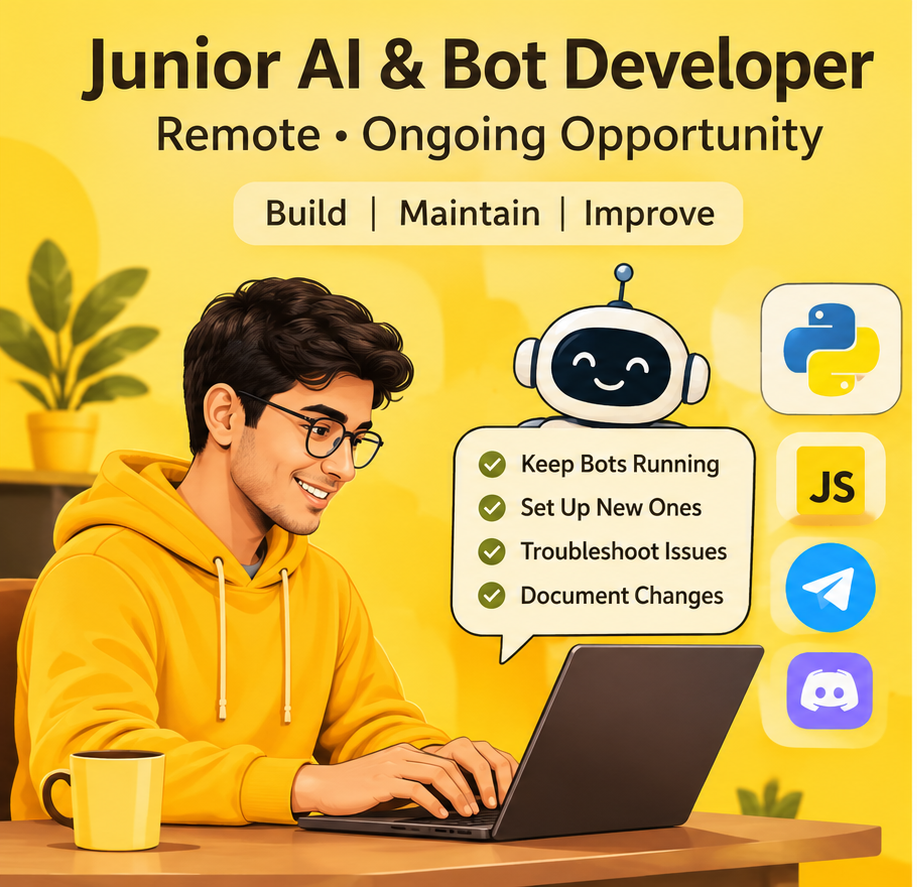
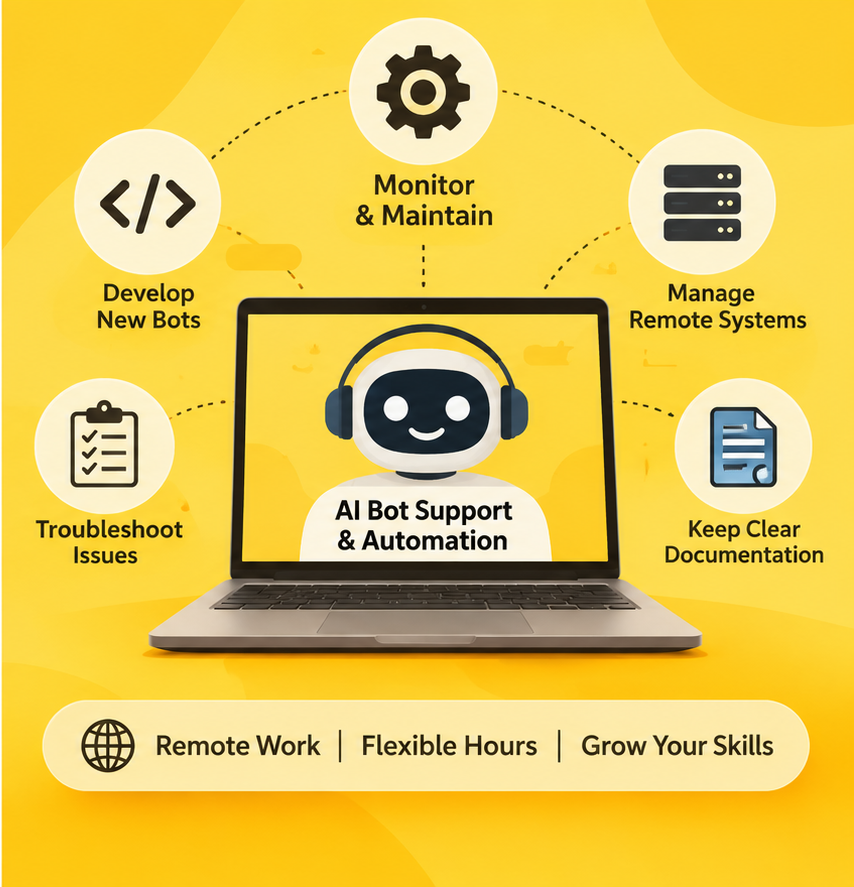
The primary requirement can be divided into four areas:
- Maintaining existing bots and automation systems.
- Configuring new bots, integrations, and automated processes.
- Managing remote machines and basic server operations.
- Maintaining clear technical documentation and communication.
The position is suitable for a junior developer, student, or recent graduate who has practical experience with programming and has already created at least one bot or AI-related project.
For CnEL India, the project represents an opportunity to demonstrate how structured technical support and practical development capabilities can help businesses maintain reliable automation environments.
1. Day-to-Day Maintenance of AI Bots
One of the most important responsibilities is ensuring that existing bots remain operational.
Businesses often depend on automated systems for regular activities. These systems may receive messages, process information, communicate with external services, perform scheduled tasks, or generate responses. Even when an automation system initially works correctly, technical problems can develop over time.
For example, a bot may stop responding because of a temporary connection failure. Another system may encounter an unexpected input that it cannot process. A scheduled task might fail to execute, or an external service may change its response format.
Without regular monitoring, these problems can remain unnoticed and affect business operations.
Proposed Maintenance Approach
CnEL India would approach this responsibility through a structured maintenance process.
Regular system checks: Existing bots and automated processes should be checked regularly to confirm that they are operating as expected. This includes reviewing their activity, identifying unexpected behavior, and checking whether scheduled operations have completed successfully.
Error monitoring: System logs provide useful information about what happens when an application runs. Reviewing these records can help identify failed requests, connection problems, unexpected responses, and other technical issues.
Issue identification: When a bot stops working, the developer should first identify the reason rather than making random changes. Understanding the cause helps prevent the same issue from returning.
Service recovery: Some problems may require restarting a service or restoring a connection. These actions should be performed carefully, with attention to the system’s dependencies and operational requirements.
Preventive maintenance: Regular checks and small improvements can reduce the possibility of repeated failures. This may include reviewing error-handling logic, checking scheduled activities, and identifying outdated configurations.
The objective is to keep business automation systems stable and reduce unnecessary interruptions.
2. Development and Configuration of New Bots
In addition to maintaining existing systems, the developer would assist with setting up new bots and integrations.
Businesses frequently identify new opportunities for automation as their operations grow. They may want to automate customer notifications, internal communication, information collection, scheduled reminders, or repetitive administrative activities.
A new bot should be developed according to a clearly defined purpose rather than simply adding automation without considering its practical value.
Understanding Business Requirements
The first step is to understand what the business wants the bot to accomplish.
For example, a company may require a communication bot that receives customer messages and provides relevant responses. Another requirement might involve an internal notification system that sends updates when a particular business activity takes place.
The developer should identify:
- The main purpose of the bot.
- The information it needs to receive.
- The actions it must perform.
- The expected response or output.
- The services it needs to communicate with.
- Possible errors and unexpected situations.
This understanding helps establish a clear development plan.
Bot Development and Configuration
Once the requirements are understood, the developer can work on the bot’s basic structure, communication flow, and required integrations.
Python and JavaScript are relevant programming languages for this type of work. They can support application logic, automated processes, message handling, and communication between different services.
The development process may include configuring message events, connecting external services, processing incoming information, and generating suitable responses.
Integration with Communication Platforms
The project specifically mentions bots operating through communication platforms such as Telegram and Discord.
These platforms can support different business activities, including:
- Sending automated notifications.
- Responding to user commands.
- Sharing operational updates.
- Collecting information from users.
- Managing internal communication.
- Triggering automated activities.
A properly configured bot should handle incoming events, process requests, and provide appropriate responses. It should also manage errors gracefully when information is incomplete or a service is temporarily unavailable.
Integration with AI Services
AI-powered functionality can make bots more useful by allowing them to interpret requests, generate responses, summarize information, and assist with specific tasks.
For example, an AI-enabled bot could receive a question, process its meaning, and return a relevant response. It could also help organize incoming information or support internal teams with routine queries.
The integration should include appropriate instructions, response handling, and safeguards to reduce incorrect or unexpected outputs.
CnEL India’s proposed approach would focus on building practical integrations that serve a defined business purpose while keeping the overall system manageable.
3. Remote Machine and Server Management
Another important part of the project involves working on company machines remotely.
The developer must be comfortable accessing remote systems, using a terminal, and performing basic Linux or macOS administration tasks.
Many automation systems operate on remote machines rather than on an employee’s personal computer. These environments may run continuously to support scheduled jobs, communication services, and background processes.
Therefore, the developer needs to understand how to work with remote environments safely.
Remote Access and Basic Administration
The expected responsibilities may include:
- Connecting to remote machines securely.
- Navigating directories and files.
- Checking application files and configurations.
- Reviewing running processes.
- Starting or restarting services when required.
- Checking available system resources.
- Identifying basic permission or access issues.
- Reviewing application activity and error records.
The developer should understand the importance of following established access procedures and avoiding unnecessary changes to production environments.
Linux and macOS Fundamentals
Basic knowledge of operating systems is important for maintaining automated applications.
A developer should be comfortable using command-line operations, managing files, checking processes, and understanding how applications run in the background.
For example, if an automated service stops unexpectedly, the developer may need to inspect its status, review relevant records, identify the cause, and restore normal operation.
The objective is not simply to restart a failed process. It is to understand why it stopped and determine whether further action is necessary.
Secure Remote Operations
Remote system management also requires responsible access practices.
The developer should avoid sharing confidential access information, changing important configurations without authorization, or exposing sensitive business data.
CnEL India would emphasize controlled access, careful configuration management, and clear communication before making changes that could affect business operations.
4. Managing Scheduled Jobs and Automated Processes
Scheduled jobs are an important part of many automation environments. They allow specific activities to run automatically at predefined times or intervals.
Examples include generating daily reports, checking system conditions, sending reminders, processing information, and performing routine maintenance.
However, scheduled activities can fail because of incorrect configurations, unavailable services, permission problems, or unexpected application errors.
Proposed Workflow
A structured process would help maintain these activities:
- Review the scheduled task and understand its purpose.
- Confirm that its execution schedule is correct.
- Check whether the task runs successfully.
- Review error records when an execution fails.
- Identify and correct the underlying issue.
- Verify the next execution.
- Document the changes made.
This approach helps ensure that important automated activities remain consistent and dependable.
5. Troubleshooting and Problem Resolution
Troubleshooting is a major responsibility in any ongoing development and maintenance engagement.
The developer may encounter issues involving communication failures, incorrect configurations, unexpected application behavior, unavailable services, or programming errors.
A reliable troubleshooting process should focus on identifying the root cause and implementing an appropriate solution.
Step-by-Step Troubleshooting Method
Step 1: Understand the issue
The developer should first establish what is not working, when the problem started, and whether it affects one system or multiple systems.
Step 2: Review system activity
Relevant logs, application responses, and process information should be examined to identify useful clues.
Step 3: Reproduce the problem
When possible, the issue should be tested in a controlled environment to understand the conditions under which it occurs.
Step 4: Identify the root cause
The developer should determine whether the issue is related to application logic, configuration, network connectivity, external services, or system resources.
Step 5: Implement a correction
The required change should be made carefully, with attention to existing functionality and other connected processes.
Step 6: Test the solution
After making a correction, the affected functionality should be tested to confirm that the problem has been resolved.
Step 7: Record the outcome
The issue, its cause, the correction, and the testing outcome should be documented for future reference.
This method reduces repeated troubleshooting and helps maintain a consistent support process.
6. Technical Documentation and Knowledge Sharing
The project also emphasizes maintaining short notes about technical changes.
Documentation is particularly important when multiple people may work on the same systems. Without clear records, another developer may not understand why a configuration was changed or how a previous issue was resolved.
Even small updates should be documented.
What Should Be Recorded?
A useful maintenance note may include:
- The date of the change.
- The name of the affected bot or process.
- The issue or requirement.
- The action performed.
- Any relevant configuration changes.
- The testing completed.
- Any remaining concerns or follow-up activities.
Documentation does not need to be lengthy. It should be clear enough for another team member to understand what happened and continue the work if required.
CnEL India considers this an important part of dependable technical support because good documentation reduces communication gaps and improves continuity.
7. Required Technical Skills and Practical Experience
The project is designed for a junior developer, so the primary focus is on practical knowledge, learning ability, and reliability rather than extensive professional experience.
The expected skills include:
Programming knowledge: Basic to intermediate understanding of Python and/or JavaScript, including variables, functions, conditions, data handling, and error management.
Bot development experience: At least one completed bot or AI-related project. This could be a university assignment, personal experiment, or independent development project.
Remote system familiarity: Basic experience working with remote machines, terminal commands, and Linux or macOS environments.
Integration knowledge: An understanding of how applications exchange information and communicate with external services.
Problem-solving ability: The ability to investigate errors, understand application behavior, and work toward practical solutions.
Written communication: Clear English communication is important because the developer will work remotely and provide regular updates.
The company is open to current students and recent graduates. This makes the opportunity suitable for individuals who have demonstrated their technical ability through personal projects, even if they have limited professional experience.
8. Proposed Project Execution Strategy by CnEL India
CnEL India would approach this type of engagement through a structured process that balances ongoing maintenance with new development requirements.
Phase 1: Initial Assessment
The first phase would involve understanding the company’s existing automation environment.
The developer would review the available bots, identify their purpose, understand their connections, and learn how they are operated.
The assessment would also identify recurring issues, important scheduled activities, and areas requiring immediate attention.
Phase 2: Establishing Maintenance Procedures
After understanding the environment, a regular maintenance process would be established.
This would include checking system activity, reviewing error records, confirming that important services are running, and identifying problems that require attention.
A simple record of system status and completed maintenance activities would help maintain visibility.
Phase 3: Handling Existing Issues
Any identified technical issues would be organized according to their importance.
Problems affecting critical business operations would receive priority. Less urgent improvements could be planned separately.
The developer would investigate each issue, apply the necessary correction, test the affected functionality, and document the result.
Phase 4: Developing New Automation Solutions
New bot requirements would be reviewed according to their business purpose and technical complexity.
The development process would include understanding the expected workflow, preparing the application logic, configuring integrations, testing different scenarios, and making the solution ready for use.
Phase 5: Continuous Improvement
Once the existing systems are stable and new requirements are implemented, the focus would shift toward ongoing improvements.
This may involve better error handling, more reliable scheduled processes, improved communication flows, and simplified maintenance procedures.
The objective would be to help the company maintain a flexible automation environment that can support changing operational requirements.
9. Communication and Remote Work Management
Since the position is fully remote and ongoing, communication is an important part of the working arrangement.
A developer may be technically capable but still create operational difficulties if updates are delayed or completed work is not communicated clearly.
The company therefore expects reliable replies during agreed working hours and the ability to explain technical progress in simple written English.
CnEL India would recommend a straightforward communication structure involving:
- Daily or periodic progress updates.
- Clear reporting of technical problems.
- Timely communication when a task is blocked.
- Confirmation before making significant system changes.
- Short completion notes after resolving issues.
- Advance communication about availability.
The developer’s working hours should be agreed upon according to the company’s requirements and the time-zone difference.
This approach helps maintain coordination without requiring unnecessary meetings or lengthy reports.
10. Project Timeline, Engagement, and Evaluation
The opportunity is structured as an ongoing engagement of approximately 20–40 hours per week, with flexible working arrangements.
The initial compensation is approximately USD 800 per month, with the possibility of growth as the developer gains experience and takes on greater responsibilities.
Before beginning a longer engagement, the company proposes a small paid test task of approximately USD 30, expected to require two to three hours.
This test task provides an opportunity to evaluate the developer’s practical skills, problem-solving approach, communication, and ability to work independently.
A suitable evaluation process may consider:
- Whether the developer understands the assigned requirement.
- The quality and reliability of the implementation.
- The ability to identify and resolve errors.
- The clarity of written explanations.
- The ability to follow instructions.
- The care taken when working with existing systems.
For a junior developer, the evaluation should focus on practical capability and willingness to learn rather than expecting advanced experience in every area.
11. Expected Business Benefits
A structured AI and bot maintenance arrangement can provide several operational advantages.
Improved system reliability: Regular monitoring and timely troubleshooting can help reduce interruptions in important automated processes.
Reduced manual effort: Properly maintained bots can continue handling repetitive communication and operational activities without requiring constant manual intervention.
Faster issue resolution: Reviewing system activity and documenting previous problems can make troubleshooting more efficient.
Better automation management: A dedicated developer can help organize existing bots and maintain a clearer understanding of how different processes work together.
Easier expansion: As business requirements grow, new bots and integrations can be introduced through a structured development process.
Improved continuity: Clear technical notes make it easier for other team members to understand system changes and continue ongoing work.
Cost-conscious technical support: A junior developer with practical skills can provide useful ongoing assistance for routine maintenance and development requirements.
These benefits depend on the quality of implementation, the complexity of the existing systems, and the consistency of ongoing maintenance.
12. Conclusion
AI-powered bots and automated workflows can help businesses operate more efficiently, but their long-term value depends on reliable maintenance and continuous technical support.
The requirement explored in this case study highlights the importance of having a developer who can manage existing bots, configure new integrations, maintain remote systems, troubleshoot technical problems, and document completed work.
For CnEL India, this opportunity reflects an important area of modern software development: supporting businesses beyond the initial creation of an application by helping them maintain, improve, and expand their automation environments.
A practical approach combining programming knowledge, remote system management, structured troubleshooting, and clear communication can create a dependable foundation for ongoing automation operations.
By focusing on system stability, useful integrations, preventive maintenance, and continuous improvement, CnEL India aims to support businesses in making their AI and automation systems more reliable, manageable, and valuable for everyday operations.