
Project Overview
CnEL India worked on a webinar launch toolkit designed to help businesses, consultants, educators, and service providers create and launch webinars that generate qualified leads and sales.
The project was different from developing a traditional online course. The objective was to create a practical, action-oriented resource that customers could use to build their own webinar without needing extensive marketing knowledge or complicated instructions.
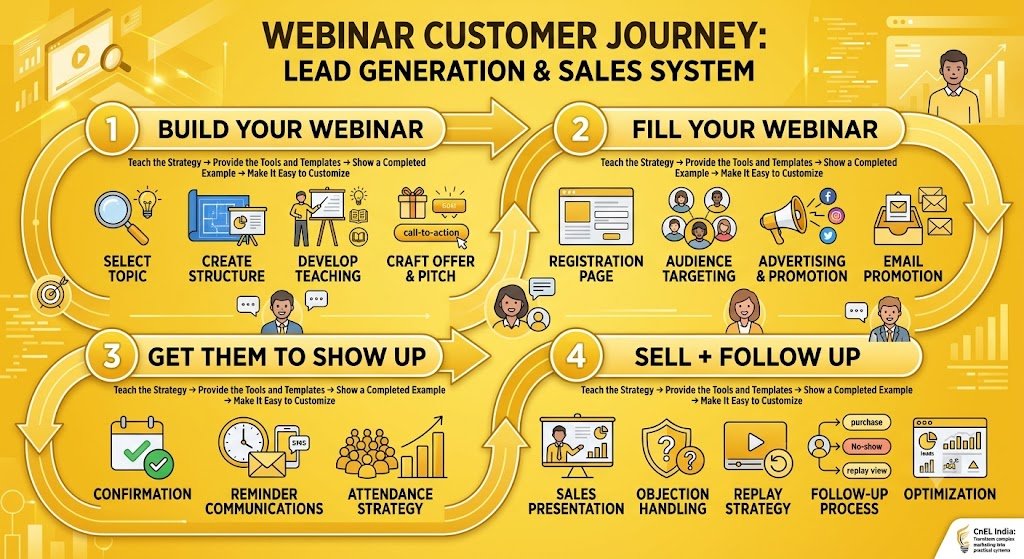
The toolkit was structured around the complete webinar customer journey, beginning with webinar creation and continuing through registration, promotion, attendance, selling, follow-up, and optimization.
The project consisted of four primary sections:
- Build Your Webinar
- Fill Your Webinar
- Get Them to Show Up
- Sell + Follow Up
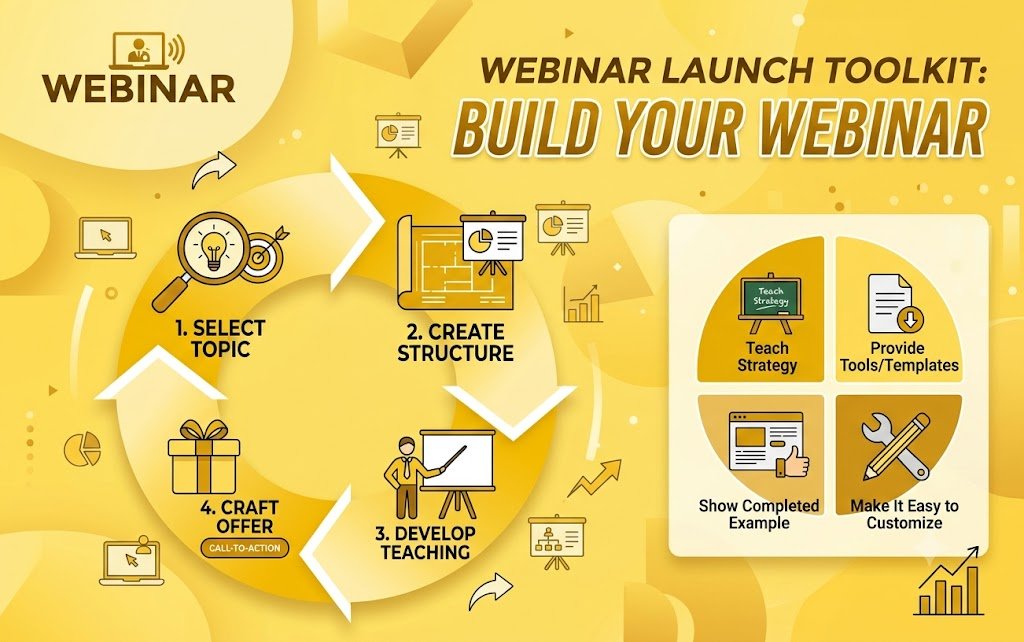
For each section, the objective was to follow a simple framework:
Teach the Strategy → Provide the Tools and Templates → Show a Completed Example → Make It Easy to Customize
In addition to written resources, four short training videos were planned to guide customers through the process and demonstrate how the resources could be used.
CnEL India’s focus was on making the toolkit practical, easy to understand, reusable, and focused on measurable business outcomes rather than theoretical marketing concepts.
Business Challenge
Many businesses understand that webinars can be useful for generating leads and selling services or products, but creating an effective webinar campaign requires several different activities to work together.
A webinar needs a relevant topic, a clear structure, engaging teaching content, a strong offer, an effective registration process, promotion, reminders, attendance management, a sales presentation, follow-up communication, and performance analysis.
When these elements are created separately without a clear strategy, businesses may experience low registrations, poor attendance, weak engagement, or limited sales.
Another challenge was information overload.
Many webinar resources contain large amounts of theoretical material, making it difficult for users to understand what they should actually do.
The objective of this project was therefore to simplify the process.
Instead of creating a long educational course, the toolkit needed to function as a practical implementation system. Customers should be able to open a section, understand the strategy, use the provided template, review an example, customize it, and move forward.
Project Objectives
The main objectives of the project were:
- Create a complete webinar launch framework.
- Simplify the webinar creation process.
- Provide practical strategies rather than excessive theory.
- Develop reusable templates and resources.
- Include completed examples for better understanding.
- Make each resource easy to customize.
- Explain webinar promotion and registration.
- Improve webinar attendance through structured reminders.
- Support lead generation and sales.
- Create a structured selling and follow-up process.
- Develop four short educational training videos.
- Make the toolkit useful for different industries and business models.
- Create a framework that could be improved using performance data.
The overall goal was to help customers move from a webinar idea to a complete launch and sales process with minimal confusion.
Understanding the Webinar Customer Journey
CnEL India began by looking at the webinar as a complete customer journey rather than a single online presentation.
A successful webinar campaign has multiple stages.
The first stage is attracting the right audience.
The second is convincing interested people to register.
The third is encouraging registered users to attend.
The fourth is delivering useful content that builds trust.
The fifth is presenting an appropriate offer.
The final stage is following up with attendees and people who registered but did not attend.
This journey formed the foundation of the toolkit.
The four sections were designed to correspond with these stages, allowing users to understand how each activity connects with the next.
Section 1: Build Your Webinar
Selecting the Right Webinar Topic
The first part of the toolkit focused on choosing a webinar topic that could attract the right audience.
A strong topic should address a specific problem, desired outcome, or opportunity.
Rather than creating a broad educational presentation, users were encouraged to focus on a meaningful result for their target audience.
The toolkit explained how to identify audience problems, understand their goals, and convert those insights into a webinar topic.
Topic selection was also connected to the eventual offer.
The webinar should provide genuine value while naturally creating interest in the product or service being offered at the end.
Webinar Structure
The next step was creating a clear presentation structure.
CnEL India developed a framework that could guide users through the webinar from introduction to conclusion.
The structure included:
- Opening and audience connection.
- Establishing the problem.
- Explaining why the problem exists.
- Teaching the core concepts.
- Providing actionable insights.
- Demonstrating the desired outcome.
- Transitioning into the offer.
- Presenting the solution.
- Addressing concerns.
- Providing a clear next step.
This structure helped prevent webinars from becoming unorganized presentations.
Teaching Strategy
A major part of the toolkit focused on teaching.
The objective was to ensure that webinar presenters could provide genuine value rather than simply spending the entire session promoting their offer.
The educational section needed to create a meaningful transformation for the viewer while also showing the limitations of trying to solve a larger problem without additional support.
The strategy was to teach enough to establish credibility and trust while maintaining a clear connection to the final offer.
Offer and Pitch
The webinar also needed a structured transition from teaching to selling.
CnEL India included guidance for developing an offer that was directly connected to the problem discussed during the webinar.
The pitch framework focused on explaining:
- What the offer provides.
- Who it is designed for.
- What outcome it supports.
- What is included.
- Why the solution is valuable.
- How customers can move forward.
This helped make the sales portion feel like a natural continuation of the webinar rather than an unexpected advertisement.
Section 2: Fill Your Webinar
Once the webinar was created, the next challenge was attracting registrations.
Registration Page Strategy
The toolkit provided a framework for creating an effective registration page.
The page needed to answer the visitor’s most important questions quickly:
What is this webinar about?
Who is it for?
What will I learn?
Why should I attend?
When is it happening?
The registration experience was designed to reduce uncertainty and make the value of attending immediately clear.
Audience Targeting
CnEL India also focused on audience relevance.
A webinar can have a large number of registrations but still perform poorly if the audience is not aligned with the offer.
Therefore, the promotional strategy focused on reaching people who were likely to have the problem being discussed and could benefit from the final solution.
This helped connect registration volume with lead quality.
Advertising and Promotion
The toolkit included a structured promotion strategy covering different communication channels.
Promotional messaging focused on the problem, desired result, webinar value, and reason to attend.
Instead of relying on a single promotional message, users could adapt different messaging angles based on their audience.
The toolkit also provided reusable promotional templates to make campaign creation faster.
Email Promotion
Email communication was another important component.
Promotional messages could be used to introduce the webinar, explain the value, highlight the key learning outcomes, and encourage registration.
The toolkit provided a sequence-based approach rather than relying on a single announcement.
This allowed businesses to communicate with their audience throughout the registration period.
Section 3: Get Them to Show Up
Registration alone does not guarantee webinar success.
A major challenge in webinar marketing is the gap between people who register and people who actually attend.
The third section of the toolkit addressed this issue.
Confirmation Strategy
After registration, attendees needed clear confirmation information.
The confirmation process communicated the webinar details, expectations, and next steps.
This helped reinforce the decision to register.
Reminder Communication
CnEL India created a structured reminder approach designed to maintain awareness leading up to the event.
Reminders could be scheduled at different stages before the webinar.
The messaging was designed to be useful rather than repetitive.
Instead of simply saying that the webinar was approaching, reminders could highlight a key benefit, remind participants of what they would learn, or create anticipation.
Attendance Strategy
The toolkit also explained how to increase the perceived value of attending live.
For example, presenters could communicate what attendees would gain from participating in real time, what questions would be addressed, or what practical information would be shared during the session.
The objective was to create a reason to attend rather than simply register.
Reducing No-Shows
No-shows are a common problem in webinar campaigns.
The toolkit therefore treated attendance as a separate stage of the customer journey.
By combining confirmation, reminders, anticipation, and clear expectations, businesses could improve the likelihood that registered participants would actually attend.
Section 4: Sell + Follow Up
The final stage focused on converting webinar engagement into business results.
Sales Presentation
The sales section provided a structured framework for presenting an offer after delivering the educational content.
The pitch needed to clearly connect the webinar lesson to the solution.
Instead of using aggressive sales messaging, the framework focused on demonstrating relevance and value.
Objection Handling
Potential customers may have questions or concerns before purchasing.
The toolkit therefore included guidance for addressing common objections around price, timing, suitability, implementation, trust, and expected results.
The objective was not to pressure the customer but to help the presenter respond clearly and confidently.
Replay Strategy
Not every registered participant attends live.
The replay therefore became an important part of the sales process.
A replay strategy allowed people who missed the live session to access the educational content and understand the offer.
This created an additional opportunity to generate conversions from people who could not attend at the scheduled time.
Follow-Up Process
Follow-up was one of the most important parts of the project.
Different audience groups may require different messages.
For example:
- Attended but did not purchase.
- Registered but did not attend.
- Watched the replay.
- Asked questions but did not make a decision.
- Showed strong interest but needed additional information.
CnEL India developed the framework around these different audience behaviors.
This allowed follow-up communication to become more relevant and personalized.
Optimization
A webinar campaign should not be treated as a one-time event.
The toolkit included an optimization mindset where businesses could review performance and identify areas for improvement.
Important metrics could include:
- Registration rate.
- Registration source.
- Attendance rate.
- Engagement.
- Offer interest.
- Conversion rate.
- Follow-up response.
- Revenue generated.
Analyzing these results allowed future webinars to become more effective.
Training Videos
Four short training videos were included as part of the toolkit.
Each video corresponded with one of the four major sections.
The purpose of these videos was not to create lengthy lectures.
Instead, they were designed as practical walkthroughs.
Each video could explain the strategy, demonstrate how to use the resources, and show how users could customize the provided examples.
The presentation style was designed to be clear, conversational, and approachable.
This was particularly important because the target customers may not have advanced marketing knowledge.
The training needed to make the process feel achievable.
Templates and Completed Examples
One of the strongest components of the toolkit was the combination of strategy, templates, and examples.
Simply explaining a concept does not always help someone implement it.
A template gives the user a starting point.
A completed example shows how the template should look when finished.
The customer can then modify the example based on their own business.
This approach reduces the time required to create a webinar campaign from scratch.
Customization Framework
The toolkit was designed to be flexible across different industries.
A consultant, coach, service provider, educator, or business owner may have different audiences and offers, but the underlying webinar journey remains similar.
Therefore, the resources were created around adaptable structures rather than overly specific examples.
Users could customize topics, audience descriptions, messaging, offers, reminders, and follow-up sequences while maintaining the underlying strategy.
Quality Assurance
CnEL India reviewed the toolkit from both a content and usability perspective.
The objective was to make sure the resources were:
- Easy to understand.
- Logically organized.
- Consistent.
- Practical.
- Reusable.
- Easy to customize.
- Connected to measurable outcomes.
The training content was also reviewed to ensure that the written resources and video explanations supported one another.
Business Benefits
The completed webinar launch toolkit provided several benefits.
Faster Webinar Creation
Users received structured resources instead of starting from a blank page.
Better Campaign Organization
The four-stage framework helped businesses understand how webinar creation, promotion, attendance, sales, and follow-up connect.
Improved Lead Generation
A structured registration and promotion process could help businesses attract more relevant prospects.
Better Attendance
Confirmation and reminder strategies helped businesses improve participation.
Stronger Sales Process
The pitch, objection handling, replay, and follow-up frameworks supported the conversion process.
Repeatable Marketing System
The toolkit could be reused for multiple webinars, allowing businesses to build a repeatable lead-generation process.
Easier Implementation
Templates and completed examples reduced the amount of work required to turn strategy into execution.
CnEL India’s Contribution
CnEL India approached the project as a practical business system rather than simply a content-writing assignment.
The focus was on connecting strategy with implementation.
Every section was designed around a simple progression:
Understand → Use the Template → Follow the Example → Customize → Launch → Measure → Improve.
This approach made the toolkit more accessible to customers who wanted practical results without going through a long theoretical course.
CnEL India also focused on maintaining consistency between the different stages of the customer journey.
A webinar topic needed to connect with the teaching content. The teaching content needed to connect with the offer. The registration messaging needed to attract the right audience. The reminder sequence needed to encourage attendance. The follow-up process needed to continue the conversation after the webinar.
This connected structure helped turn individual resources into one complete system.
Future Scalability
The webinar toolkit can be expanded over time as more customer feedback and performance data become available.
Additional examples can be added for different industries.
New templates can be introduced for different webinar formats.
The system can also support multiple webinar campaigns, evergreen presentations, live events, product launches, workshops, and educational sessions.
Performance data can be used to identify which topics, promotional messages, attendance strategies, and offers produce the strongest results.
This creates an ongoing improvement cycle where each campaign contributes insights to the next.
Conclusion
The Webinar Launch Toolkit project demonstrates how CnEL India can transform a complex marketing process into a simple, practical, and repeatable business system.
Rather than creating a lengthy course filled with theory, the project focused on implementation.
The four-part structure guided customers through the complete journey:
Build the Webinar → Fill the Webinar → Get People to Show Up → Sell and Follow Up.
By combining clear strategy, practical templates, completed examples, customization guidance, and short training videos, the toolkit provided customers with the resources needed to move from an initial webinar idea toward an organized launch and sales process.
The project also demonstrates the importance of treating webinars as complete customer journeys rather than isolated online events.
When topic selection, teaching, registration, promotion, attendance, selling, follow-up, and optimization work together, a webinar can become a repeatable system for generating leads, building trust, and supporting business growth.
CnEL India’s structured approach helped make that process easier to understand, easier to implement, and easier to improve over time.