
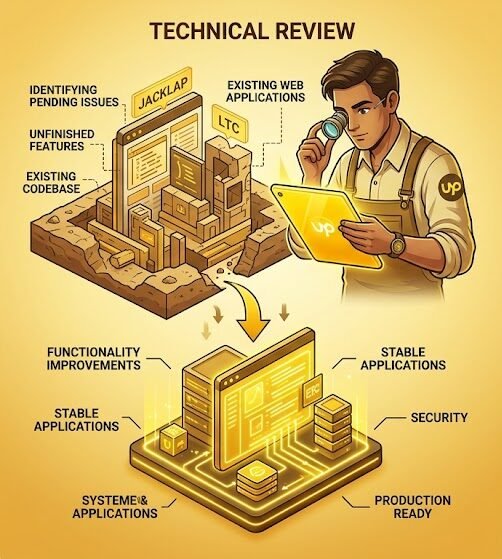
Project Overview
Taking over an existing web application is often more challenging than developing a new application from the beginning. An existing project may contain partially completed features, legacy code, inconsistent structures, unresolved bugs, incomplete integrations, database issues, or deployment problems.
CnEL India worked on a full stack web application improvement project involving two existing web applications that required technical review, feature completion, bug resolution, performance improvements, security checks, and preparation for stable production use.
The objective was not to rebuild the applications unnecessarily. Instead, the focus was on understanding the existing codebase, identifying the current state of the applications, resolving outstanding issues, completing unfinished functionality, and creating a reliable foundation for future development.
The project required both frontend and backend expertise along with experience in APIs, databases, third-party integrations, testing, deployment, and troubleshooting.
A major requirement was the ability to work independently. Since the applications already existed, the development process depended heavily on understanding the existing architecture before making changes.
CnEL India approached the project as a structured recovery and optimization process, beginning with codebase analysis and gradually moving toward feature completion, testing, security validation, and production deployment.
Business Challenge
When an application is partially developed, several problems can exist simultaneously.
Some features may work correctly while others remain incomplete. Certain parts of the code may have been written at different stages by different developers. The database may contain structures that are no longer aligned with the application. APIs may require updates, and third-party integrations may not function consistently.
The business needed a developer who could quickly understand the existing applications without relying on step-by-step instructions.
The key challenges included:
- Understanding an unfamiliar codebase
- Identifying incomplete features
- Finding existing bugs
- Resolving backend issues
- Improving frontend functionality
- Reviewing database structures
- Checking API communication
- Validating third-party integrations
- Improving application security
- Testing existing and new features
- Preparing the applications for production
The goal was to move the applications from an incomplete development stage toward stable and reliable operation.
Project Objectives
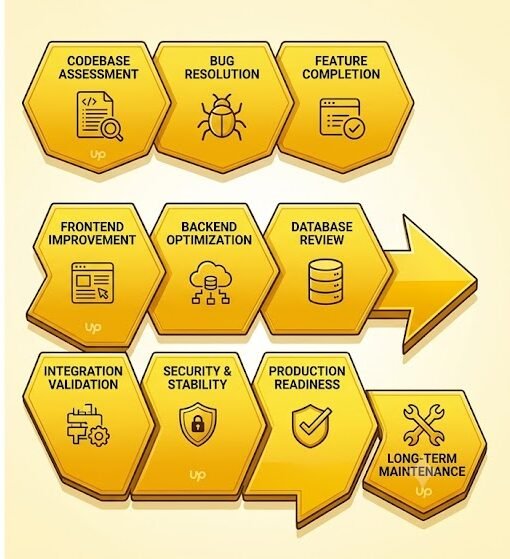
CnEL India structured the project around several objectives.
Codebase Assessment
Understand the existing application architecture and identify areas requiring attention.
Bug Resolution
Locate and fix functional problems affecting application behavior.
Feature Completion
Complete unfinished features according to the existing business requirements.
Frontend Improvement
Ensure that application interfaces work correctly and provide a consistent user experience.
Backend Optimization
Review business logic, APIs, authentication, data processing, and server-side functionality.
Database Review
Check data structures, relationships, queries, and consistency.
Integration Validation
Ensure external services and connected systems communicate correctly.
Security and Stability
Identify potential security issues and improve overall application reliability.
Production Readiness
Prepare the applications for stable deployment and real-world use.
Understanding an Existing Codebase
The first stage of the project was understanding what already existed.
Starting development immediately without reviewing the existing architecture could introduce additional problems.
CnEL India therefore began with a technical assessment.
The review focused on:
- Application structure
- Frontend components
- Backend architecture
- Database design
- API endpoints
- Authentication
- User roles
- Existing integrations
- Configuration
- Error handling
- Deployment setup
- Unfinished modules
The objective was to create a clear picture of the application’s current condition.
This allowed development work to be prioritized according to business importance rather than simply fixing issues in random order.
Creating a Technical Roadmap
After reviewing the applications, issues were categorized into different groups.
Critical Issues
Problems that prevented the application from functioning correctly or created significant security or data risks.
Functional Issues
Bugs affecting specific features or workflows.
Incomplete Features
Modules that had been started but were not fully implemented.
Performance Issues
Slow queries, inefficient processing, or unnecessary frontend operations.
Integration Issues
Problems communicating with external services.
UI and UX Issues
Problems affecting usability, navigation, responsiveness, or visual consistency.
This classification helped create a practical development roadmap.
Critical issues were addressed first, followed by important functionality and optimization.
Frontend Development
The frontend is the primary interaction layer for users.
An existing application may contain pages that technically work but still require improvements in usability, responsiveness, validation, or consistency.
CnEL India reviewed the frontend experience across the applications.
The review included:
- Navigation
- Forms
- Buttons and interactions
- Data display
- Validation
- Responsive behavior
- Error messages
- Loading states
- User feedback
- Page consistency
Incomplete interface elements were completed according to the existing application’s design and business logic.
The objective was to ensure that frontend improvements remained consistent with the application’s existing structure rather than introducing unnecessary changes.
Backend Development
The backend controls much of the application’s core functionality.
CnEL India reviewed backend components responsible for:
- Business logic
- User authentication
- Authorization
- Data processing
- API requests
- Database operations
- Notifications
- Validation
- Error handling
Incomplete backend functionality was implemented based on the application’s existing requirements.
Where existing logic was inefficient or unreliable, it was improved without disrupting working functionality.
This required careful testing because changes to shared backend logic can affect multiple application modules.
API Development and Integration
Modern web applications frequently depend on APIs for communication between different systems.
An existing application may contain several API endpoints that require review.
CnEL India examined:
- Request handling
- Response structures
- Authentication
- Input validation
- Error responses
- Data formatting
- Endpoint consistency
Third-party integrations were also reviewed to ensure external services were communicating correctly.
When an integration failed, the issue could originate from incorrect requests, authentication problems, outdated configurations, invalid data, or changes in the external service.
A structured debugging approach was used to identify the actual source of the problem.
Database Review and Optimization
The database is a critical component of any full stack application.
Problems in database structure or queries can lead to incorrect information, slow performance, or application failures.
CnEL India reviewed the existing database architecture, including:
- Tables
- Relationships
- Data types
- Constraints
- Indexing
- Queries
- Duplicate records
- Data validation
- Data consistency
Where necessary, database structures were improved to better support application functionality.
Queries were also reviewed for efficiency.
The objective was to make sure the application could handle its expected workload without unnecessary database operations.
Completing Unfinished Features
One of the main requirements was completing features that had already been partially developed.
This required understanding both the existing implementation and the intended business behavior.
For each incomplete feature, CnEL India examined:
- What had already been implemented?
- What functionality was missing?
- Which backend services were involved?
- What database information was required?
- What frontend changes were needed?
- How should errors be handled?
- How should the completed feature interact with other modules?
This prevented unfinished functionality from being implemented in isolation.
The completed feature needed to work correctly within the larger application.
Bug Identification and Resolution
Existing applications often contain bugs that are not immediately visible.
Some problems may occur only under specific conditions.
For example:
- A form may fail when optional data is missing.
- A user may receive an incorrect status.
- An API may fail with a particular input.
- A database query may produce unexpected results.
- A feature may work on one device but fail on another.
CnEL India used structured troubleshooting to reproduce issues, identify their underlying causes, implement fixes, and test the affected workflow again.
The objective was to resolve root causes rather than simply hide visible symptoms.
Authentication and User Access
Applications with user accounts require proper authentication and authorization.
CnEL India reviewed areas such as:
- Login functionality
- Session handling
- Password-related workflows
- User roles
- Permission checks
- Protected pages
- API access
- Unauthorized requests
A user should only be able to access functionality appropriate for their role.
This becomes particularly important when applications contain multiple user types or administrative functions.
Security Review
Production applications need to protect both users and business information.
CnEL India considered common security areas during the application review.
These included:
- Input validation
- Access control
- Authentication
- Authorization
- Data exposure
- API security
- Sensitive configuration
- Error messages
- File handling
- Database access
The objective was to reduce avoidable security risks and ensure that sensitive information was handled appropriately.
Security was treated as part of the development process rather than as an activity performed only at the end.
Error Handling and Application Stability
A production application will eventually encounter unexpected conditions.
Servers may temporarily fail, external services may become unavailable, or users may provide unexpected information.
CnEL India improved error-handling processes so that the application could respond more predictably.
Instead of displaying unclear technical errors, the application could provide appropriate user-facing messages while recording technical information for troubleshooting.
This helps both users and developers.
Good error handling also reduces the likelihood of a single failure affecting unrelated parts of the application.
Performance Optimization
Once major functional issues were addressed, performance could be reviewed.
Performance optimization can involve several areas:
- Database queries
- API response times
- Server-side processing
- Frontend rendering
- Large data handling
- Unnecessary requests
- Asset loading
The goal was not to optimize every component unnecessarily.
Instead, CnEL India focused on identifying actual bottlenecks and improving the areas that could have the greatest effect on user experience and system stability.
Testing Strategy
Testing was an important part of the project.
Because the applications already contained working functionality, new changes needed to be tested carefully to avoid breaking existing features.
Testing covered:
- Individual features
- User workflows
- API communication
- Database operations
- Authentication
- User permissions
- Forms
- Error handling
- External integrations
- Responsive behavior
- Completed features
- Previously reported bugs
Regression testing was particularly important.
Whenever a major change was introduced, related functionality was tested again to ensure that existing features continued to work correctly.
Integration Testing
Third-party integrations require additional testing because the application depends on systems outside its direct control.
CnEL India validated:
- Data exchange
- Request formats
- Response handling
- Authentication
- Failure conditions
- Timeout behavior
- Incorrect responses
The goal was to ensure that integration failures could be handled gracefully.
If an external service became temporarily unavailable, the application should not unnecessarily crash or corrupt existing data.
Deployment and Production Preparation
After development and testing, the applications needed to be prepared for production.
Production readiness included reviewing:
- Server configuration
- Environment settings
- Database configuration
- Application dependencies
- Security settings
- Error logging
- Backup considerations
- Deployment procedures
The deployment process needed to be controlled so that changes could be introduced without unnecessarily disrupting users.
A reliable deployment process also makes future updates easier.
Monitoring and Maintenance
Completing an application does not mean development is finished permanently.
Production systems need ongoing monitoring.
CnEL India considered mechanisms for identifying:
- Application errors
- Failed integrations
- Performance issues
- Unexpected behavior
- Database problems
- User-reported issues
This information can be used for future improvements.
The applications can then evolve through a continuous cycle of:
Monitor → Identify → Fix → Test → Deploy → Review
This approach supports long-term stability.
Business Benefits
Completing and stabilizing an existing application can provide several business benefits.
Faster Product Readiness
Unfinished features can be completed without starting development from scratch.
Reduced Development Cost
Existing working components can be preserved and improved.
Improved Reliability
Bug fixes and testing reduce unexpected failures.
Better User Experience
Frontend improvements make applications easier to use.
Stronger Security
Security reviews help reduce avoidable risks.
Improved Performance
Optimized processing provides a smoother experience.
Easier Maintenance
A better-organized codebase makes future development easier.
Scalable Foundation
A stable application provides a stronger foundation for future features.
CnEL India’s Contribution
CnEL India approached the project as a complete full stack application recovery and optimization process.
The contribution included:
- Reviewing the existing codebase
- Understanding application architecture
- Identifying incomplete functionality
- Creating a development roadmap
- Fixing frontend issues
- Completing backend features
- Reviewing APIs
- Validating database operations
- Resolving integration issues
- Improving authentication and access control
- Addressing security concerns
- Improving error handling
- Optimizing application performance
- Testing existing and new functionality
- Performing regression testing
- Preparing applications for deployment
- Supporting production readiness
- Establishing a foundation for future maintenance
The focus remained on understanding the existing system first and making controlled improvements.
Future Scalability
Once an existing application is stabilized, future development becomes easier.
New features can be introduced on top of a cleaner and more reliable foundation.
Potential future improvements could include:
- Advanced dashboards
- Additional user roles
- New business workflows
- Enhanced reporting
- Improved automation
- Additional integrations
- Mobile-friendly enhancements
- Performance scaling
- Advanced security controls
- Expanded administrative functionality
The applications can therefore continue evolving without requiring a complete rebuild.
Long-Term Support
Existing applications often require ongoing technical support after the initial stabilization phase.
CnEL India can support long-term maintenance through:
- Bug resolution
- Security updates
- Feature enhancements
- Performance monitoring
- Database maintenance
- Integration updates
- Deployment support
- Technical improvements
This creates continuity between the initial application recovery and future development.
Conclusion
Taking over an existing web application requires a different approach from building a new application.
The developer must first understand what already exists, determine which components are reliable, identify what is incomplete, and carefully improve the system without disrupting working functionality.
CnEL India approached this project through structured codebase assessment, frontend and backend development, API and database review, integration troubleshooting, security improvements, testing, and production preparation.
The objective was not simply to make the applications work temporarily.
The larger goal was to create stable, maintainable, secure, and production-ready applications that could continue to evolve.
By combining careful technical assessment with independent problem-solving and systematic testing, CnEL India can help transform partially completed applications into reliable digital products ready for real-world use.
A strong existing codebase does not always require a complete rebuild. With the right technical analysis and development approach, unfinished features, bugs, integration problems, and performance issues can be resolved while preserving the valuable work that has already been completed.