
Project Overview
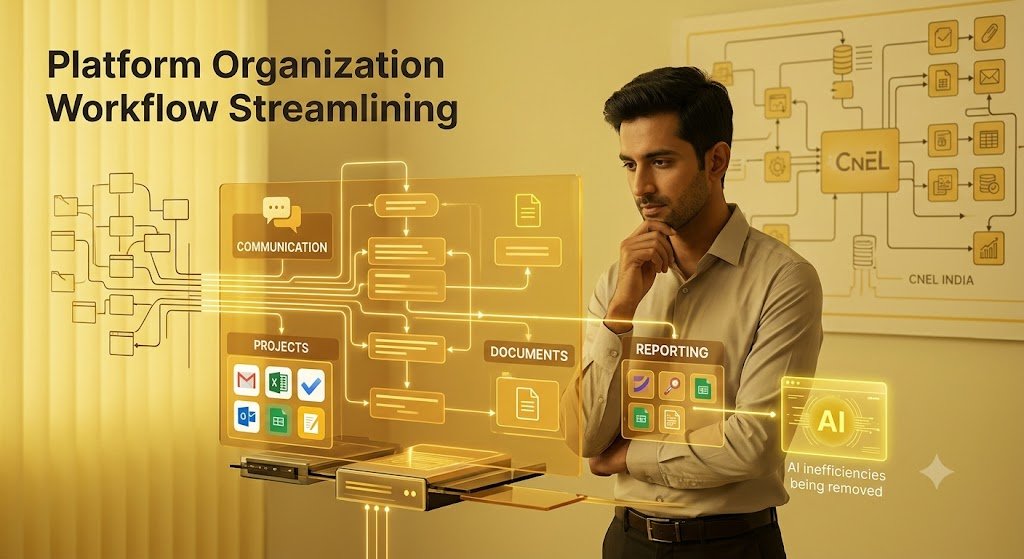
As businesses grow, the number of digital platforms, applications, workflows, documents, communication channels, and operational processes can increase rapidly. While these systems are useful individually, managing them together can become complicated.
Information may be stored in different places, similar tasks may be performed through multiple processes, and employees may spend unnecessary time moving information between systems. Over time, this can create a fragmented digital environment where the business has access to many capabilities but does not use them efficiently.
CnEL India worked on an AI-driven platform organization and workflow optimization project designed to improve the structure of personal and business digital systems. The objective was to assess existing platforms, identify inefficiencies, simplify workflows, improve organization, and implement practical solutions that could support long-term operational efficiency.
The project was not focused on introducing technology simply for the sake of technology. Instead, the approach was based on understanding how the existing systems were being used and identifying where AI and automation could create measurable improvements.
The solution was designed as an ongoing optimization process rather than a one-time implementation. This allowed the organization to gradually improve its digital environment, test new workflows, and adapt the system as business requirements changed.
Business Challenge
Digital platforms often grow organically.
A business may initially adopt one system for communication, another for project management, another for storing documents, and another for tracking customers or operations. As the business expands, additional systems are introduced to solve new problems.
Eventually, several challenges can appear.
Information may be duplicated across different locations. Employees may not know where a particular piece of information should be stored. Tasks may be entered manually in multiple places. Important information may be difficult to locate. Some workflows may depend heavily on individual employees remembering specific steps.
These problems can result in:
- Repetitive manual work
- Duplicate data
- Disorganized information
- Unclear responsibilities
- Slow communication
- Inefficient workflows
- Difficulty finding important records
- Unused platform capabilities
- Inconsistent processes
- Increased administrative effort
The organization needed a structured approach to understand its existing environment and determine where improvements could be made.
Project Objectives
CnEL India structured the project around several core objectives.
Assess Existing Systems
The first objective was to understand how the existing digital platforms were being used and what role each system played.
Improve Platform Organization
Information, processes, and responsibilities needed to be organized in a logical manner.
Streamline Workflows
Repetitive or unnecessarily complicated workflows needed to be simplified.
Identify Automation Opportunities
Tasks that could be automated or partially automated needed to be identified.
Improve Efficiency
The overall digital environment needed to support faster and more consistent operations.
Establish a Scalable Structure
The organization needed a foundation that could continue to evolve as new requirements emerged.
Understanding the Existing Digital Environment
Before implementing changes, CnEL India focused on understanding the current environment.
This involved examining how information moved through the organization.
For example, a typical business process may involve:
Information Received → Employee Review → Data Entry → Internal Communication → Task Creation → Follow-Up → Reporting
Each stage may be handled through a different system or manual process.
The first step was to understand whether every stage was necessary and whether information could be transferred more efficiently.
The assessment also considered:
- Where information originates
- Where information is stored
- Who accesses it
- How it is updated
- How tasks are created
- How communication occurs
- How reports are prepared
- Where approvals happen
- Which steps are manual
- Which processes create delays
This provided a foundation for improving the overall architecture.
Platform Mapping and Organization
One of the major components of the project was platform mapping.
CnEL India categorized systems according to their primary purpose rather than allowing different systems to overlap unnecessarily.
Typical categories could include:
- Communication
- Customer management
- Project management
- Document storage
- Knowledge management
- Task management
- Reporting
- Financial operations
- Marketing
- Content management
- Internal administration
The purpose was not necessarily to reduce the number of platforms.
Instead, the goal was to establish a clear role for each system.
When each platform has a defined purpose, employees are less likely to store the same information in multiple places or use inconsistent processes.
Identifying Workflow Bottlenecks
Once the existing environment was mapped, CnEL India analyzed individual workflows.
A workflow may appear simple but contain several unnecessary steps.
For example:
- An employee receives information.
- The employee copies the information manually.
- The employee enters it into another system.
- A message is sent to another team member.
- The second employee creates a task.
- A spreadsheet is updated.
- A report is prepared manually.
Several of these steps could potentially be automated.
The assessment therefore focused on identifying:
- Repeated data entry
- Repeated communication
- Manual status updates
- Unnecessary approvals
- Duplicate records
- Repetitive reporting
- Delayed notifications
- Manual data movement
Removing unnecessary steps can significantly improve productivity without changing the underlying business process.
AI-Driven Workflow Optimization
AI can provide value beyond basic automation.
Traditional automation typically follows predefined instructions.
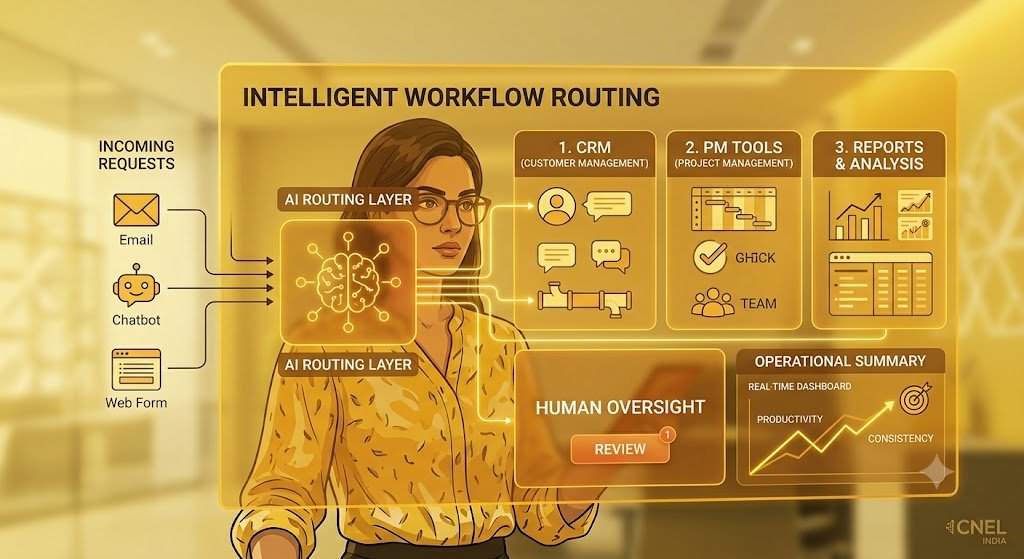
AI-driven workflows can also interpret information and determine which predefined process should be followed.
For example, an incoming business request could be analyzed to determine:
- What type of request it is
- Which department should handle it
- Whether it requires a task
- What information needs to be recorded
- Whether a response should be prepared
- Whether human approval is necessary
The AI component does not need to replace business rules.
Instead, it can act as an intelligent layer that helps interpret information and route it into the appropriate workflow.
This makes automation more flexible while still maintaining organizational control.
Improving Information Organization
Poor information organization is one of the most common causes of wasted time.
Employees may know that a document exists but not remember where it was stored.
CnEL India approached information organization by establishing logical categories and consistent structures.
Information could be organized according to:
- Business function
- Project
- Customer
- Date
- Document type
- Status
- Department
- Priority
Consistent naming and categorization also make information easier for AI systems to interpret.
A well-organized information environment creates better foundations for search, automation, reporting, and future AI applications.
Centralizing Important Business Information
Centralization does not necessarily mean putting everything into one system.
Instead, it means creating a clear source of truth for important categories of information.
For example, customer information should have a defined primary location.
Project information should have a defined primary location.
Documents should follow a consistent organizational structure.
Reports should be generated from reliable information rather than manually combining data from multiple sources every time.
This reduces confusion and improves data consistency.
Reducing Duplicate Data
Duplicate information can create serious operational problems.
If the same customer information exists in several locations, one record may be updated while another remains outdated.
CnEL India focused on identifying where duplicate information was being created and determining which system should be considered the authoritative source.
The workflow could then be redesigned so that information was entered once and reused wherever necessary.
This reduces manual effort and helps maintain data accuracy.
Automating Repetitive Processes
After identifying workflow bottlenecks, CnEL India prioritized tasks that were repetitive and rule-based.
Examples could include:
- Creating routine tasks
- Updating statuses
- Moving information between systems
- Sending internal notifications
- Preparing summaries
- Organizing documents
- Generating recurring reports
- Categorizing incoming information
- Creating follow-up reminders
Automation was introduced carefully.
Not every process should be automated.
Tasks involving sensitive decisions or significant business consequences may require human review.
The objective was to automate predictable work while keeping people involved where judgment is important.
Intelligent Task Management
Task management can become inefficient when tasks are created manually from multiple sources.
AI-driven workflows can help identify actionable information and convert it into structured tasks.
For example, an incoming request could be analyzed and transformed into:
- Task title
- Description
- Responsible person
- Priority
- Deadline
- Related project
- Required follow-up
This reduces the amount of administrative work required to maintain task lists.
The system can also help identify overdue or pending tasks and provide structured summaries.
Improving Communication Workflows
Communication is another area where platform organization can create significant improvements.
Employees often receive information through multiple channels.
Without a clear process, important requests may be missed or duplicated.
CnEL India designed communication workflows around structured routing.
Information could be categorized according to:
- Urgency
- Topic
- Department
- Customer
- Project
- Required action
The system could then prepare the appropriate next step.
For example, an informational message might simply be archived, while an actionable request could create a task and notify the responsible person.
This makes communication more manageable without requiring employees to manually review every piece of information in the same way.
AI-Assisted Reporting
Reporting often involves collecting information from different sources and manually preparing summaries.
This can consume significant time.
An AI-assisted reporting workflow can organize information into structured summaries.
Reports may include:
- Completed activities
- Pending tasks
- Workflow performance
- Operational issues
- Customer activity
- Project progress
- Key changes
- Important exceptions
The system can highlight significant information while leaving the final interpretation to management.
This makes reports more useful for decision-making.
Improving Personal and Business Workflows
The project addressed both business and individual productivity.
For personal workflows, optimization could include:
- Task organization
- Scheduling
- Information management
- Reminder systems
- Personal planning
- Research organization
For business workflows, improvements could include:
- Customer processes
- Project management
- Team communication
- Reporting
- Document organization
- Administrative workflows
The same underlying principles apply to both:
Organize → Simplify → Automate → Monitor → Improve
Human Oversight and Control
AI-driven optimization should not mean removing humans from every workflow.
CnEL India included human oversight wherever judgment or approval was important.
The system could identify situations requiring human involvement, such as:
- Unclear information
- Sensitive requests
- Conflicting instructions
- Important external communication
- Financial decisions
- Major workflow changes
- Low-confidence AI interpretation
This creates a controlled automation environment.
Routine activities can be automated, while important decisions remain under human supervision.
Reliability and Error Handling
A workflow is only useful if it performs consistently.
CnEL India therefore considered reliability throughout the implementation.
The system could track:
- Workflow status
- Successful actions
- Failed actions
- Missing information
- Processing errors
- Manual interventions
- Pending approvals
When an automated process fails, the system should not simply assume success.
Instead, the issue should be recorded and routed appropriately.
This creates transparency and makes troubleshooting easier.
Security and Access Management
Platform organization also requires careful consideration of information security.
Different employees may need different levels of access.
For example:
- Employees may access operational information.
- Managers may access reports.
- Administrators may manage workflows.
- Authorized personnel may approve sensitive actions.
CnEL India designed the optimization process with controlled access in mind.
The principle was simple: users and automated workflows should only have access to the information and actions required for their responsibilities.
Documentation and Standardization
Long-term platform optimization requires good documentation.
Without documentation, improvements can become difficult to maintain when employees change roles or new systems are introduced.
CnEL India documented:
- Platform responsibilities
- Workflow processes
- Automation rules
- Data ownership
- Approval stages
- Exception handling
- Maintenance requirements
This documentation also makes onboarding easier.
New employees can understand how information should move through the organization without relying entirely on informal knowledge.
Testing and Continuous Improvement
Platform optimization is not a one-time activity.
After implementing improvements, CnEL India focused on testing actual workflows and identifying areas that could still be improved.
Testing included:
- Normal workflow execution
- Incorrect information
- Missing information
- Duplicate records
- Failed actions
- Unexpected inputs
- Human approval scenarios
- Data synchronization
- Reporting accuracy
Feedback from users was also important.
Employees working with the systems every day can identify practical problems that may not be obvious during initial analysis.
The optimization process therefore continued through repeated testing and refinement.
Business Benefits
The platform organization and AI optimization project can provide several measurable business benefits.
Reduced Manual Work
Employees spend less time on repetitive administrative tasks.
Better Organization
Information becomes easier to find and manage.
Improved Data Consistency
Clear sources of truth reduce conflicting records.
Faster Workflows
Automated information movement reduces delays.
Better Visibility
Managers gain clearer insight into operational activities.
Reduced Errors
Standardized workflows reduce manual mistakes.
Improved Employee Productivity
Teams can focus more on meaningful work instead of repetitive administration.
Scalable Operations
The digital environment becomes easier to expand as the business grows.
CnEL India’s Contribution
CnEL India approached the project as a combination of technology assessment, workflow redesign, and AI-driven optimization.
The contribution included:
- Reviewing existing digital platforms
- Mapping business processes
- Identifying workflow bottlenecks
- Defining platform responsibilities
- Improving information organization
- Identifying automation opportunities
- Designing AI-assisted workflows
- Reducing duplicate data entry
- Improving task management
- Supporting intelligent communication routing
- Developing reporting workflows
- Establishing human approval stages
- Improving error handling
- Supporting access control
- Documenting workflows
- Testing and refining the overall system
The focus remained on practical improvements rather than unnecessary complexity.
Future Scalability
The optimized environment provides a foundation for future AI initiatives.
As the organization becomes more comfortable with automation, additional workflows can be introduced.
Potential future applications include:
- Intelligent customer support
- Automated document processing
- Advanced business reporting
- Predictive workflow alerts
- AI-assisted project management
- Automated research
- Knowledge management
- Intelligent scheduling
- Customer relationship workflows
- Internal business assistants
Because the underlying platform structure is already organized, these additions can be implemented more efficiently.
Long-Term Support
A major advantage of this type of project is that optimization can continue over time.
Business requirements change.
New employees join the organization. New processes are introduced. Existing platforms add new capabilities. Customer expectations evolve.
CnEL India therefore treats platform optimization as an ongoing process.
Regular reviews can identify:
- New automation opportunities
- Outdated workflows
- Unused capabilities
- Data quality issues
- New integration requirements
- Security improvements
- Employee feedback
- Opportunities for AI adoption
This ensures that the digital environment continues to support the business rather than becoming another source of complexity.
Conclusion
Organizing personal and business platforms is not simply a matter of connecting systems together.
The real objective is to create a digital environment where information has a clear structure, workflows are easy to understand, repetitive tasks are automated, and employees can focus on higher-value activities.
CnEL India’s AI-driven platform optimization approach begins with understanding the existing environment, identifying inefficiencies, simplifying processes, and then introducing automation where it provides genuine value.
AI can add another layer of intelligence by helping interpret information, route requests, summarize data, identify actions, and support decision-making.
At the same time, human oversight remains important for sensitive or complex situations.
The result is a more organized, efficient, and scalable digital environment.
Instead of continuously adding new systems without a clear structure, businesses can build an intentional platform ecosystem where every system, workflow, and automation has a defined purpose.
Through ongoing assessment, documentation, testing, and improvement, CnEL India helps businesses transform fragmented digital operations into structured and intelligent workflows that are easier to manage today and ready for future growth.