
Client Requirement
The client was a high-volume content production team responsible for creating short-form videos for platforms such as social media feeds, vertical video channels, and other short-content formats. Their primary requirement was not traditional video editing from scratch, but a fast and scalable production workflow powered primarily by generative artificial intelligence.
The client already had scripts, character references, visual assets, brand guidelines, and a large library of previously produced content. The challenge was to convert these prepared materials into polished 20–30 second vertical videos while maintaining character consistency, visual quality, brand identity, and production speed.
The client needed an AI video production operator who could manage the complete generation workflow, identify problems quickly, refine prompts when required, perform lightweight post-production, and conduct a final quality-control check before delivery.
The objective was simple: produce a high volume of usable short-form videos without allowing quality-control issues or unnecessary manual editing to slow down the production pipeline.
CnEL India approached this requirement as an AI-assisted content production and quality-control workflow rather than a conventional video-editing project.
The Challenge
Producing a large number of AI-generated videos presents challenges that are different from conventional video editing.
The client needed realistic cinematic scenes featuring business owners in real-world environments rather than generic talking-head content. Since the characters were predefined, maintaining their identity across different scenes was extremely important.
Several issues could occur during generation:
- Character identity could change between shots.
- Facial features could drift.
- Clothing could change unexpectedly.
- Hands and body movements could appear unnatural.
- Background environments could become inconsistent.
- On-screen text could contain spelling or wording errors.
- Audio could become distorted or mismatched.
- Scenes could fail to communicate the intended message.
- Generated footage might require minor trimming or assembly.
- Repeated manual editing could significantly reduce production speed.
Another major challenge was maintaining a balance between quality and volume.
The client did not want every clip to go through an extensive editing process. If a generated video was already good enough, it needed to be approved and shipped quickly. If a small correction was required, the operator needed to make the correction efficiently. Only when automated generation could not achieve the required result should traditional editing techniques be used.
This required an operator who could make fast production decisions rather than spending excessive time perfecting individual clips.
CnEL India’s Approach
CnEL India designed the workflow around five major stages:
Script & Asset Preparation → AI Generation → Prompt Refinement → Quality Control → Final Delivery
The approach was designed to keep artificial intelligence responsible for the majority of the production workload while keeping human intervention focused on decisions that required judgment.
1. Understanding the Script and Character Assets
The first stage involved reviewing the supplied script, character references, visual assets, and brand requirements.
Before generating a video, the operator needed to understand:
- Who the character was
- What the character should look like
- What environment the scene required
- What the character needed to communicate
- What clothing and visual identity should be maintained
- What the intended camera style should be
- What words or information needed to appear on screen
- What the final video needed to accomplish
This preparation reduced unnecessary generation attempts and provided a consistent foundation for the production process.
CnEL India treated the character reference as a controlled visual asset rather than simply an image. Maintaining the same identity throughout the generated content was considered one of the most important quality requirements.
2. AI-Based Video Generation
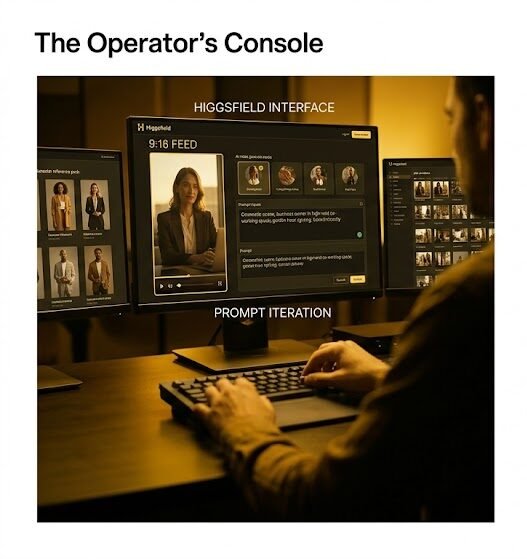
After understanding the creative requirements, the production operator generated the initial vertical video.
The target format was generally a 20–30 second 9:16 short-form video, designed specifically for mobile consumption.
The generation process focused on creating realistic cinematic scenes rather than basic presenter-style videos.
Prompts were structured around several elements:
- Character identity
- Physical appearance
- Wardrobe
- Environment
- Camera positioning
- Lighting
- Body movement
- Facial expression
- Dialogue or intended communication
- Cinematic style
- Brand requirements
The objective was not simply to generate a visually attractive clip. The generated video needed to match the original creative direction.
For example, if the script required a business owner standing inside a modern retail environment, the output needed to preserve the character’s identity while placing that person naturally within the required setting.
This made prompt quality an important part of the production workflow.
3. Prompt Refinement and Iteration
AI-generated video does not always produce the desired result on the first attempt.
CnEL India’s workflow therefore included a rapid iteration process.
When a generated clip failed, the operator first identified the exact problem rather than regenerating the entire concept randomly.
For example:
Problem: Character’s clothing changed.
Action: Refine the instructions to reinforce wardrobe consistency.
Problem: Face appeared different from the approved character.
Action: Strengthen identity-related instructions and regenerate.
Problem: Scene looked artificial.
Action: Improve environmental, lighting, camera, and realism instructions.
Problem: Movement looked unnatural.
Action: Adjust movement and action instructions.
This systematic approach helped reduce unnecessary generation cycles.
AI-assisted language models were used as prompt-support systems to help refine instructions and improve unsuccessful generations. Instead of relying on trial and error, the operator could analyze the failed output, identify the missing requirement, modify the prompt, and run another generation.
This created a feedback loop:
Generate → Review → Identify Issue → Refine Instructions → Regenerate → Review Again
The purpose of this process was speed. The operator was not expected to spend unlimited time refining a single clip.
4. Human Quality Control
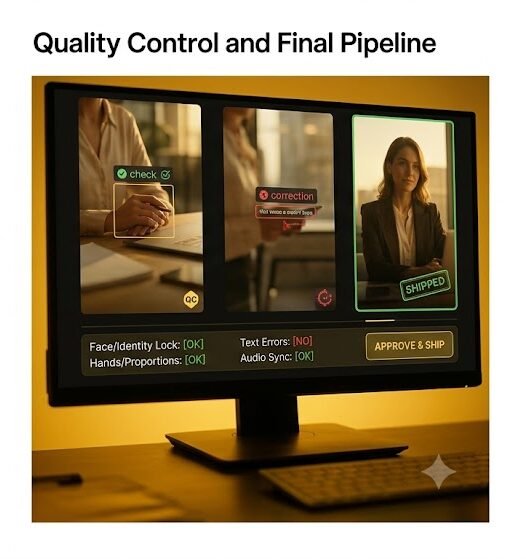
One of the most important parts of the project was quality control.
AI-generated content can look impressive at first glance while still containing small errors that can negatively affect a brand.
CnEL India’s QC process therefore required the operator to watch the completed video instead of simply assuming that a successful generation was automatically ready for publication.
The operator checked several areas.
Character Consistency
The character needed to remain visually consistent with the supplied reference.
The operator checked:
- Face
- Hair
- Clothing
- General appearance
- Identity
- Body proportions
- Visual continuity
Any significant identity drift required another generation or correction.
Hands and Body Movement
AI-generated human movement can sometimes contain visual abnormalities.
The operator checked for:
- Unnatural hand positions
- Distorted fingers
- Strange gestures
- Incorrect body movements
- Unnatural facial expressions
- Sudden visual changes
These issues were particularly important because viewers notice abnormalities quickly in close-up human footage.
Wardrobe and Branding
The clothing needed to remain aligned with the character and brand requirements.
Unexpected wardrobe changes could make multiple videos appear inconsistent, so the operator checked clothing throughout the clip.
Text and Typography
On-screen text was checked for:
- Spelling errors
- Incorrect words
- Missing words
- Duplicate words
- Incorrect information
- Unintended characters
Even a visually strong video could not be shipped if its text contained obvious mistakes.
Audio
The final audio was reviewed for:
- Clarity
- Synchronization
- Missing audio
- Unexpected sounds
- Broken dialogue
- Audio inconsistencies
Overall Visual Quality
The operator also evaluated whether the video actually looked professional.
This included:
- Scene quality
- Lighting
- Composition
- Camera movement
- Transitions
- Visual consistency
- Overall realism
The goal was to make sure that the final output was not merely technically generated but genuinely ready for publication.
5. Lightweight Post-Production
The project was designed around an AI-first production philosophy, but CnEL India recognized that AI generation cannot solve every problem.
When a generated clip required a small correction, lightweight post-production was used.
Typical corrections included:
- Trimming unnecessary footage
- Combining multiple clips
- Adding or correcting captions
- Adjusting timing
- Removing unwanted sections
- Arranging generated scenes
- Making simple audio adjustments
For simple assembly tasks, command-line video processing and automated workflows could be used to reduce repetitive manual work.
The principle was straightforward:
Use AI wherever possible and traditional editing only where necessary.
This prevented the production workflow from becoming unnecessarily complicated.
Production Workflow
CnEL India’s final workflow can be represented as:
1. Receive Script & Assets
The production team provides the script, character reference, visual assets, and brand requirements.
↓
2. Analyze Creative Requirements
The operator identifies the character, environment, action, dialogue, visual style, and required output.
↓
3. Prepare Generation Instructions
Detailed instructions are created covering identity, scene, movement, wardrobe, camera, lighting, and other requirements.
↓
4. Generate Initial Video
The AI generation system produces the first version of the short-form video.
↓
5. Review Output
The operator watches the complete clip and identifies visual, audio, identity, or textual issues.
↓
6. Refine Instructions
If the output misses the creative requirement, instructions are improved and the clip is regenerated.
↓
7. Apply Lightweight Editing
If only a small correction is required, the clip is trimmed, assembled, captioned, or otherwise adjusted.
↓
8. Final QC
The operator performs a final watch-through.
↓
9. Approve & Ship
If the clip meets the required standards, it is delivered and the operator immediately moves to the next production task.
This workflow allowed the team to prioritize throughput without compromising the final quality threshold.
Results and Business Value
The biggest value of the solution was the creation of a repeatable, scalable AI-assisted production pipeline.
Instead of treating every video as a completely manual editing project, the workflow allowed the majority of production work to be handled through automated generation and structured prompting.
This provided several operational advantages.
Faster Production
The operator could generate and evaluate multiple short-form videos without spending hours manually editing every clip.
Scalable Content Creation
Because scripts and character assets were already available, the workflow could be repeated across a large content library.
Reduced Manual Editing
Traditional editing was reserved for cases where it actually added value.
Better Consistency
A structured QC process helped maintain character identity, wardrobe, visual quality, text accuracy, and brand standards.
Faster Problem Resolution
Instead of repeatedly generating random variations, operators could identify specific failures and refine the generation instructions accordingly.
Efficient Human Oversight
Human effort was concentrated on areas where judgment mattered most: reviewing outputs, identifying errors, deciding whether regeneration was necessary, and approving final content.
CnEL India’s Contribution
CnEL India positioned itself not simply as a video editing provider but as an AI-assisted content operations partner.
The project demonstrated CnEL India’s ability to combine:
- Generative AI
- Prompt engineering
- Automated video workflows
- Human quality control
- Lightweight post-production
- Process optimization
- High-volume content operations
The key strength was understanding that successful AI video production is not only about generating content. It requires a complete operational process around generation.
The combination of automation and human review created a practical workflow where AI performed the heavy production work while experienced operators remained responsible for creative accuracy and final quality.
Conclusion
This project demonstrates how CnEL India can help content teams scale short-form video production through an AI-first workflow.
The solution was designed around a simple principle: generate quickly, review carefully, correct efficiently, and keep the production pipeline moving.
Rather than replacing human oversight completely, the workflow used artificial intelligence for high-volume production while keeping people responsible for quality control and final decisions.
This approach is particularly valuable for organizations producing dozens or hundreds of short-form videos where traditional editing for every individual clip would become expensive and time-consuming.
By combining structured prompting, AI-generated video production, rapid iteration, lightweight editing, and systematic quality control, CnEL India created a workflow capable of supporting high-volume content production while maintaining professional standards.
The result is a scalable production model in which every video moves through a clear pipeline—from script and character preparation to generation, refinement, quality inspection, and final delivery—allowing the content team to produce more videos, resolve problems faster, and maintain consistency across a growing content library.