

Introduction
Running a large language model in a development environment is very different from operating the same model in production.
A local deployment may work perfectly when serving a few requests, but production workloads introduce a completely different set of challenges. Multiple users may send requests simultaneously, models may require several GPUs, response-time requirements may be strict, and infrastructure costs can increase rapidly if resources are not managed efficiently.
At CnEL India, we approach large-scale AI infrastructure with the understanding that successful model serving is not simply about loading a model onto a GPU. The complete serving architecture needs to account for GPU allocation, parallel execution, request scheduling, memory consumption, KV-cache utilization, concurrency, latency, throughput, and operational reliability.
A production inference environment therefore needs to be designed as a system rather than as an isolated model-serving process.
This case study explains the key considerations involved in deploying and optimizing large language model inference workloads on Kubernetes using a high-performance inference engine such as vLLM.
Understanding the Production Inference Problem
The first step is understanding what happens when an inference request reaches a production system.
A user sends a prompt to an API endpoint. The request is accepted by the serving layer, queued or scheduled for execution, processed by the language model, and eventually returned as generated tokens.
The process sounds straightforward, but several resources are involved simultaneously.
GPU memory stores model weights, intermediate states, and the key-value cache required during generation. GPU compute resources execute the model operations. CPU resources handle request processing, networking, scheduling, and supporting services.
As the number of concurrent requests increases, the system must efficiently share these resources.
One of the most important characteristics of language-model inference is that requests are not identical. A short prompt generating a short response has very different resource requirements from a long-context request generating hundreds or thousands of tokens.
This variability makes traditional resource planning insufficient.
A production system must therefore be able to maintain high GPU utilization while protecting latency and preventing memory exhaustion.
Why GPU Memory Becomes a Bottleneck
Large language models can require substantial GPU memory simply to store their parameters.
However, model weights are only part of the memory requirement.
During autoregressive generation, the system maintains attention-related information for previously processed tokens. This is commonly referred to as the KV cache.
As context length and concurrent requests increase, KV-cache consumption can become one of the largest consumers of GPU memory.
This creates an important operational relationship:
More concurrent requests + longer contexts = higher KV-cache requirements.
If the available memory is insufficient, requests may be delayed, rejected, or cause instability.
Efficient memory management is therefore one of the most important parts of production inference.
A high-performance serving engine can manage this memory dynamically rather than treating every request as a completely independent allocation. This improves utilization and allows the available GPU memory to support more active requests.
Continuous Batching and Throughput
Traditional batch processing assumes that requests arrive together and can be processed as a fixed group.
That approach is not ideal for interactive language-model workloads.
Production traffic is continuous. Requests arrive at different times, have different prompt lengths, and finish at different times.
Continuous batching addresses this problem by allowing the serving system to dynamically manage requests while generation is taking place.
Instead of waiting for an entire batch to finish before introducing new requests, the system can continually adjust the active workload.
This can significantly improve GPU utilization.
For example, imagine a GPU processing several requests simultaneously. One request finishes while the others are still generating tokens. A static batching strategy may leave that capacity underutilized. A continuous scheduling approach can introduce another request and keep the GPU busy.
The result is generally better throughput without requiring a proportional increase in hardware.
However, maximizing throughput cannot be the only objective. Interactive applications also care about latency.
Throughput Versus Latency
Two important metrics for production inference are throughput and latency.
Throughput measures how much work the system can process over a period of time. For language models, this may be measured in generated tokens per second or requests processed per second.
Latency measures how long an individual request takes.
A system optimized purely for throughput may accumulate requests into larger workloads and achieve excellent GPU utilization, but individual users may experience longer waiting times.
Conversely, a system optimized aggressively for low latency may process smaller workloads and leave GPU capacity unused.
The correct configuration depends on the application.
For an interactive assistant, time-to-first-token and token-generation latency may be more important.
For offline document processing, maximum token throughput may be the primary goal.
This is why benchmarking must reflect the real workload instead of relying on a single theoretical number.
Distributed Inference and Tensor Parallelism
Some models cannot efficiently fit onto a single GPU.
In these situations, distributed inference becomes necessary.
Tensor parallelism divides parts of the model’s computation across multiple GPUs. Instead of requiring every GPU to contain and execute the entire model independently, computational operations can be distributed across the available devices.
This allows larger models to be served while also potentially increasing available computational capacity.
However, adding GPUs does not automatically produce linear performance improvements.
Communication between GPUs becomes increasingly important as the number of devices increases. Every distributed operation introduces synchronization and communication overhead.
Therefore, an effective tensor-parallel configuration requires consideration of:
- GPU memory capacity
- GPU interconnect bandwidth
- Number of GPUs
- Model architecture
- Batch size
- Input and output sequence lengths
- Communication overhead
- Expected concurrency
The ideal configuration is determined through measurement rather than assumptions.
For example, increasing from two GPUs to four may provide substantial benefits for a particular workload, while increasing from four to eight could produce diminishing returns if communication overhead becomes significant.
Kubernetes as the Infrastructure Layer
Kubernetes provides an orchestration layer for production inference workloads.
Instead of manually managing individual servers, teams can define workloads declaratively and allow the orchestration system to schedule and manage them.
For GPU workloads, this requires careful resource configuration.
The cluster needs to identify GPU-capable nodes and schedule inference workloads onto appropriate hardware.
Node labels, resource requests, scheduling constraints, health checks, and workload placement all become important.
A production deployment may also need to account for different GPU types. A workload requiring a large amount of memory should not accidentally be scheduled onto a smaller GPU.
Infrastructure configuration therefore becomes part of the model-serving architecture.
The deployment should clearly define which resources are required and under what conditions a workload can run.
Handling GPU Scheduling
GPU scheduling becomes especially important when several workloads share the same Kubernetes cluster.
Suppose one model requires multiple GPUs while another requires only a single GPU. If the cluster is not configured carefully, resources may become fragmented.
A multi-GPU workload may remain pending even though the cluster has sufficient total GPU capacity, simply because the required GPUs are not available together on a suitable node.
This is an important distinction:
Available resources are not always the same as schedulable resources.
Production infrastructure therefore needs to consider GPU topology, node capacity, workload requirements, and placement constraints.
The objective is not merely to maximize the number of deployed workloads but to make sure that workloads receive the resources they actually require.
Benchmarking Before Production
Benchmarking should be performed before moving an inference workload into production.
A useful benchmark should represent realistic traffic.
Important variables include:
- Number of concurrent requests
- Input token length
- Output token length
- Maximum context length
- GPU count
- Model size
- Request arrival rate
- Target latency
- Memory utilization
The benchmark should measure both average performance and tail behavior.
Average latency can look acceptable while a small percentage of requests experience extremely high delays.
For production systems, metrics such as p50, p95, and p99 latency are therefore valuable.
For example, a system might have a p50 latency of one second while p99 latency is ten seconds. From the perspective of users experiencing those slow requests, the system is not delivering consistently low latency.
Benchmarking should also monitor GPU utilization and memory consumption.
High GPU utilization is generally desirable, but 100% utilization is not automatically an indication of a healthy system. If memory is exhausted or latency becomes unpredictable, additional optimization may be required.
Diagnosing KV-Cache Bottlenecks
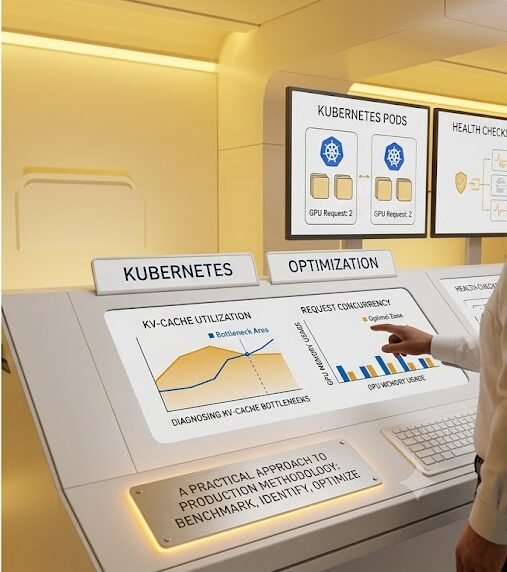
One of the most common challenges in large-context inference is KV-cache pressure.
If requests contain long prompts or remain active for extended generation periods, the cache can grow significantly.
When cache capacity becomes constrained, the serving system may need to limit concurrency or make scheduling decisions that reduce overall throughput.
A practical troubleshooting process begins by correlating:
- Request concurrency
- Input sequence length
- Output sequence length
- GPU memory usage
- KV-cache utilization
- Request latency
- Tokens processed per second
If latency increases sharply as concurrency increases, while GPU memory approaches its limit, cache pressure may be one of the primary bottlenecks.
The solution may involve reducing maximum context length, adjusting concurrency, improving memory utilization, or increasing available GPU memory.
The correct decision depends on application requirements.
Diagnosing Throughput Bottlenecks
When throughput is lower than expected, GPU utilization is an important starting point.
Low GPU utilization can indicate that the workload is CPU-bound, network-bound, scheduling-bound, or simply receiving insufficient concurrent work.
High GPU utilization with poor throughput can indicate a compute-intensive workload, inefficient model configuration, excessive communication overhead, or an unfavorable parallelism strategy.
The investigation should therefore consider the complete request path.
It is useful to separate the inference process into stages:
Request arrival → tokenization → scheduling → prefill → decoding → response transmission
Different stages can become bottlenecks under different workloads.
For example, long prompts may place greater pressure on the prefill phase, while long generated responses may make decoding the dominant cost.
This distinction is important because optimizing the wrong stage may produce little improvement.
Prefill and Decode Behavior
Language-model inference can broadly be understood as two phases.
During prefill, the system processes the input prompt and builds the state required for generation.
During decode, the model generates output tokens sequentially.
These phases have different performance characteristics.
A workload with extremely long prompts may spend considerable computational resources during prefill.
A workload producing long answers may spend much more time in decode.
Understanding this difference helps engineers select appropriate benchmarks and interpret performance results.
For example, optimizing a system for short prompts and short answers does not guarantee good performance when the same deployment is exposed to long-context enterprise workloads.
Real production traffic must therefore be represented in performance testing.
Reliability and Operational Considerations
Performance is only one part of production readiness.
An inference service must also recover gracefully from failures.
Kubernetes can restart unhealthy workloads, reschedule workloads when nodes become unavailable, and provide mechanisms for controlled deployments.
Health checks should distinguish between a service that is temporarily initializing and one that is genuinely unhealthy.
Large model loading can take significant time, so readiness behavior must be configured carefully.
A workload should not receive production traffic before the model is fully initialized.
Logging and metrics are equally important.
Operational teams should be able to determine:
- Which model version is running
- Which GPU resources are allocated
- How much memory is being used
- How many requests are active
- How long requests are waiting
- How long generation takes
- Whether errors are increasing
- Whether performance changes after deployment
Without these signals, diagnosing production issues becomes significantly harder.
Cost Optimization
GPU infrastructure is expensive, which makes utilization a major business consideration.
If a GPU spends much of its time idle, the organization is paying for capacity that is not being converted into useful inference.
On the other hand, aggressively increasing concurrency can cause latency and memory problems.
The objective is therefore to find the operating point that provides the required service quality at an acceptable infrastructure cost.
This requires measuring performance at different concurrency levels and identifying the point where additional load produces diminishing returns.
Sometimes adding another GPU can be more economical than attempting to squeeze additional throughput from an overloaded deployment.
In other situations, better scheduling and memory management can increase capacity without additional hardware.
A Practical Production Methodology
At CnEL India, a structured methodology for this type of infrastructure can be summarized into several stages.
1. Understand the workload
Identify model size, context length, expected concurrency, request patterns, latency requirements, and output characteristics.
2. Select the GPU configuration
Determine how much memory and compute capacity are required and whether a single GPU is sufficient.
3. Configure parallel execution
For models requiring multiple GPUs, determine an appropriate parallelism strategy based on model requirements and hardware topology.
4. Deploy through Kubernetes
Define resource requirements, scheduling rules, health checks, and deployment configuration.
5. Benchmark realistic traffic
Test different concurrency levels and representative prompt and response lengths.
6. Identify bottlenecks
Correlate latency, throughput, GPU utilization, memory consumption, and cache behavior.
7. Optimize
Adjust batching, concurrency, memory limits, context limits, and GPU allocation based on measured results.
8. Validate reliability
Test restarts, node failures, deployment updates, and high-load conditions.
9. Monitor continuously
Production optimization is not a one-time activity. Traffic patterns and model workloads change over time.
Conclusion
Production large language model inference is an infrastructure engineering problem as much as it is a machine-learning problem.
A successful deployment requires more than loading a model onto a GPU. Engineers need to understand how GPU memory, KV-cache capacity, request scheduling, batching, parallel execution, Kubernetes resource management, latency, and throughput interact.
Distributed inference can make very large models practical, but additional GPUs introduce communication and scheduling considerations. Similarly, increasing concurrency can improve throughput until memory pressure or latency becomes the limiting factor.
The most reliable approach is therefore measurement-driven.
Rather than assuming that a particular GPU configuration or parallelism strategy will be optimal, production teams should benchmark realistic workloads, identify the actual bottleneck, make targeted changes, and measure the result again.
This approach creates an inference platform that is not only capable of serving large models but is also predictable, observable, scalable, and economically sustainable.
For organizations deploying AI applications at scale, these engineering principles provide the foundation for turning experimental model serving into a dependable production service.