
Case Study by CnEL India
Introduction
Modern product marketing increasingly depends on high-quality visual content. Businesses need product images for websites, advertisements, social media, marketplaces, promotional campaigns, and brand communication. Traditionally, producing these visuals requires photographers, designers, image editors, and repeated manual adjustments.
Generative AI has changed this process by allowing product visuals to be created and adapted much faster. However, simply generating an image from a text description is not enough for professional production. Businesses need consistency, control, repeatability, and brand alignment.
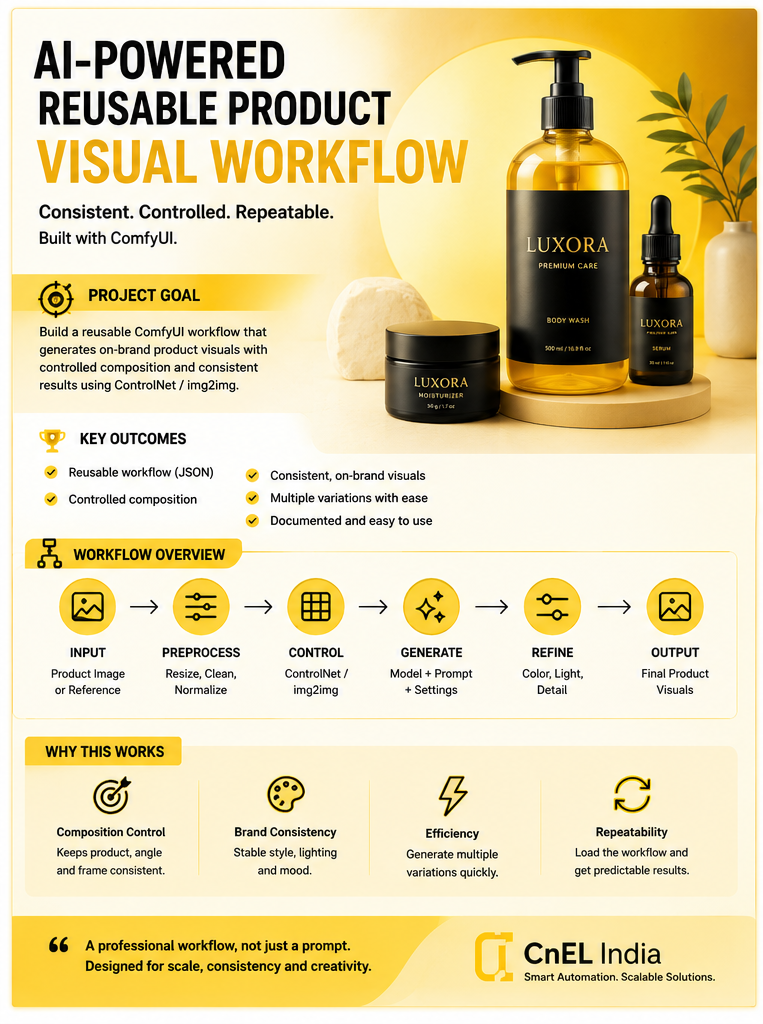
CnEL India approached this challenge by developing a reusable AI-powered visual production workflow capable of generating multiple product visuals while maintaining control over composition, product positioning, style, lighting, and overall brand appearance.
The objective was to create a workflow rather than a collection of individual prompts. The final system needed to be reusable by another operator, capable of producing consistent outputs, and flexible enough to generate different visual variations without rebuilding the process from scratch.
Project Background
The requirement came from a research-oriented environment focused on understanding how professionals interact with creative and technical software.
The assignment was designed as a realistic production exercise rather than a theoretical experiment.
The primary challenge was to create a visual generation workflow that could:
- Generate professional product visuals
- Maintain a defined visual style
- Control composition
- Preserve important product characteristics
- Produce multiple variations
- Remain reusable
- Provide predictable results
- Allow another user to operate the workflow
- Document the configuration and decisions
The project also required the development process itself to remain transparent.
Instead of simply delivering finished images, the workflow needed to demonstrate how a professional approaches experimentation, problem-solving, iteration, and visual refinement.
Understanding the Challenge
Generative image systems can produce impressive results, but they can also introduce unwanted changes.
For example, when generating a product image, the system may unintentionally alter:
- Product proportions
- Shape
- Position
- Perspective
- Packaging details
- Labels
- Background relationships
- Lighting
- Shadows
A single successful image does not necessarily mean the process is reliable.
If a business needs six, twenty, or hundreds of product images, manually recreating every image would eliminate many of the productivity benefits of AI.
Therefore, the central requirement was repeatability.
The workflow needed to preserve important visual characteristics while allowing controlled changes to the environment and creative direction.
Project Objectives
CnEL India’s solution focused on several core objectives:
- Build a reusable visual generation workflow.
- Establish a consistent product-focused visual style.
- Maintain control over composition.
- Generate multiple visual variations.
- Reduce dependence on manual image editing.
- Create a workflow that another person could load and operate.
- Document the configuration and creative decisions.
- Demonstrate the workflow through multiple final outputs.
The project was intentionally designed around practical usability rather than simply demonstrating AI image generation.
Product Selection and Visual Direction
The first step was to select a product and define its desired visual identity.
A product can be presented in many different ways depending on the brand.
For example, a premium product may require:
- Minimal backgrounds
- Controlled lighting
- Elegant composition
- Subtle shadows
- Clean surfaces
A lifestyle product may instead require:
- Environmental backgrounds
- Human interaction
- Natural lighting
- Contextual objects
- More dynamic compositions
CnEL India established a clear visual direction before building the workflow.
This was important because the workflow needed to produce outputs that belonged to the same visual family.
Workflow Architecture
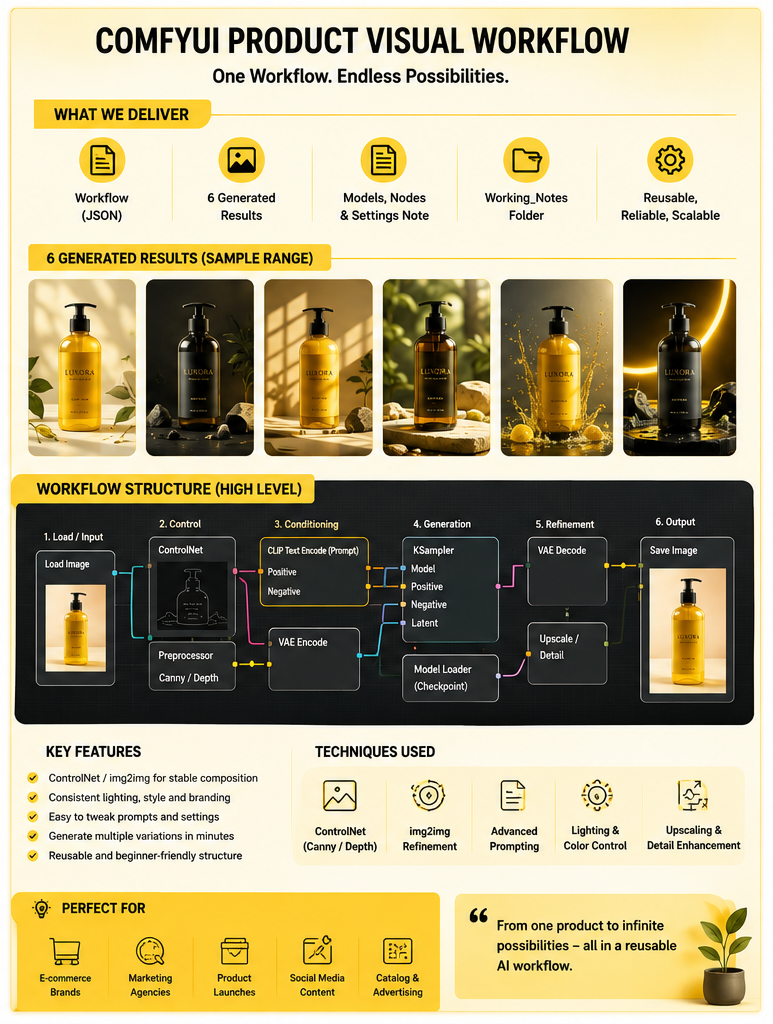
The core system was structured as a connected visual processing pipeline.
A simplified concept was:
Input Product → Image Preparation → Composition Control → Visual Generation → Refinement → Output
Each stage performed a specific function.
This modular approach made it easier to understand where changes were required when an output was not satisfactory.
Instead of treating the entire generation process as a single operation, the workflow provided multiple points of control.
Composition Control
One of the most important challenges was maintaining composition.
For professional product visuals, the product often needs to remain in a particular position or orientation.
For example, a brand may require:
- Product centered in frame
- Product positioned on the right
- Specific camera angle
- Defined amount of negative space
- Consistent product scale
Composition-control techniques were incorporated into the workflow to help preserve these relationships.
This made it possible to change the visual environment while keeping the main product composition relatively stable.
Controlled Image Transformation
The workflow also incorporated image-based transformation techniques.
Instead of generating every image entirely from scratch, an existing visual reference could guide the generation process.
This allowed the workflow to retain important characteristics of the original composition while changing elements such as:
- Background
- Lighting
- Atmosphere
- Surface
- Color environment
- Supporting visual elements
This approach was particularly valuable for commercial product photography because it reduced unpredictable changes.
Prompt and Workflow Iteration
One of the most important parts of the project was understanding when to modify the textual instruction and when to modify the workflow itself.
If an image was nearly correct, the first question was whether the problem came from the description or from the underlying generation structure.
For example, if the composition was correct but the atmosphere was wrong, modifying the visual instruction could be sufficient.
However, if the product position, structural relationship, or image-control mechanism was incorrect, changing the workflow itself would be more appropriate.
This distinction helped prevent unnecessary experimentation.
Visual Refinement
Initial outputs were treated as iterations rather than final results.
Each generation was evaluated for:
- Product accuracy
- Composition
- Lighting
- Background quality
- Visual balance
- Brand consistency
- Realism
- Unwanted artifacts
The workflow was then adjusted where necessary.
This iterative approach reflects how professional creative production works: generate, evaluate, identify the problem, make a targeted adjustment, and regenerate.
Creating a Reusable System
A major distinction between this project and a one-off image generation task was reusability.
The workflow was organized so that another person could load it and understand its structure.
Reusable elements included:
- Input configuration
- Image-processing stages
- Composition controls
- Generation parameters
- Refinement stages
- Output settings
This reduced the dependency on the original creator.
A well-designed workflow should allow another operator to reproduce the process without needing to understand every experimental decision made during development.
Six-Output Validation
The workflow was validated by producing six different results.
The purpose was not simply to demonstrate six attractive images.
The outputs needed to show that the workflow could operate across multiple visual variations while maintaining the intended identity.
The results could vary in:
- Background environment
- Lighting
- Product setting
- Composition variations
- Creative atmosphere
- Supporting elements
At the same time, the product itself needed to remain visually coherent.
This demonstrated that the workflow had practical range rather than being optimized for a single successful image.
Documentation
Documentation was another important deliverable.
CnEL India structured documentation around the major elements required to reproduce the workflow.
The documentation explained:
- Models used
- Processing stages
- Important settings
- Composition approach
- Image references
- Creative decisions
- Output considerations
This ensures that the project remains useful after delivery.
Without documentation, a complex visual workflow can become difficult for another team member to maintain.
Working Notes and Research
The development process also included supporting materials.
These could include:
- Visual references
- Preliminary sketches
- Test outputs
- Experimental configurations
- Notes about unsuccessful attempts
- Refinement decisions
Keeping these materials is valuable because failed experiments can reveal why a particular approach was abandoned.
For research-oriented projects, the process itself can be as useful as the final output.
Reliability and Repeatability
The biggest business value of the solution comes from repeatability.
Consider a company that needs 50 product visuals.
A traditional approach might require separate creative work for every image.
A reusable workflow can instead provide a standardized foundation.
The operator can modify controlled parameters and produce new variations while maintaining the same overall production methodology.
This can significantly improve:
- Production speed
- Creative consistency
- Team collaboration
- Workflow standardization
- Scalability
Brand Consistency
For commercial businesses, visual consistency is critical.
Customers should be able to recognize that multiple product images belong to the same brand.
A reusable workflow can establish common characteristics such as:
- Lighting direction
- Image composition
- Background treatment
- Product presentation
- Visual atmosphere
- Overall aesthetic
This prevents every new product image from looking like it was created using an unrelated creative style.
Practical Applications
The workflow can be adapted for multiple business applications.
E-Commerce
Generate product imagery for online stores and marketplaces.
Advertising
Create campaign variations for different audiences and placements.
Social Media
Produce visually consistent promotional content.
Product Launches
Create multiple visual concepts before a product enters the market.
Catalog Production
Generate standardized product images across large inventories.
Brand Campaigns
Maintain a recognizable visual identity across campaigns.
Creative Prototyping
Test different visual directions before investing in traditional production.
Efficiency Improvements
One of the main advantages of the system is reduced repetitive work.
A designer does not need to rebuild the entire image-generation process for every variation.
Instead, the reusable structure provides a foundation from which new outputs can be generated.
This allows creative professionals to spend more time on:
- Art direction
- Brand strategy
- Visual selection
- Campaign concepts
- Quality evaluation
rather than repeatedly rebuilding technical workflows.
Quality Assurance
CnEL India incorporated quality checks into the production process.
Each output could be evaluated against a defined checklist:
Product Quality
Does the product remain recognizable and visually accurate?
Composition
Is the product positioned correctly?
Visual Quality
Are lighting, shadows, and perspective believable?
Brand Alignment
Does the image follow the intended aesthetic?
Technical Quality
Is the output suitable for its intended use?
Consistency
Does the image belong to the same visual family as the other outputs?
This structured evaluation improves reliability.
Human Creativity and AI Assistance
The objective of the workflow was not to eliminate creative professionals.
Instead, it was designed to provide them with a repeatable production framework.
Human expertise remains important for:
- Selecting visual direction
- Evaluating outputs
- Understanding brand requirements
- Choosing references
- Making creative decisions
The automated workflow handles much of the repetitive generation and transformation process.
This creates a collaboration between creative judgment and automated production.
Scalability
Although the initial assignment focused on a single product and style, the architecture can support broader use.
A future implementation could include multiple workflow presets for:
- Different brands
- Different products
- Different campaign styles
- Different image formats
- Different advertising requirements
The same underlying methodology could then support a larger production operation.
Expected Business Benefits
A successful reusable visual workflow can provide several measurable advantages.
Faster Production
Multiple visual variations can be created more efficiently.
Consistent Branding
Products maintain a unified visual identity.
Lower Production Overhead
Less repetitive manual work is required.
Better Creative Experimentation
Teams can test multiple concepts quickly.
Easier Collaboration
A standardized workflow can be shared between team members.
Improved Scalability
The process can support larger product catalogs and campaign requirements.
Knowledge Preservation
The documented workflow captures the production methodology instead of keeping it only in one person’s experience.
Future Opportunities
The initial workflow can serve as the foundation for a broader AI-powered creative production system.
Future improvements could include:
- Automated product-image batches
- Multiple predefined brand styles
- Automatic image resizing
- Campaign-specific presets
- Background variation libraries
- Automated quality checks
- Product catalog integration
- Approval workflows
- Centralized asset management
- Large-scale visual production
These capabilities could transform the workflow from a single creative process into a complete product-content production system.
Conclusion
This case study demonstrates how CnEL India can develop a reusable AI-powered product visualization workflow rather than relying on isolated image-generation prompts.
The key achievement is repeatability.
The workflow provides structured control over product composition, visual style, transformation, refinement, and output generation. By validating the process across six different results, the system demonstrates that it can produce varied visuals while maintaining a consistent creative direction.
The project also highlights the importance of experimentation. Not every generation will be successful, and professional AI-assisted creative work requires the ability to identify whether a problem comes from the visual instruction, the workflow structure, the source image, or the generation settings.
By documenting the final configuration and preserving working notes, CnEL India creates a solution that can be understood and reused by other professionals.
Ultimately, the workflow provides a scalable foundation for faster product visualization, consistent brand presentation, creative experimentation, and repeatable commercial image production. It can be extended beyond the initial demonstration to support e-commerce catalogs, advertising campaigns, social media content, product launches, and large-scale visual production across different industries.