
Case Study by CnEL India
Introduction
Preparing for a professional examination such as the Indian Patent Agent Examination requires more than simply reading large volumes of legal material. Aspirants need to understand complex provisions, remember important concepts, practice different question formats, revise regularly, and evaluate their progress over time.
Traditional preparation methods often depend on books, lengthy notes, static question banks, and manually maintained study schedules. While these resources can contain valuable information, they do not always provide the engagement, feedback, and consistency required for effective long-term learning.
CnEL India can address this challenge by developing a gamified learning website specifically designed for Patent Agent Examination aspirants in India. The proposed platform would combine structured legal learning with short content modules, interactive questions, progress tracking, achievement systems, learning streaks, and competitive elements.
The objective is not to create a large enterprise-level education platform immediately. Instead, the project would begin with a focused Minimum Viable Product (MVP) containing the most important learning and engagement features. This allows the concept to be launched quickly, tested with real learners, and improved based on actual usage.
Understanding the Business Requirement
The proposed platform is intended for students preparing for the Patent Agent Examination.
The customer already has the educational content and question material. The primary requirement is therefore to transform this information into an engaging digital learning experience.
The platform needs to make legal learning:
- Simple
- Structured
- Interactive
- Motivating
- Mobile-friendly
- Easy to revise
- Measurable
- Gamified
Instead of presenting the Patent Act as a long static document, the platform would break the material into smaller learning experiences.
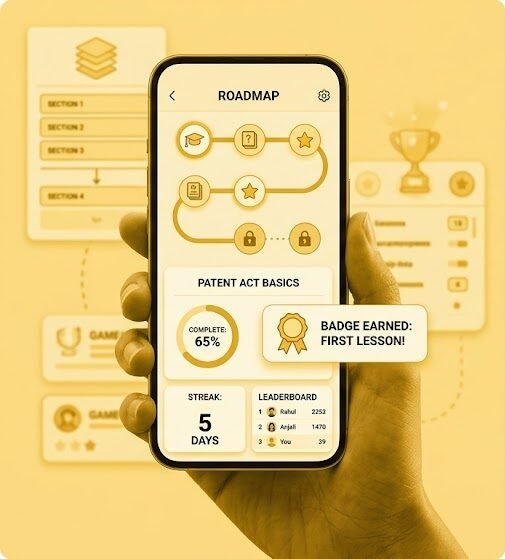
For example, a learner could log in, see their current position on a learning roadmap, complete a short lesson, answer several questions, receive an immediate score, earn progress points, and return later to continue from the same location.
This creates a continuous learning cycle.
Project Objectives
The primary objective is to create a functional and visually engaging MVP that encourages consistent preparation.
The major objectives include:
- User registration and login
- Learner profiles
- Structured learning roadmap
- Patent Act learning modules
- Interactive question sets
- Multiple question formats
- Instant results
- Score tracking
- Progress tracking
- Achievement badges
- Learning streaks
- Basic leaderboard
- Responsive design
- Easy content management
- Expandable architecture
The platform should remain simple enough for an MVP while establishing a strong foundation for future expansion.
Product Vision
The overall experience would follow the principles of modern gamified learning platforms.
When a student logs in, they should immediately understand:
Where am I?
What should I learn next?
How much have I completed?
How well am I performing?
What can I achieve next?
The interface should therefore prioritize clarity over complexity.
Instead of displaying dozens of menus and options, the dashboard could present a visual learning journey.
For example:
Patent Agent Preparation
→ Foundation
→ Patent Act Basics
→ Selected Sections
→ Practice Zone
→ Revision
→ Mock Challenges
Each completed stage would unlock further progress.
User Registration and Profile
The first component of the platform would allow learners to create an account.
A basic profile could contain:
- Name
- Password
- Learning progress
- Completed modules
- Scores
- Achievements
- Current streak
- Leaderboard position
The profile becomes the learner’s personal learning record.
This is important because gamification depends on continuity. Students should be able to leave the platform and return later without losing their progress.
Gamified Learning Roadmap
The roadmap would be one of the most important visual components.
Rather than presenting the Patent Act as a traditional list of chapters, the platform could represent learning as a sequence of milestones.
Each milestone can display:
- Section name
- Completion status
- Score
- Number of questions
- Recommended next step
Completed lessons could visually indicate progress, while upcoming lessons could remain locked until prerequisite material has been completed.
This creates a sense of progression and achievement.
Learning Modules
The MVP would initially contain approximately two or three Patent Act sections.
Each section would be divided into smaller learning modules.
A typical module could include:
1. Concept Introduction
A concise explanation of the legal concept.
2. Important Points
Key provisions summarized for quick understanding.
3. Examples
Practical examples that make the concept easier to understand.
4. Quick Revision
Important facts presented in a compact format.
5. Practice Questions
Questions designed to reinforce the material.
This structure reduces cognitive overload compared with presenting long blocks of legal text.
Interactive Question System
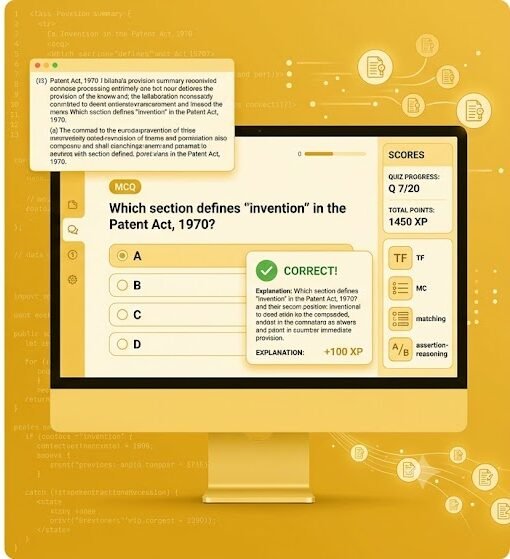
Practice questions would form the core of the learning experience.
The platform should support several question formats requested for the MVP.
True or False
Students determine whether a statement is correct.
Multiple Choice
Students select the correct answer from multiple options.
Assertion and Reasoning
Students evaluate a statement and its supporting reasoning.
Matching
Students connect related legal concepts, provisions, terms, or explanations.
Memory-Based Questions
Questions test important factual information.
Case-Law-Based Questions
Students apply legal principles to practical situations.
Different question formats prevent repetitive learning patterns and provide broader examination preparation.
Immediate Feedback
After answering a question, the learner should receive immediate feedback.
The system can display:
- Correct or incorrect result
- Correct answer
- Explanation
- Score earned
- Progress update
This makes mistakes useful rather than discouraging.
A learner who answers incorrectly should understand why the answer was wrong and have an opportunity to revise the underlying concept.
Score and Progress Tracking
The platform would maintain a record of learner performance.
Possible metrics include:
- Questions attempted
- Correct answers
- Incorrect answers
- Accuracy percentage
- Completed sections
- Overall progress
- Best score
- Recent performance
A visual progress indicator can show how far the learner has progressed through the curriculum.
This provides motivation and helps learners identify weak areas.
Achievement Badges
Gamification becomes more effective when students receive recognition for meaningful accomplishments.
The platform could provide badges such as:
- First Lesson Completed
- First Quiz Completed
- Perfect Score
- Five-Day Learner
- Section Master
- Practice Champion
- Consistency Award
Badges should reward useful learning behavior rather than simply encouraging students to click through content.
Learning Streaks
Learning streaks encourage regular study habits.
For example, a learner who completes at least one learning activity each day can maintain a streak.
The dashboard might show:
Current Streak: 7 Days
This simple mechanism encourages students to return regularly.
For examination preparation, consistency is particularly valuable because students often struggle with maintaining a long-term study schedule.
Leaderboard
The MVP would also include a basic leaderboard.
The leaderboard could rank learners based on carefully selected performance indicators such as:
- Completed learning activities
- Quiz performance
- Consistency
- Achievement points
The objective should be healthy competition rather than creating excessive pressure.
The leaderboard can encourage students to continue practicing and improve their performance.
Mobile-First Experience
Because many learners study using smartphones, mobile responsiveness is essential.
The platform should work effectively across:
- Smartphones
- Tablets
- Laptops
- Desktop computers
Important mobile considerations include:
- Large touch-friendly controls
- Easy navigation
- Readable legal content
- Fast page transitions
- Compact question layouts
- Accessible progress indicators
The learning experience should not feel like a desktop website squeezed onto a phone.
Simple Content Management
The client should be able to expand the platform without requiring developers for every new question.
The MVP should therefore include an easy content-management mechanism.
Authorized administrators should be able to add:
- New sections
- Lessons
- Questions
- Answer choices
- Explanations
- Categories
- Difficulty levels
This becomes particularly important when the platform moves beyond the initial two or three sections.
Admin Workflow
A simple administrative interface can provide visibility into the learning system.
Administrators could manage:
- Users
- Learning sections
- Questions
- Answers
- Explanations
- Badges
- Progress information
The system can also provide basic usage information to help identify which learning materials students are using most frequently.
Future Expansion
Although the initial project is intentionally limited to an MVP, the architecture should allow additional features to be introduced later.
Potential future capabilities include:
Flashcards
Students can quickly revise important legal concepts.
Timed Challenges
Learners can practice answering questions under examination-style time pressure.
Peer Competitions
Students can compete in structured learning challenges.
Collaboration
Learners can participate in educational activities together.
Discussion Forum
Students can discuss difficult concepts and questions.
Comparison Modules
Visual comparisons can explain amendments, legal provisions, and related concepts.
Premium Access
Future versions can introduce paid learning plans and subscription-based access.
Technical Architecture Approach
CnEL India would recommend a practical and cost-conscious architecture for the MVP.
The implementation should prioritize:
- Fast development
- Easy maintenance
- Responsive performance
- Secure user accounts
- Structured data storage
- Expandability
- Affordable hosting
- Simple administration
The architecture should avoid unnecessary complexity because the client has specifically requested a lean MVP rather than an enterprise application.
The initial version should be designed so that future features can be added without rebuilding the entire platform.
Security and User Data
Even a learning platform requires appropriate security.
The system should protect:
- User accounts
- Passwords
- Learning records
- Scores
- Administrative access
- Content management functions
Administrative features should be restricted to authorized users.
User information should also be handled responsibly with appropriate access controls.
Testing and Quality Assurance
Before launch, CnEL India would test the platform across multiple areas.
Functional Testing
Verifying registration, login, lessons, quizzes, scores, badges, and progress.
Question Testing
Ensuring correct answers and explanations are displayed accurately.
Progress Testing
Confirming that completed lessons and scores are recorded correctly.
Gamification Testing
Checking badges, streaks, and leaderboard calculations.
Responsive Testing
Testing different screen sizes.
Usability Testing
Ensuring students can navigate the learning roadmap without confusion.
Performance Testing
Checking that pages and questions load quickly.
This testing is particularly important because incorrect scoring or progress tracking could damage user trust.
Expected Business Benefits
A successful implementation can provide significant benefits for the education business.
Better Student Engagement
Gamification makes preparation more interactive.
Improved Learning Consistency
Streaks and progress indicators encourage regular study.
Better Knowledge Retention
Short modules combined with practice reinforce important concepts.
Measurable Performance
Students can see their scores and identify weak areas.
Scalable Content
The platform can gradually expand beyond the initial Patent Act sections.
Reduced Manual Management
An administrator can add content without depending heavily on technical teams.
Stronger Product Differentiation
A gamified Patent Agent preparation platform can offer a more engaging experience than traditional static study materials.
MVP Implementation Strategy
Because the budget is limited to approximately ₹25,000–₹30,000, CnEL India would keep the first release tightly focused.
The MVP would prioritize:
- User registration and login
- Learner profile
- Learning roadmap
- Two to three Patent Act sections
- Interactive question system
- Multiple question formats
- Score tracking
- Progress tracking
- Badges
- Learning streaks
- Basic leaderboard
- Responsive interface
- Simple content administration
Features such as discussion forums, advanced competitions, subscriptions, flashcards, and complex analytics should remain outside the initial scope.
This prevents budget and timeline overruns.
Development and Launch Approach
CnEL India would approach the project in focused phases.
Phase 1 – Product Structure
Define the learner journey, roadmap, screens, navigation, and content structure.
Phase 2 – Core Learning System
Develop user accounts, learning modules, questions, scoring, and progress tracking.
Phase 3 – Gamification
Introduce badges, streaks, achievements, and leaderboard functionality.
Phase 4 – Administration
Create the mechanism for adding and managing educational content.
Phase 5 – Testing
Perform functional, responsive, usability, and performance testing.
Phase 6 – Launch
Deploy the MVP and monitor initial learner feedback.
This approach allows the client to begin validating the concept quickly.
Why CnEL India
CnEL India approaches this project as a product-development challenge rather than simply building a collection of web pages.
The objective is to understand how students learn, how examination preparation can be structured, and how gamification can encourage consistent engagement.
The platform would therefore combine:
- Clean user experience
- Structured learning
- Interactive assessments
- Progress visualization
- Gamification
- Content management
- Responsive design
- Scalable architecture
The MVP remains intentionally lean while providing a strong foundation for future development.
Conclusion
This case study demonstrates how CnEL India can transform traditional Patent Agent Examination preparation into a modern, interactive, and gamified learning experience.
Instead of asking students to navigate large volumes of static legal material, the platform divides preparation into manageable learning modules and connects them through a visual roadmap. Interactive questions provide immediate feedback, while scores, badges, streaks, and leaderboards encourage continued participation.
The initial MVP would focus on a limited number of Patent Act sections, allowing the business to launch quickly, validate student interest, collect feedback, and understand which features create the greatest learning value.
Once the concept is validated, the platform can gradually expand with flashcards, timed challenges, peer competitions, discussion features, amendment comparisons, premium access, and additional examination content.
The result is a scalable digital learning platform designed to make Patent Agent Examination preparation simpler, more engaging, measurable, and motivating while giving the education business a strong foundation for future growth.