
Case Study by CnEL India
Introduction
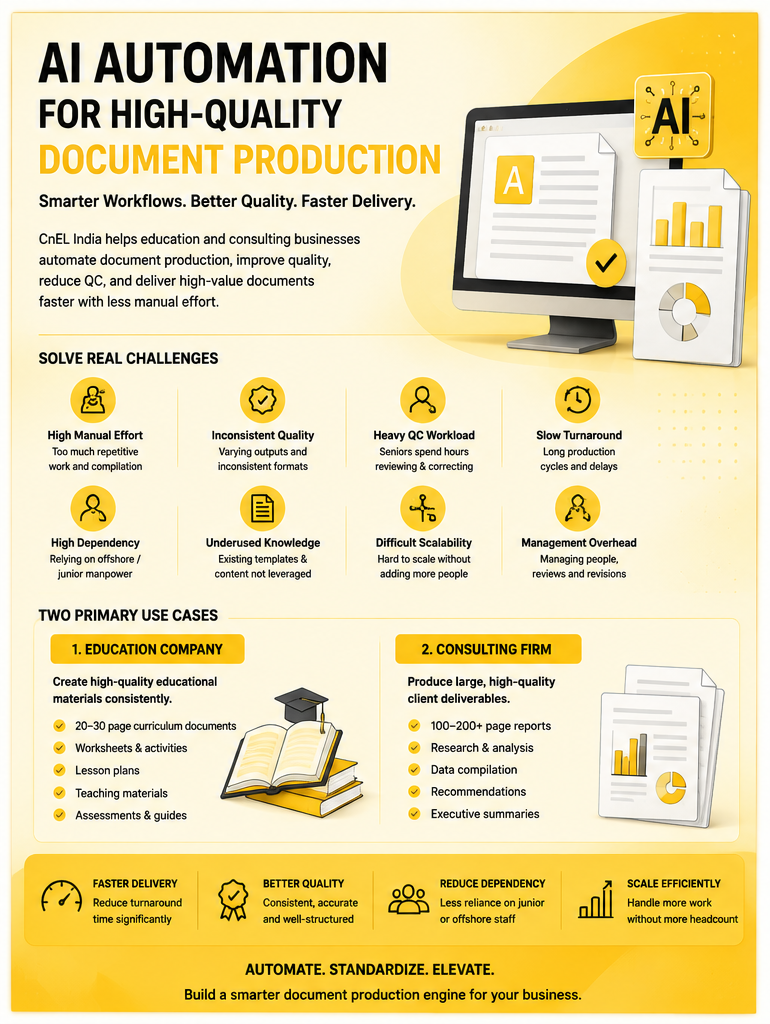
Many organizations depend heavily on teams of junior employees, offshore staff, researchers, writers, and quality-control professionals to produce large volumes of business and educational documents. While this traditional approach can be cost-effective, it often creates challenges related to consistency, production speed, quality assurance, repetitive manual work, and management overhead.
The challenge becomes even greater when documents are long and complex. An educational organization may need to produce 20–30 page curriculum documents, worksheets, lesson plans, and teaching materials on a regular basis. Similarly, a consulting organization may need to produce reports of 100–200 pages or more that require research, analysis, writing, compilation, formatting, and multiple rounds of review.
CnEL India can address this challenge by developing an intelligent document production and automation system that combines company knowledge, structured workflows, document generation, research, quality control, formatting, and human review into one scalable process.
The objective is not simply to generate text automatically. The real objective is to create a practical production system capable of understanding source information, following established methodologies, producing professionally structured documents, checking its own output, and reducing the amount of repetitive work performed by junior teams.
This case study explains how CnEL India can design such a system for two different industries while keeping the underlying architecture flexible enough to support dozens of future clients.
Business Challenge
The organizations described in this project already have functioning production processes. Their problem is not a lack of employees or content.
The problem is that too much human effort is required to turn existing knowledge into finished documents.
A typical workflow may involve:
- Receiving source information
- Reviewing previous documents
- Conducting research
- Creating an outline
- Writing individual sections
- Collecting supporting information
- Formatting the document
- Reviewing the content
- Correcting inconsistencies
- Performing quality checks
- Making revisions
- Producing the final document
For large reports, this process can involve several employees and multiple rounds of senior review.
The result is higher production costs, longer turnaround times, and significant management overhead.
CnEL India’s solution focuses on improving the entire workflow rather than automating only one individual step.
Project Objectives
The primary objective is to create a reusable AI-powered document production framework capable of producing high-quality, industry-specific documents.
The system should:
- Reduce manual document production
- Improve content consistency
- Reduce repetitive research work
- Use existing company knowledge
- Follow organizational methodologies
- Reuse approved templates
- Reduce quality-control workload
- Improve document formatting
- Increase production speed
- Support human review
- Maintain traceability
- Adapt to different industries
- Scale across multiple clients
The ultimate goal is to transform document production from a largely manual operation into an intelligent, repeatable workflow.
Use Case 1 – Education Company
The first application focuses on an education organization that regularly produces detailed learning materials.
These may include:
- Curriculum documents
- Worksheets
- Lesson plans
- Teaching guides
- Learning activities
- Assessment materials
- Instructor resources
- Student exercises
- Supporting educational documentation
A typical curriculum document may contain 20–30 pages and require careful organization, appropriate educational progression, consistent terminology, and professional formatting.
Education Content Production Workflow
CnEL India can structure the education workflow around a series of automated stages.
Stage 1: Requirements
The system receives information such as:
- Subject
- Grade level
- Learning objectives
- Course duration
- Teaching methodology
- Required topics
- Student level
- Existing curriculum
Stage 2: Knowledge Retrieval
Relevant approved educational materials are identified from the organization’s existing knowledge base.
This can include:
- Previous curriculum
- Existing lesson plans
- Teaching methodologies
- Internal guidelines
- Approved examples
- Educational standards
Stage 3: Curriculum Structure
The system creates a structured curriculum outline before generating the complete document.
This allows the organization to review the overall structure before significant production work takes place.
Stage 4: Content Generation
Individual sections are developed according to the approved structure.
The system can produce:
- Learning objectives
- Lesson explanations
- Activities
- Exercises
- Assessments
- Teacher instructions
- Student assignments
Stage 5: Quality Review
The generated document is evaluated against predefined educational and formatting requirements.
Education Quality Control
Quality control is particularly important in educational documents.
The system can check:
- Learning objective alignment
- Grade-level suitability
- Repetition
- Missing sections
- Inconsistent terminology
- Formatting consistency
- Instruction clarity
- Assessment alignment
- Content completeness
Instead of replacing human educators entirely, the system acts as a first-level quality reviewer.
Senior staff can then focus on higher-value educational decisions.
Use Case 2 – Consulting Firm
The second application involves a consulting organization producing large client deliverables.
These reports may exceed 100–200 pages and typically contain:
- Research
- Market analysis
- Business analysis
- Client information
- Recommendations
- Supporting evidence
- Charts and tables
- Executive summaries
- Appendices
These projects often require substantial involvement from junior analysts and consultants.
Senior consultants subsequently spend considerable time reviewing and correcting the work.
CnEL India’s approach is to reduce the amount of manual production required while keeping senior professionals in control of important decisions.
Consulting Document Workflow
A consulting workflow can be divided into several controlled stages.
1. Client Brief
The system receives the initial project requirements.
This may include:
- Business objectives
- Industry
- Target market
- Research questions
- Deliverable requirements
- Existing client materials
2. Source Material Collection
Relevant internal and client-provided materials are organized into a structured knowledge environment.
3. Research Planning
The system identifies the information required to answer the project’s questions.
4. Research and Synthesis
Relevant information is collected, organized, compared, and synthesized into structured findings.
5. Report Architecture
Before generating hundreds of pages, the system establishes:
- Report structure
- Chapters
- Sections
- Key arguments
- Supporting evidence
- Recommendations
6. Draft Production
Individual sections are generated according to the approved architecture.
7. Quality Control
The entire report undergoes automated checks before human review.
8. Senior Review
Consultants review important conclusions, recommendations, and strategic decisions.
This allows senior professionals to spend less time correcting basic production problems.
Company Knowledge Integration
One of the most important components of the project is the organization’s existing knowledge.
Companies already possess significant intellectual property in the form of:
- Previous reports
- Templates
- Internal methodologies
- Research
- Brand guidelines
- Standard operating procedures
- Curriculum frameworks
- Approved terminology
- Historical projects
Instead of generating documents from generic information, CnEL India can create a structured knowledge system that allows the document workflow to reference approved internal material.
This improves consistency and reduces unnecessary recreation of existing knowledge.
Template-Based Document Production
Professional documents should not look like automatically generated text.
CnEL India can create reusable document structures that define:
- Cover pages
- Headers
- Footers
- Section hierarchy
- Typography
- Tables
- Charts
- References
- Page numbering
- Appendices
The content generation process then operates within these predefined structures.
This creates consistent, professional deliverables.
Multi-Step AI Workflow
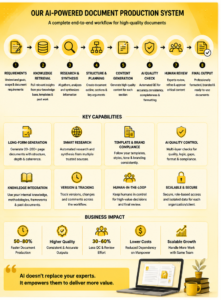
The proposed system is not based on a single prompt.
Instead, it uses multiple controlled stages.
A simplified architecture could be:
Input → Knowledge Retrieval → Planning → Research → Drafting → Review → Formatting → Quality Control → Human Approval → Final Document
Each stage has a specific responsibility.
This approach provides greater reliability than asking an AI system to create an entire 200-page report in one step.
Automated Quality Control
Quality control is one of the most valuable components of the system.
The system can automatically check:
Content Quality
- Missing information
- Contradictions
- Repetition
- Unsupported statements
- Incomplete sections
Structural Quality
- Correct section order
- Required chapters
- Consistent headings
- Appropriate document hierarchy
Formatting Quality
- Consistent styles
- Tables
- Spacing
- Page structure
- Headers and footers
Business Requirements
- Client-specific requirements
- Required terminology
- Methodology compliance
- Deliverable checklist
This creates an automated first layer of quality assurance.
Human-in-the-Loop Review
Complete automation is not always appropriate for professional documents.
CnEL India therefore recommends a human-in-the-loop approach.
Human reviewers remain responsible for:
- Strategic decisions
- Sensitive information
- Final recommendations
- Critical conclusions
- Client-specific judgments
The automated system handles repetitive production and preliminary quality checks.
This creates a balance between efficiency and professional oversight.
Proof of Concept
Because document quality is subjective and highly dependent on the organization’s requirements, CnEL India would begin with a small proof of concept.
The initial implementation could focus on one representative document from either industry.
For example:
Education:
One complete curriculum package.
Consulting:
One representative client report.
The proof of concept would measure:
- Output quality
- Production time
- Accuracy
- Formatting
- Review effort
- Consistency
- Required human intervention
Only after validating the results would the workflow be expanded.
Scalability Across Industries
A major requirement is the ability to support dozens of future clients.
CnEL India can achieve this by separating the core automation engine from industry-specific configurations.
The underlying system can remain consistent while each client receives its own:
- Knowledge base
- Templates
- Brand guidelines
- Workflow
- Methodology
- Quality rules
- Document types
- Approval process
This creates a reusable multi-client architecture.
Client-Specific Customization
An education company and a consulting company have completely different document requirements.
Therefore, the system should not force both businesses into the same workflow.
Instead, each client can have configurable production rules.
For example:
Education configuration
- Curriculum structure
- Learning objectives
- Grade-level requirements
- Lesson formats
- Assessment standards
Consulting configuration
- Research methodology
- Report structure
- Executive summary format
- Analysis framework
- Recommendation structure
This provides flexibility without rebuilding the entire platform.
Document Review Dashboard
A centralized interface can allow users to monitor document production.
Possible statuses include:
- Draft
- Researching
- Generating
- Under Review
- Revision Required
- Approved
- Finalized
Users can see which documents require attention and where they are within the workflow.
Version Control
Long documents frequently go through multiple revisions.
The system can maintain:
- Draft versions
- Review versions
- Approved versions
- Revision history
- Final versions
This reduces confusion and ensures that teams always know which document is current.
Security and Data Protection
Because consulting projects may contain confidential client information, security is a critical component.
CnEL India can implement:
- Role-based access
- Controlled document permissions
- Secure storage
- Client-level data separation
- Audit logs
- Controlled sharing
- Data retention policies
Each organization’s information should remain isolated from unrelated clients.
Testing and Validation
Before production deployment, CnEL India would test the workflow using real representative documents.
Testing would evaluate:
Accuracy
Does the system preserve important information?
Completeness
Are all required sections present?
Consistency
Does terminology remain uniform?
Formatting
Does the final document meet professional standards?
Review Effort
How much manual correction remains?
Production Speed
How much faster is the workflow compared with the existing process?
These measurements provide a clear basis for deciding whether the system should be expanded.
Expected Business Benefits
A successful implementation can provide substantial operational improvements.
Reduced Production Work
Routine writing, compilation, formatting, and organization become significantly more automated.
Faster Delivery
Documents can move through production more quickly.
Improved Consistency
Templates and structured workflows reduce variations in quality.
Lower QC Requirements
Automated checks identify many issues before senior review.
Better Knowledge Utilization
Existing company materials become reusable production assets.
Reduced Junior-Level Workload
Employees can focus on tasks that require human judgment.
Senior Consultant Efficiency
Senior professionals spend more time on strategic review instead of correcting basic production errors.
Scalable Operations
The same framework can support additional clients without proportionally increasing staff.
Why CnEL India
CnEL India approaches this project as a complete business process transformation rather than a simple content-generation implementation.
The focus is on understanding the existing workflow, identifying repetitive activities, integrating organizational knowledge, creating structured production stages, implementing automated quality control, and preserving human oversight where it adds the most value.
The solution can combine AI-driven content generation, research automation, knowledge management, document workflows, quality assurance, and professional document production into a single scalable ecosystem.
This makes the system suitable not only for the initial two businesses but also for future clients across education, consulting, professional services, research, finance, legal documentation, marketing, and other knowledge-intensive industries.
Conclusion
This case study demonstrates how CnEL India can transform high-volume document production from a labor-intensive process into an intelligent, scalable, and quality-controlled workflow.
For education companies, the solution can accelerate the creation of curriculum documents, lesson plans, worksheets, and teaching materials while maintaining educational consistency.
For consulting firms, it can streamline research, analysis, report generation, formatting, and quality review for large client deliverables.
The most important aspect is that the system is not designed simply to generate large amounts of text. It is designed to understand requirements, use existing organizational knowledge, follow established methodologies, produce structured documents, perform automated quality checks, and involve human experts where judgment is essential.
Starting with a focused proof of concept allows the business to validate actual document quality and operational savings before scaling the solution.
Once proven, the architecture can be customized for multiple industries and clients, creating a long-term document automation platform that reduces production costs, improves quality, accelerates delivery, and allows organizations to scale their knowledge-work operations without relying solely on increasing headcount.