
Case Study by CnEL India
Introduction
The rapid growth of publicly accessible chatbot platforms has created a large volume of valuable digital content, including conversation records, metadata, publicly available documentation, and structured information that organizations may wish to archive for research, analysis, compliance, knowledge management, or long-term preservation. However, publicly available information on online platforms often changes over time, making it difficult to maintain a consistent historical record without an organized retrieval and archival process.
Manual collection of publicly accessible content becomes increasingly inefficient as data volumes grow. Visiting multiple pages, copying information, organizing files, tracking updates, and synchronizing records with an internal repository consumes significant time while increasing the risk of duplicate records, missing updates, and inconsistent data organization.
CnEL India specializes in developing automated data management solutions that collect publicly accessible information responsibly, organize it into structured records, synchronize updates with private repositories, and maintain reliable archival workflows. Rather than creating a simple data collection script, the focus is on building a complete retrieval and synchronization ecosystem that emphasizes efficiency, maintainability, structured storage, and long-term scalability.
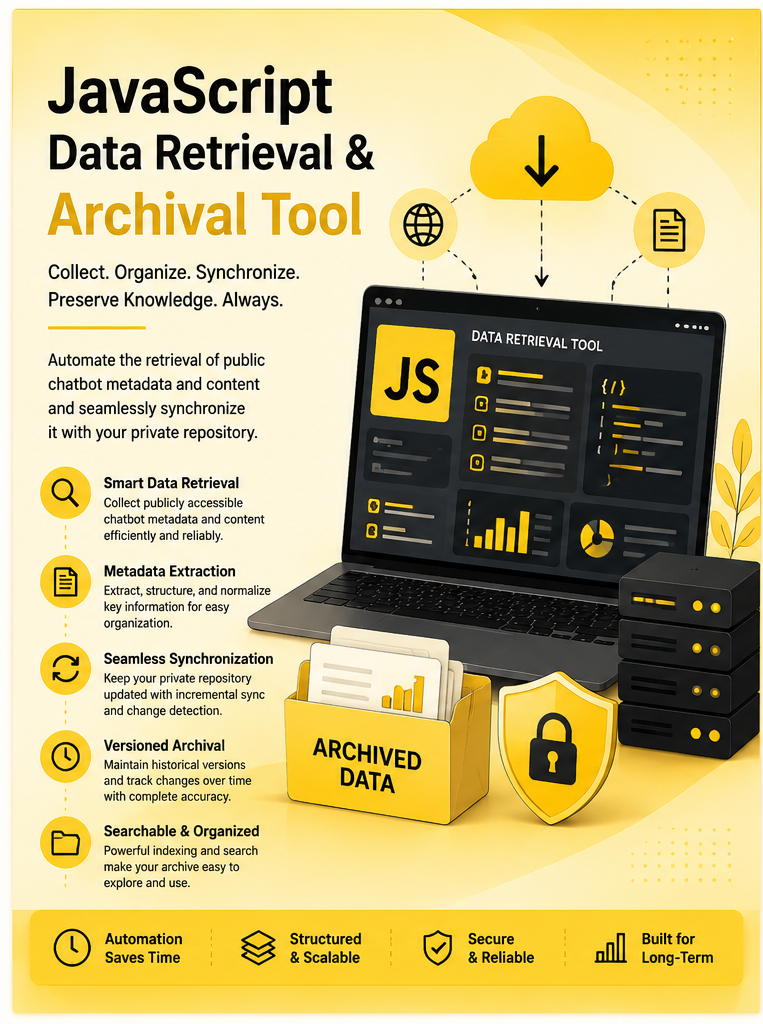
This case study explains how CnEL India designs a JavaScript-based data retrieval and archival system capable of collecting publicly accessible chatbot metadata and content while maintaining organized synchronization with a private repository under the owner’s control.
Business Background
Organizations maintaining research repositories, internal knowledge bases, or digital archives often need to preserve publicly accessible online information before it changes or disappears.
Typical challenges include:
-
Manual data collection
-
Repetitive archival work
-
Duplicate records
-
Missing updates
-
Inconsistent metadata
-
Large content volumes
-
Poor synchronization
-
Weak search capabilities
-
Version confusion
-
Limited historical tracking
-
Time-consuming organization
-
Scalability limitations
As the amount of publicly available information grows, manual workflows become increasingly unsustainable.
CnEL India addresses these challenges through intelligent retrieval and archival automation.
Project Objectives
The primary objective is to create a reliable JavaScript-based system that automatically retrieves publicly accessible chatbot metadata and content while synchronizing organized records with a private repository.
The project focuses on:
-
Public content retrieval
-
Metadata extraction
-
Content organization
-
Repository synchronization
-
Duplicate prevention
-
Version management
-
Structured storage
-
Automated workflows
-
Incremental updates
-
Search optimization
-
Scalable architecture
-
Long-term archival
The solution enables efficient preservation of publicly accessible information while minimizing manual effort.
Understanding Business Requirements
CnEL India begins by understanding the owner’s archival goals before designing the technical workflow.
Requirement analysis includes:
-
Repository structure
-
Content categories
-
Retrieval frequency
-
Metadata requirements
-
Update behavior
-
Synchronization rules
-
Storage preferences
-
Search expectations
-
Security requirements
-
Future expansion plans
This ensures that the archival system aligns with real operational needs.
Public Content Retrieval
The retrieval process focuses exclusively on information that is publicly accessible.
The system identifies publicly available content such as:
-
Public chatbot pages
-
Public metadata
-
Titles
-
Descriptions
-
Timestamps
-
Public conversation content
-
Related information
-
Public references
Only accessible information intended for public viewing is processed.
Automated Retrieval Workflow
Instead of requiring manual collection, CnEL India builds an automated retrieval pipeline.
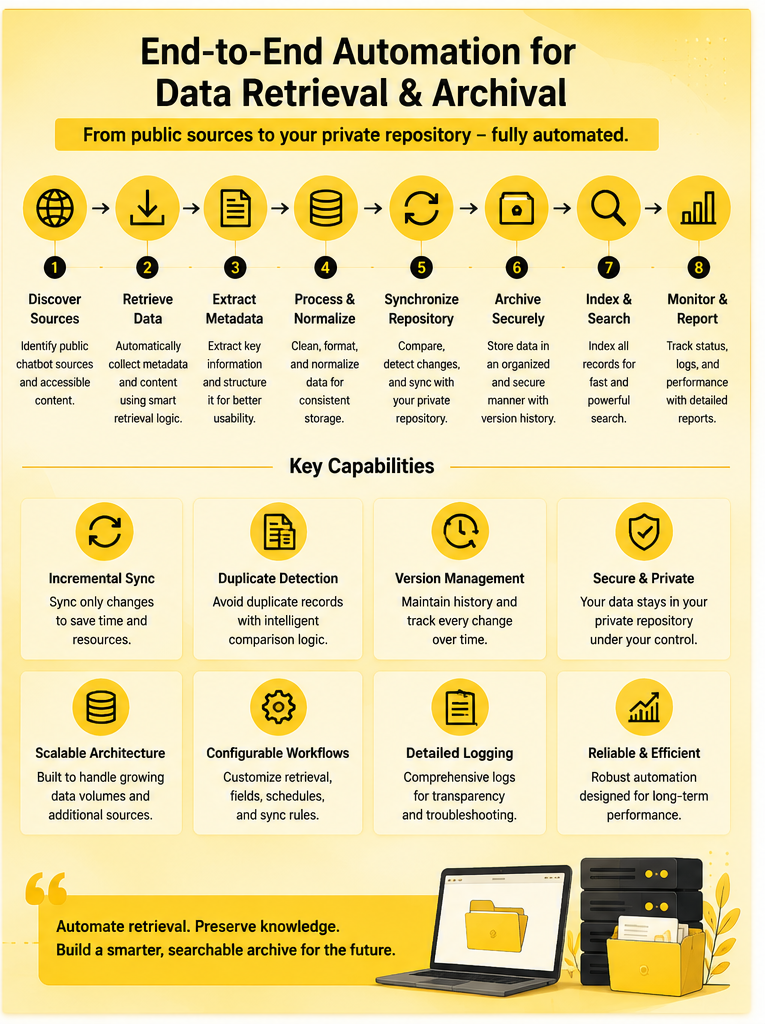
The workflow typically includes:
-
Identify public sources
-
Retrieve accessible content
-
Extract metadata
-
Organize structured records
-
Compare existing repository data
-
Detect changes
-
Synchronize updates
-
Archive historical versions
-
Generate reports
Automation significantly improves operational efficiency.
Metadata Extraction
Metadata provides valuable context beyond the primary content.
The system organizes information such as:
-
Page title
-
Public identifier
-
Description
-
Publication information
-
Last update information
-
Source location
-
Content category
-
Retrieval timestamp
-
Repository status
Structured metadata improves organization.
Content Normalization
Public information often appears in different formats.
CnEL India standardizes retrieved content by organizing:
-
Text formatting
-
Date formats
-
Identifiers
-
Categories
-
Content structure
-
Metadata fields
Normalization creates consistency across archived records.
Repository Synchronization
A major project requirement is seamless synchronization with a private repository.
Rather than recreating records each time, the system intelligently determines whether content is:
-
New
-
Updated
-
Unchanged
-
Archived
This reduces unnecessary duplication.
Incremental Updates
Continuous synchronization should avoid processing the entire archive repeatedly.
CnEL India implements incremental update logic that:
-
Detects changes
-
Updates modified records
-
Preserves unchanged content
-
Adds new entries
-
Maintains historical organization
Incremental processing improves efficiency.
Duplicate Detection
Archival systems must avoid storing identical records repeatedly.
The platform compares:
-
Public identifiers
-
Metadata
-
Content similarity
-
Retrieval history
-
Repository records
Duplicate detection maintains a clean archive.
Version Management
Public content may change over time.
Instead of losing previous information, CnEL India supports version-aware archival.
Version management preserves:
-
Earlier records
-
Updated content
-
Change history
-
Retrieval dates
-
Repository revisions
Historical preservation improves long-term research value.
Structured Repository Organization
An organized repository makes future retrieval significantly easier.
CnEL India structures archived information using:
-
Categories
-
Collections
-
Metadata indexing
-
Date organization
-
Source grouping
-
Searchable records
Well-structured storage improves accessibility.
Search Optimization
As repositories grow, locating information becomes increasingly important.
The system supports search through indexed fields such as:
-
Titles
-
Categories
-
Dates
-
Metadata
-
Keywords
-
Public identifiers
Search optimization improves usability.
Content Classification
Automatically organizing retrieved records reduces manual management.
Classification may group records by:
-
Content type
-
Topic
-
Source
-
Date
-
Collection
-
Repository section
Consistent classification supports scalable archives.
Retrieval Scheduling
Public information changes at different frequencies.
CnEL India designs flexible scheduling options supporting:
-
On-demand retrieval
-
Daily synchronization
-
Weekly updates
-
Periodic archival
-
Manual triggering
Scheduling allows organizations to balance freshness and efficiency.
Error Handling
Reliable automation requires graceful handling of retrieval problems.
The system manages situations such as:
-
Missing pages
-
Temporary failures
-
Inaccessible resources
-
Incomplete metadata
-
Network interruptions
-
Unexpected content changes
Clear logging improves operational visibility.
Logging and Monitoring
Visibility into archival activity helps administrators maintain confidence.
The platform records:
-
Retrieval history
-
Synchronization status
-
Updated records
-
New entries
-
Skipped content
-
Processing outcomes
-
Error events
Comprehensive logs simplify troubleshooting.
Performance Optimization
Large repositories require efficient processing.
CnEL India improves performance through:
-
Incremental synchronization
-
Optimized retrieval
-
Efficient comparisons
-
Structured indexing
-
Reduced redundant processing
Performance optimization supports long-term scalability.
Security and Repository Protection
Although the retrieved content is publicly accessible, the private repository requires appropriate protection.
CnEL India incorporates security measures including:
-
Controlled repository access
-
Authentication
-
Permission management
-
Secure synchronization
-
Data integrity validation
-
Activity logging
Repository security remains a key consideration.
Scalability
The archival system is designed for future expansion.
Possible future capabilities include:
-
Larger repositories
-
Additional public sources
-
Expanded metadata
-
Advanced search
-
Analytics dashboards
-
Collaboration features
-
Historical comparisons
-
Research tools
The architecture remains flexible as requirements grow.
Testing and Validation
Before deployment, the complete workflow undergoes extensive testing.
Testing includes:
Retrieval Testing
Verifying successful collection.
Metadata Validation
Checking structured information.
Duplicate Testing
Preventing redundant records.
Synchronization Testing
Confirming repository updates.
Version Testing
Preserving historical records.
Performance Testing
Evaluating large-scale processing.
Security Testing
Protecting repository access.
Comprehensive testing improves reliability.
Documentation
CnEL India provides clear documentation covering:
-
Repository structure
-
Retrieval workflow
-
Metadata fields
-
Synchronization process
-
Configuration
-
Maintenance procedures
-
Troubleshooting guidance
Good documentation simplifies long-term management.
Business Benefits
The completed archival system delivers measurable advantages.
Expected benefits include:
-
Automated public content collection
-
Reduced manual effort
-
Organized repository management
-
Faster synchronization
-
Better historical preservation
-
Improved search capabilities
-
Cleaner metadata
-
Version-aware archival
-
Higher operational efficiency
-
Scalable architecture
-
Better research support
-
Long-term knowledge preservation
Challenges Solved
CnEL India addresses several common archival challenges.
Manual Collection
Automation reduces repetitive work.
Duplicate Records
Intelligent comparison maintains clean archives.
Missing Updates
Incremental synchronization improves freshness.
Inconsistent Organization
Structured metadata improves consistency.
Version Loss
Historical records remain preserved.
Search Difficulties
Indexed repositories improve retrieval.
Large Data Volumes
Optimized processing supports scalability.
Repository Maintenance
Clear workflows simplify ongoing operations.
Why CnEL India
CnEL India combines expertise in JavaScript development, data processing, workflow automation, repository synchronization, structured metadata management, scalable software architecture, knowledge management systems, and enterprise automation solutions.
Rather than building a basic retrieval script, CnEL India develops complete archival ecosystems that improve data organization, preserve historical information, simplify synchronization, strengthen repository management, and support long-term operational growth.
Every solution emphasizes reliability, maintainability, scalability, and practical business value.
Conclusion
This case study demonstrates how CnEL India transforms manual public content collection into an intelligent, automated archival platform.
By combining responsible public content retrieval, structured metadata extraction, automated synchronization, duplicate detection, version management, organized repositories, searchable archives, performance optimization, secure repository integration, and scalable workflows, the solution creates a reliable foundation for long-term digital preservation.
The result is a future-ready archival ecosystem that improves efficiency, strengthens knowledge management, preserves valuable publicly accessible information, reduces administrative effort, and provides organizations with a structured repository capable of supporting research, compliance, and long-term information management.