
Case Study by CnEL India
Introduction
Customer communication has evolved dramatically as messaging platforms have become one of the most preferred ways for people to interact with businesses. Instead of making phone calls or waiting for email responses, customers now expect quick, personalized, and convenient conversations through messaging applications. Whether they are asking about products, checking order status, booking appointments, requesting support, or seeking business information, they expect responses that are both immediate and accurate.
For businesses, this shift creates new opportunities as well as new challenges. Managing hundreds or thousands of conversations manually requires significant time and resources, often resulting in delayed responses, inconsistent customer experiences, and increased operational costs. As businesses grow, maintaining high-quality communication without expanding support teams becomes increasingly difficult.
CnEL India specializes in designing intelligent automation solutions that transform messaging-based customer service into efficient, scalable, and personalized communication systems. Instead of replacing human support entirely, the approach focuses on creating a balanced experience where automated conversations handle routine interactions while seamlessly involving human representatives whenever necessary.
This case study explains how CnEL India develops an AI-powered automation solution for a WhatsApp-based customer service platform, improving customer engagement, operational efficiency, and long-term business scalability.
Business Background
Messaging applications have become an essential communication channel for businesses across industries, including retail, healthcare, education, hospitality, finance, real estate, and professional services.
Customers commonly use messaging platforms for:
-
Product inquiries
-
Appointment bookings
-
Order tracking
-
Service requests
-
Business information
-
Customer support
-
Payment assistance
-
Feedback submission
-
Complaint resolution
-
Follow-up communication
As conversation volume increases, businesses face several operational challenges:
-
Delayed responses
-
Repetitive questions
-
High support workload
-
Inconsistent communication
-
Manual appointment handling
-
Missed customer inquiries
-
Limited service availability
-
Slow issue resolution
-
Poor conversation tracking
-
Difficulty scaling support
CnEL India addresses these challenges through intelligent conversation automation while preserving a human-centered customer experience.
Project Objectives
The primary objective is to enhance a WhatsApp-based customer service platform by introducing intelligent automation that improves response quality, operational efficiency, and customer satisfaction.
The project focuses on:
-
Automated customer conversations
-
Intelligent message understanding
-
Personalized responses
-
Customer intent recognition
-
Workflow automation
-
Appointment management
-
Business information delivery
-
Human support escalation
-
Customer history management
-
Operational optimization
-
Performance monitoring
-
Scalable communication architecture
The solution aims to reduce manual effort while improving customer engagement across every stage of the conversation.
Understanding Customer Communication
CnEL India begins by analyzing how customers currently interact with the business.
The discovery process examines:
-
Common questions
-
Conversation patterns
-
Response delays
-
Business workflows
-
Customer expectations
-
Support escalation rules
-
Service availability
-
Internal processes
-
Future communication goals
Understanding real customer behavior ensures that automation supports business operations naturally.
Intelligent Conversation Design
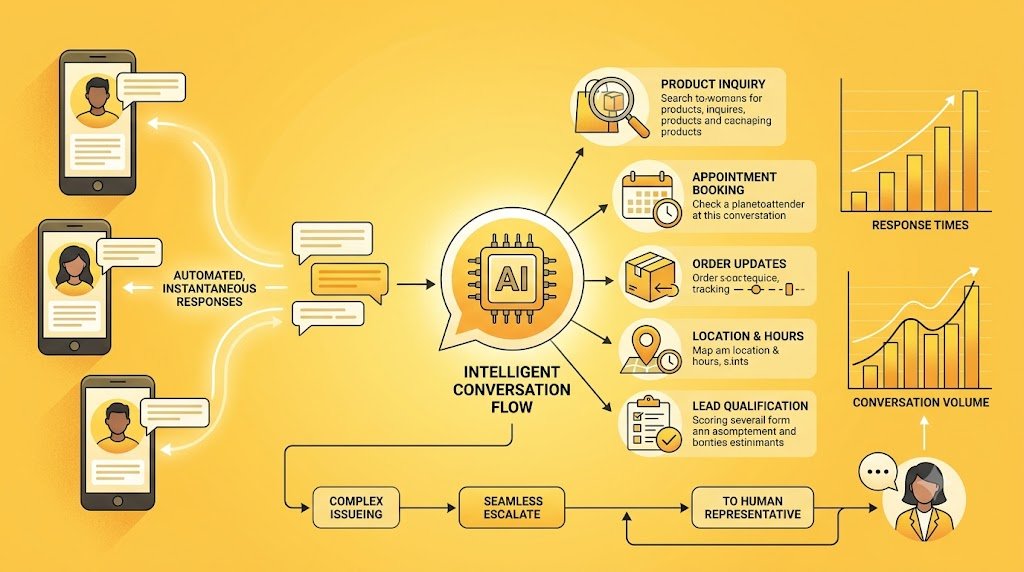
Rather than relying on rigid scripted replies, CnEL India develops conversation flows that understand customer intent and respond appropriately.
The system can recognize requests such as:
-
Product information
-
Pricing questions
-
Booking requests
-
Order updates
-
Business hours
-
Location details
-
Service inquiries
-
General support
This creates more natural customer interactions.
Customer Intent Recognition
Every incoming message represents a customer objective.
The automation system identifies common intents including:
-
Information requests
-
Purchase interest
-
Appointment scheduling
-
Complaint reporting
-
Order assistance
-
Technical support
-
Follow-up requests
-
Feedback submission
Correct intent recognition improves response accuracy.
Personalized Customer Experience
Modern customers expect businesses to remember previous interactions.
CnEL India designs personalized experiences using available customer context such as:
-
Previous conversations
-
Service history
-
Inquiry type
-
Returning customers
-
Ongoing requests
-
Preferred communication flow
Personalization strengthens customer relationships.
Automated Frequently Asked Questions
Many customer inquiries repeat throughout the day.
The automation platform can instantly answer common questions regarding:
-
Business hours
-
Product availability
-
Pricing
-
Delivery information
-
Service details
-
Company policies
-
Contact information
-
Basic troubleshooting
Instant responses reduce support workload.
Appointment Automation
For businesses offering scheduled services, appointment management becomes an important feature.
The system can support:
-
Booking requests
-
Date selection
-
Time availability
-
Confirmation messages
-
Rescheduling
-
Cancellation handling
-
Reminder notifications
Automated scheduling reduces administrative effort.
Customer Support Escalation
Not every conversation should remain automated.
CnEL India builds escalation workflows that transfer conversations to human representatives when necessary.
Escalation can occur when:
-
The customer requests human support.
-
The issue becomes complex.
-
The conversation exceeds automation limits.
-
Sensitive cases require personal attention.
This ensures customers always receive appropriate assistance.
Workflow Automation
Customer conversations often trigger business processes beyond messaging.
The automation system can initiate workflows such as:
-
Lead creation
-
Appointment records
-
Support tickets
-
Internal notifications
-
Customer follow-ups
-
Sales opportunities
-
Feedback requests
This reduces repetitive manual tasks.
Lead Qualification
Businesses often receive inquiries from potential customers.
Instead of treating every inquiry equally, the system can gather important information such as:
-
Customer name
-
Business type
-
Service interest
-
Budget range
-
Timeline
-
Contact preferences
Qualified leads help sales teams prioritize opportunities.
Customer Journey Management
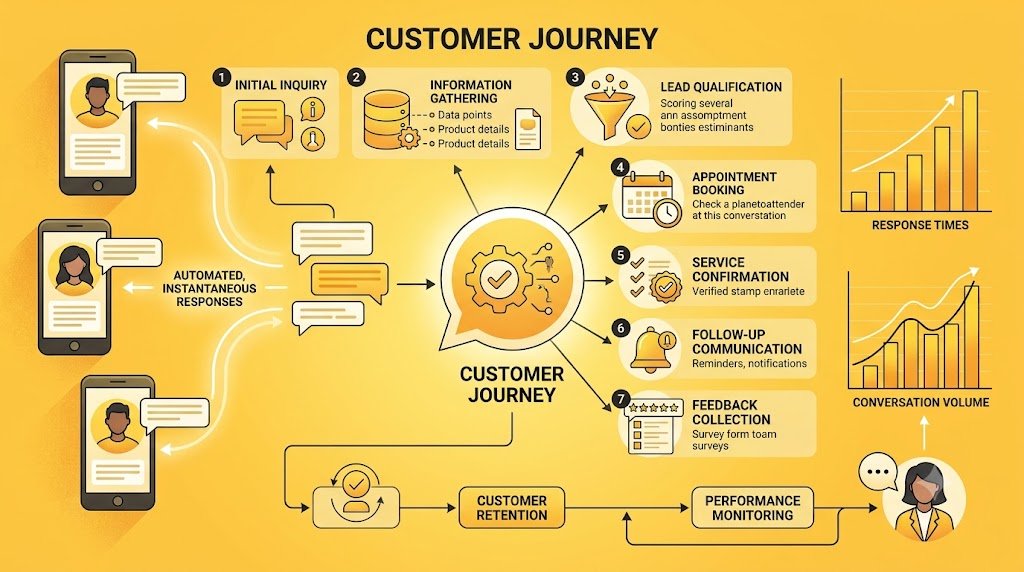
A successful messaging platform supports customers throughout their complete journey.
Typical journey stages include:
-
Initial inquiry
-
Information gathering
-
Lead qualification
-
Appointment booking
-
Service confirmation
-
Follow-up communication
-
Feedback collection
-
Repeat engagement
CnEL India designs automation around this complete lifecycle.
Business Information Delivery
Businesses frequently update customers with important information.
The automation system can provide:
-
Service availability
-
Product details
-
Promotional campaigns
-
Event announcements
-
Business updates
-
Policy changes
-
Order notifications
Timely communication improves customer experience.
Conversation History Management
Maintaining conversation history helps create continuity.
The platform organizes:
-
Previous inquiries
-
Support interactions
-
Booking records
-
Follow-up messages
-
Customer preferences
-
Resolution history
This allows future conversations to become more contextual.
Internal Team Collaboration
Customer service often involves multiple departments.
CnEL India improves collaboration by supporting workflows between:
-
Customer support
-
Sales
-
Operations
-
Management
-
Appointment teams
-
Technical support
Centralized communication improves operational coordination.
Performance Monitoring
Businesses need visibility into messaging performance.
The platform can track metrics such as:
-
Response times
-
Conversation volume
-
Resolution rates
-
Escalation frequency
-
Customer engagement
-
Appointment completion
-
Support efficiency
Performance data supports continuous improvement.
Security and Privacy
Customer conversations often contain sensitive information.
CnEL India incorporates security measures including:
-
Secure authentication
-
Controlled access
-
Conversation protection
-
Data encryption
-
Permission management
-
Activity logging
-
Privacy compliance
Security remains a core design principle throughout the platform.
Scalability
As businesses grow, communication volume increases.
The automation architecture supports:
-
Larger customer bases
-
Higher conversation volume
-
Multiple business locations
-
Additional services
-
Expanded workflows
-
Future integrations
Scalable design reduces the need for major future redesigns.
Human-Centered Automation
A key principle of CnEL India’s approach is balancing automation with human expertise.
The system is designed to:
-
Handle repetitive tasks automatically.
-
Respond instantly to routine inquiries.
-
Escalate complex cases.
-
Preserve natural conversations.
-
Support customer confidence.
This creates a more satisfying experience for both customers and support teams.
Testing and Quality Assurance
Before deployment, the complete automation workflow undergoes extensive testing.
Testing includes:
Conversation Testing
Verifying response accuracy.
Intent Recognition
Checking message understanding.
Workflow Testing
Validating automated actions.
Appointment Testing
Ensuring booking reliability.
Escalation Testing
Confirming smooth transfers to human support.
Performance Testing
Evaluating high conversation volumes.
Security Testing
Protecting customer information.
Comprehensive testing improves production reliability.
Deployment Strategy
CnEL India follows a structured implementation approach.
Deployment activities include:
-
Workflow configuration
-
Conversation validation
-
Security verification
-
Business rule testing
-
Team onboarding
-
Live monitoring
-
Performance optimization
A phased rollout minimizes operational disruption.
Business Benefits
The completed automation platform delivers measurable advantages.
Expected benefits include:
-
Faster customer responses
-
Reduced manual workload
-
Improved customer satisfaction
-
Better lead qualification
-
More efficient appointment management
-
Consistent communication
-
Higher operational efficiency
-
Better conversation tracking
-
Increased service availability
-
Scalable customer support
-
Stronger business insights
-
Long-term automation foundation
Challenges Solved
CnEL India addresses several common messaging challenges.
Delayed Responses
Automation provides immediate replies.
Repetitive Questions
Routine inquiries are handled efficiently.
High Support Costs
Manual workload is reduced.
Missed Leads
Qualification improves opportunity management.
Appointment Complexity
Scheduling becomes more efficient.
Inconsistent Communication
Standardized workflows improve quality.
Limited Scalability
The platform supports future growth.
Customer Frustration
Human escalation maintains service quality.
Why CnEL India
CnEL India combines expertise in conversational automation, business process optimization, customer engagement platforms, workflow design, enterprise software development, messaging solutions, scalable architecture, and intelligent customer service systems.
Rather than simply automating replies, CnEL India develops complete communication ecosystems that strengthen customer relationships, improve operational efficiency, simplify business workflows, and support sustainable growth.
Every solution emphasizes reliability, personalization, scalability, and long-term business value.
Conclusion
This case study demonstrates how CnEL India transforms a traditional WhatsApp-based customer service operation into an intelligent, scalable, and customer-focused communication platform.
By combining automated conversations, personalized interactions, workflow automation, appointment management, lead qualification, human escalation, performance monitoring, secure communication, and scalable architecture, the solution enables businesses to deliver faster, more consistent, and more engaging customer experiences.
The result is a future-ready messaging ecosystem that improves customer satisfaction, reduces operational effort, strengthens business relationships, and creates a strong foundation for continued digital transformation and business growth.