
Case Study for CnEL India
Introduction
The travel industry has evolved beyond traditional booking websites. Modern travelers increasingly look for meaningful experiences, local perspectives, cultural connections, educational content, and authentic stories about the places they visit. A digital travel platform that combines geography, community storytelling, scholarship, and ethical travel therefore requires more than a collection of attractive web pages. It needs a well-structured, responsive, accessible, and engaging digital experience.
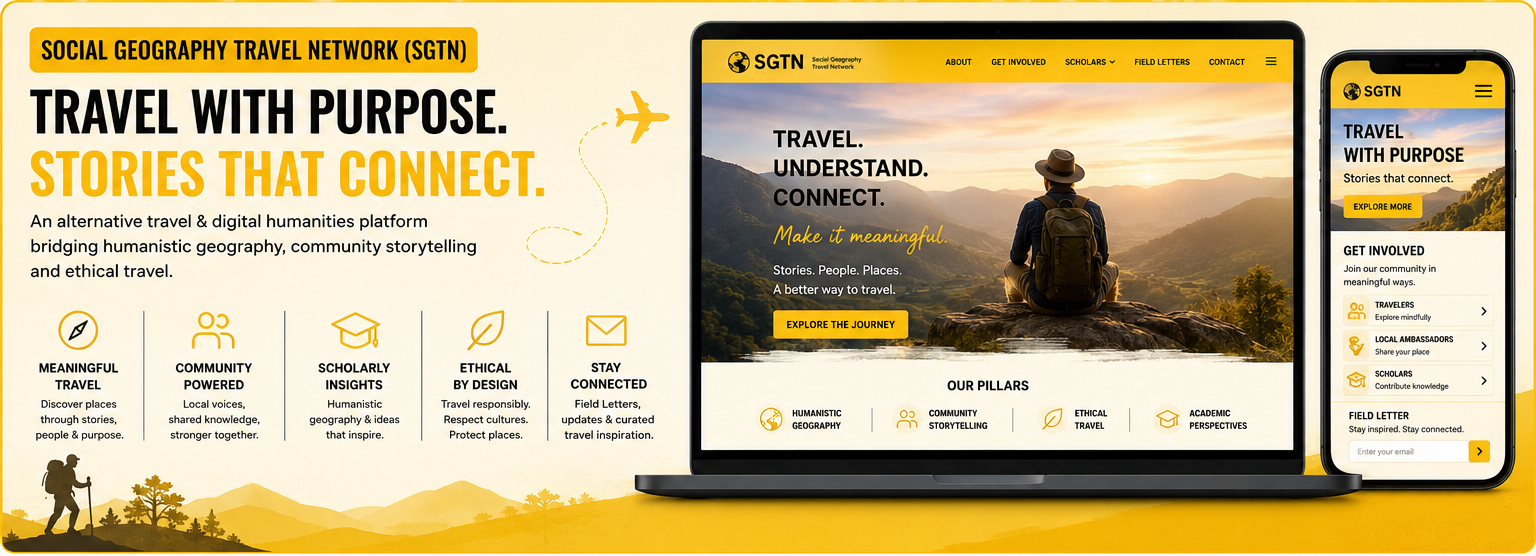
CnEL India worked on the development approach for a travel and digital humanities platform designed to connect travelers, local communities, scholars, and storytellers. The project involved taking an already prepared application structure, written content, design specifications, and visual assets and transforming them into a polished, production-ready website.
The primary challenge was not creating the platform concept from scratch. Instead, the focus was on accurately implementing the prepared content and interface, ensuring that the pages worked consistently across devices, establishing intuitive navigation, connecting forms, optimizing visual assets, and preparing the complete platform for a reliable public launch.
This case study explains how CnEL India approached the project, the challenges involved, the development process, and the resulting business and user experience benefits.
Business Background
The Social Geography Travel Network was conceived as an alternative travel and digital humanities platform connecting humanistic geography, community storytelling, academic perspectives, and responsible travel.
The platform serves several types of audiences, including:
- Travelers looking for meaningful experiences
- Local ambassadors sharing regional knowledge
- Scholars contributing research and perspectives
- Communities documenting local stories
- Readers interested in geography and culture
- Visitors discovering ethical travel opportunities
Because the platform serves multiple audiences, its website must communicate its purpose clearly while making navigation simple.
A poorly implemented website could make a rich collection of content difficult to explore. Therefore, the project required a strong balance between visual presentation, content hierarchy, technical performance, and accessibility.
Project Objectives
The main objective was to prepare the travel platform for public launch by implementing five core pages and creating a consistent experience across the entire website.
The project objectives included:
- Implementing five core pages
- Integrating prepared content and components
- Building responsive layouts
- Improving navigation
- Creating mobile-friendly interfaces
- Implementing onboarding pathways
- Developing scholar feature pages
- Optimizing visual assets
- Connecting forms
- Implementing error handling
- Preparing search-engine metadata
- Configuring the production environment
- Ensuring secure access
- Launching the platform successfully
The project was designed around a short implementation timeline, making efficient development and careful quality assurance especially important.
Understanding the Existing Application
CnEL India first analyzed the existing application structure before making changes.
The review focused on:
- Existing page components
- Navigation structure
- Layout hierarchy
- Reusable interface elements
- Styling conventions
- Content structure
- Image assets
- Responsive behavior
- Form functionality
- Deployment requirements
Understanding the existing architecture reduced unnecessary development and allowed the team to build upon the work already completed.
Page Implementation
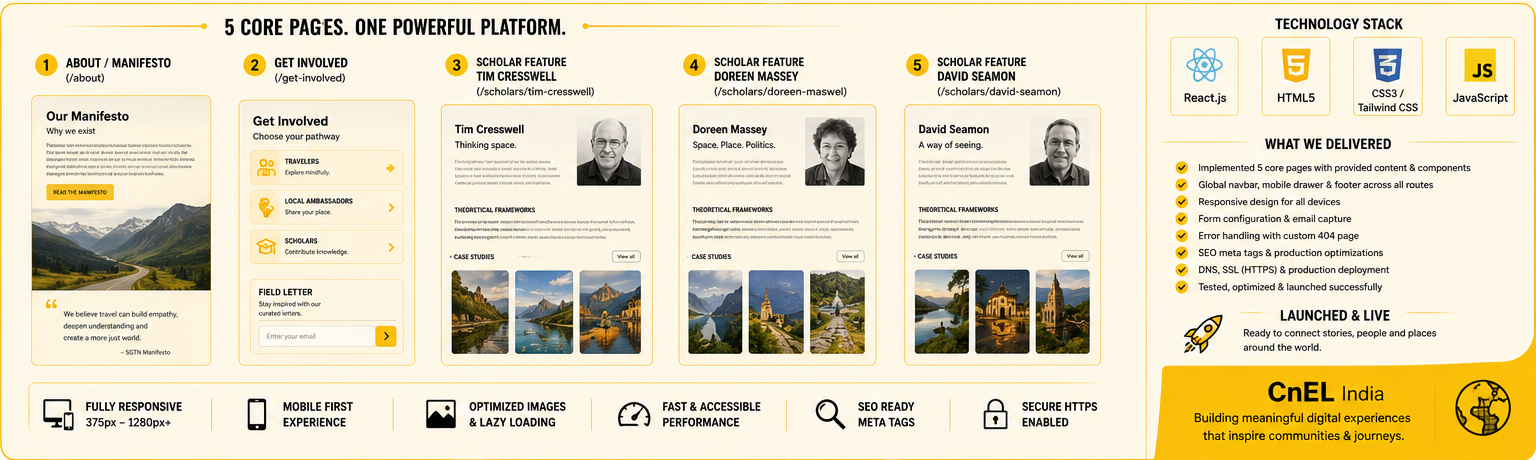
Five major pages formed the core of the launch.
Each page had a different purpose and therefore required a different content structure.
The implementation process ensured that every page remained visually connected to the broader platform while retaining its individual functionality.
About and Manifesto Page
The About page serves as an introduction to the platform’s philosophy.
It communicates the project’s:
- Purpose
- Values
- Vision
- Travel philosophy
- Community focus
- Academic foundation
- Approach to geography and storytelling
The content was structured so visitors could understand the platform quickly without being overwhelmed by large blocks of text.
The implementation focused on strong headings, readable typography, appropriate spacing, and logical content hierarchy.
The page needed to feel editorial and thoughtful rather than like a conventional commercial travel website.
Get Involved Page
The Get Involved page was designed as the primary onboarding area for different groups interested in participating in the platform.
The experience was divided into four major pathways:
Travelers
Visitors interested in discovering meaningful travel experiences.
Local Ambassadors
People who can contribute local knowledge, stories, and experiences.
Scholars
Researchers and academics who can contribute perspectives related to geography, culture, and travel.
Field Letter Signup
Visitors interested in receiving updates and curated information.
This structure helps users immediately identify the pathway relevant to them.
Scholar Feature Pages
Three high-density scholar pages were included in the launch.
These pages highlighted:
- Tim Cresswell
- Doreen Massey
- David Seamon
Each page required careful content presentation because the material combines biography, theoretical concepts, academic ideas, and visual storytelling.
The pages were structured using:
- Profile sections
- Biography information
- Theoretical frameworks
- Supporting explanations
- Visual cards
- Case-study imagery
- Related content
The objective was to make academic material approachable while preserving its intellectual depth.
Visual Storytelling
Travel and geography are highly visual subjects.
The platform’s visual assets therefore played an important role in communicating its identity.
CnEL India integrated the prepared visual assets while ensuring:
- Correct proportions
- Consistent placement
- Appropriate cropping
- Responsive behavior
- Efficient loading
- Visual hierarchy
Images were treated as part of the storytelling experience rather than simply decorative elements.
Global Navigation
A consistent navigation system was required across all pages.
CnEL India updated the global header to provide access to important areas of the platform.
The navigation structure was designed to remain intuitive regardless of which page a visitor entered from.
A consistent footer was also implemented to provide access to supporting information and important navigation links.
Mobile Navigation
Desktop navigation does not automatically translate well to mobile devices.
Therefore, the platform required a mobile navigation drawer that could accommodate smaller screens.
The mobile interface was designed to:
- Keep navigation accessible
- Reduce screen clutter
- Provide clear menu options
- Support touch interaction
- Maintain consistent branding
This created a smoother experience for mobile visitors.
Responsive Design
One of the major requirements was responsive behavior across different screen sizes.
The platform was optimized for:
- Small smartphones
- Large smartphones
- Tablets
- Laptops
- Desktop displays
- Large desktop monitors
Responsive design ensured that layouts, images, text, navigation, and content cards adapted appropriately.
Mobile-First Considerations
Travelers frequently browse travel content on mobile devices while commuting, planning trips, or exploring destinations.
CnEL India therefore prioritized:
- Readable typography
- Touch-friendly controls
- Flexible content sections
- Responsive images
- Simplified navigation
- Appropriate spacing
- Fast page loading
This ensured that the website remained usable even on smaller screens.
Form Integration
Forms are an important part of the platform’s community-building strategy.
The project included form functionality for user participation and email capture.
CnEL India verified:
- Input fields
- Required fields
- Validation
- Submission behavior
- Error handling
- Confirmation behavior
A reliable form experience reduces friction and helps convert visitors into active community members.
Error Handling
A professional website must handle incorrect or unavailable URLs gracefully.
CnEL India implemented an appropriate error experience for pages that could not be found.
The error page was designed to:
- Inform users clearly
- Maintain the site’s visual identity
- Provide navigation back to important sections
- Prevent visitors from reaching a dead end
This improves overall usability.
Search Engine Optimization
The production launch also required basic search-engine configuration.
CnEL India implemented appropriate metadata for important pages, including:
- Page titles
- Descriptions
- Relevant metadata
- Structured page information
This helps search engines understand the purpose of individual pages and improves the platform’s discoverability.
Image Optimization
The website contains several visual assets, particularly on scholar feature pages.
Large images can significantly increase page loading times.
CnEL India therefore focused on:
- Appropriate image dimensions
- Compression
- Responsive image behavior
- Lazy loading
- Efficient delivery
Images that are not immediately visible can be loaded when needed, reducing initial page weight.
Performance Optimization
Performance is particularly important for a content-rich travel website.
Optimization efforts focused on:
- Efficient component rendering
- Image optimization
- Lazy loading
- Reducing unnecessary resources
- Responsive layouts
- Clean navigation
- Efficient page structure
Improved performance contributes to a better user experience and can also support stronger search visibility.
Production Deployment
Once development and testing were completed, the project was prepared for production.
The deployment process involved:
- Production environment configuration
- Domain connection
- Secure HTTPS setup
- Application deployment
- Routing verification
- Form testing
- Error-page verification
- Metadata verification
The objective was to ensure that the website was ready for real visitors rather than simply functioning in a development environment.
Domain and Security Configuration
A production website requires correct domain configuration and secure communication.
CnEL India ensured that:
- The primary domain pointed to the application
- Secure HTTPS access was enabled
- Routing worked correctly
- Visitors could access all required pages
Security and availability were treated as essential launch requirements.
Quality Assurance
The platform underwent testing before launch.
Testing included:
Page Testing
Every core page was checked for content and layout accuracy.
Navigation Testing
All important links and navigation pathways were verified.
Responsive Testing
Different screen sizes were tested for layout consistency.
Form Testing
Inputs, validation, and submissions were reviewed.
Image Testing
Visual assets were checked for quality and loading behavior.
Error Testing
Invalid routes were tested to verify the error experience.
Performance Testing
Pages were reviewed for loading and rendering issues.
Challenges Solved
The project addressed several important challenges.
Existing Content Integration
Prepared content had to be translated into a consistent digital interface.
Complex Academic Content
Scholar pages required a strong information hierarchy.
Multiple User Audiences
The platform needed clear pathways for travelers, ambassadors, scholars, and subscribers.
Responsive Design
Content-heavy pages needed to work across many screen sizes.
Visual Performance
Large visual assets needed optimization without compromising quality.
Production Readiness
The platform required more than page development; deployment, forms, security, and error handling also had to be completed.
Business Benefits
The completed platform provides several important benefits:
- Professional public-facing presence
- Improved visitor experience
- Clear audience segmentation
- Stronger community onboarding
- Better mobile usability
- Faster content discovery
- Improved visual storytelling
- Search-friendly page structure
- Reliable forms
- Production-ready infrastructure
- Scalable foundation for future features
The platform is positioned to support continued content growth and community participation.
Future Expansion
The launch provides a foundation for future development.
Potential future improvements include:
- Interactive travel maps
- Destination discovery
- Community profiles
- Scholar archives
- Story submission systems
- Membership functionality
- User accounts
- Personalized recommendations
- Advanced search
- Community discussions
- Travel resources
- Analytics and engagement reporting
Because the initial implementation follows a structured architecture, these features can be introduced progressively.
Why CnEL India
CnEL India combines expertise in web application development, responsive interface design, content-driven websites, deployment, performance optimization, and digital product development.
The approach focuses on more than simply making pages functional. CnEL India considers the complete user journey—from the moment a visitor arrives on the website to discovering content, understanding the platform, selecting a participation pathway, submitting information, and returning for future engagement.
This combination of technical implementation, usability, responsive design, performance optimization, and production deployment helps create websites that are prepared for real-world audiences.
Conclusion
This case study demonstrates how CnEL India can transform a prepared travel platform concept into a polished, responsive, and production-ready digital experience.
The project brings together five core content-rich pages, audience-specific onboarding pathways, scholar feature pages, responsive navigation, optimized visual assets, functional forms, search-friendly metadata, secure deployment, and comprehensive quality assurance.
The resulting platform provides travelers, scholars, local ambassadors, and other visitors with a clear and engaging way to explore the project’s vision and participate in its growing community.
For CnEL India, the project demonstrates the ability to take an existing application foundation and efficiently transform it into a reliable public-facing product while maintaining visual quality, technical performance, mobile accessibility, and future scalability.