
Case Study by CnEL India
Introduction
Artificial intelligence systems are becoming part of everyday business operations across industries. Organizations now use AI-supported solutions for customer communication, research, reporting, document review, knowledge management, content support, process automation, data interpretation, and decision-making assistance. However, an AI system is only as useful as the quality, relevance, and accuracy of the information used to train, evaluate, and improve it.
General knowledge alone is not enough when AI is expected to work in professional environments. A system supporting finance, healthcare, law, engineering, manufacturing, real estate, film production, accounting, social work, or other specialized fields must understand domain-specific language, workflows, standards, risks, and real-world expectations.
This is where experienced AI trainers become essential.
CnEL India supports organizations by providing domain-focused AI training services that help improve the quality, reliability, and usefulness of AI systems. The work involves human experts who can evaluate outputs, identify inaccuracies, create high-quality examples, improve instructions, classify information, test responses, and guide systems toward more accurate and human-aligned performance.
The goal is not simply to make an AI system generate more text. The goal is to help it provide useful, responsible, context-aware, and professionally relevant outputs for real users.
This case study explains how CnEL India can support businesses and technology teams that need experienced AI trainers from professional domains.
Business Background
AI systems are increasingly being used in industries where accuracy matters. A small mistake in a casual conversation may be manageable, but an incorrect answer in a professional setting can create confusion, reduce trust, delay work, or lead to poor decisions.
For example, a financial AI system must understand common reporting structures, accounting terminology, compliance considerations, and numerical context. A healthcare support system must recognize the importance of careful communication, accurate terminology, privacy awareness, and responsible guidance. A legal support system must understand legal language, document structures, jurisdiction-related limitations, and the difference between general information and professional advice.
Similarly, an engineering-focused system should understand technical documentation, specifications, calculations, safety considerations, and operational workflows. A real estate support system should recognize property-related terminology, buyer and seller concerns, local market context, transaction processes, and documentation needs.
These professional use cases require people with real domain expertise. They need trainers who understand not only the terminology but also the practical meaning behind the information.
CnEL India helps bridge the gap between technical AI development and real professional expertise.
Project Objectives
The main objective of this project is to support the development and improvement of AI systems through experienced trainers from specialized professional domains.
The project focuses on:
- Identifying qualified domain experts
- Evaluating AI-generated responses
- Improving accuracy and clarity
- Creating domain-specific training examples
- Reviewing professional terminology
- Detecting incorrect or misleading outputs
- Improving instruction quality
- Supporting human-aligned communication
- Building reliable evaluation frameworks
- Testing AI responses in real-world scenarios
- Creating structured feedback loops
- Supporting ongoing model improvement
The final goal is to create AI systems that are more useful, trustworthy, and relevant for professional users.
Why Domain Expertise Matters
A general AI system may understand broad concepts, but professional work often requires deeper context.
For example, the phrase “financial performance” can mean different things depending on whether the user is discussing revenue, cash flow, profit margins, debt, budgeting, audit preparation, or investment analysis. A domain expert understands these differences and can evaluate whether an AI response is useful in the right context.
In healthcare, a system may need to understand medical terminology, patient communication, administrative workflows, documentation standards, and the importance of avoiding unsafe or overly confident responses.
In manufacturing, the system may need to understand production workflows, quality control, supply chain coordination, equipment maintenance, safety procedures, and process optimization.
Professional domain trainers help ensure that AI systems do not provide vague, incomplete, or misleading responses when users need specific and practical support.
Domain Areas Supported by CnEL India
CnEL India can support AI training projects across multiple professional domains.
Finance and Accounting
Finance and accounting experts can help train systems to understand:
- Financial reports
- Budgeting
- Cash flow
- Expense tracking
- Tax-related documentation
- Financial planning
- Audit preparation
- Accounting terminology
- Business performance analysis
- Invoice and payment workflows
These experts can review whether AI-generated responses are accurate, clear, and suitable for business use.
Healthcare and Medical Administration
Healthcare-focused trainers can support systems that work with:
- Medical terminology
- Patient communication
- Healthcare documentation
- Appointment workflows
- Clinical support content
- Insurance-related communication
- Medical records structure
- Health education content
- Administrative processes
The focus is on accuracy, clarity, responsible communication, and appropriate boundaries.
Legal and Compliance
Legal domain experts can help evaluate systems that work with:
- Contract language
- Legal document summaries
- Compliance documentation
- Policy interpretation
- Case-related information
- Business agreements
- Regulatory language
- Legal research support
- Client communication
The goal is to improve clarity and reduce the risk of inaccurate or overly broad responses.
Mechanical Engineering
Mechanical engineering trainers can support AI systems that need to understand:
- Technical specifications
- Engineering drawings
- Equipment documentation
- Maintenance processes
- Manufacturing workflows
- Product design concepts
- Safety procedures
- Quality control
- Technical reporting
- Troubleshooting guidance
Their expertise helps ensure that the system understands technical language and practical engineering requirements.
Real Estate
Real estate professionals can support AI systems that assist with:
- Property listings
- Buyer and seller communication
- Property comparison
- Rental information
- Market research
- Lead qualification
- Transaction workflows
- Property documentation
- Customer questions
- Local market terminology
This helps create more relevant and useful responses for property-related tasks.
Film and Video Production
Film and video professionals can help train systems to understand:
- Script structure
- Production planning
- Shot lists
- Editing workflows
- Visual storytelling
- Creative briefs
- Production schedules
- Budget planning
- Post-production processes
- Client feedback management
This is useful for creative teams that want AI support for planning, documentation, and content workflows.
Manufacturing
Manufacturing experts can support AI systems that work with:
- Production planning
- Quality assurance
- Supply chain communication
- Safety procedures
- Equipment maintenance
- Inventory workflows
- Process documentation
- Operational reporting
- Standard operating procedures
- Factory communication
Their feedback helps improve the system’s ability to support practical operations.
Social Work and Community Services
Social work experts can help evaluate AI systems used for:
- Case documentation
- Client communication
- Resource guidance
- Program information
- Community support workflows
- Referral processes
- Educational content
- Service coordination
- Sensitive communication
This requires careful attention to empathy, clarity, privacy, and responsible language.
Role of an AI Trainer
An AI trainer is not simply a content writer or reviewer. The role involves helping a system learn what a high-quality response looks like within a specific domain.
CnEL India’s AI trainers can contribute through several activities.
Response Evaluation
Trainers review AI-generated answers and assess whether they are:
- Accurate
- Relevant
- Clear
- Complete
- Safe
- Professional
- Context-aware
- Useful for the intended audience
They identify weaknesses and provide structured feedback.
Error Identification
AI systems can sometimes generate incorrect facts, outdated information, unclear explanations, or overly confident answers.
Domain experts help identify:
- Incorrect terminology
- Missing context
- Misleading statements
- Weak reasoning
- Incomplete explanations
- Inappropriate recommendations
- Unsafe language
- Unprofessional tone
This feedback helps improve future responses.
Training Example Creation
AI trainers can create high-quality examples that demonstrate how the system should respond to common questions, tasks, and professional scenarios.
Examples may include:
- Customer support responses
- Document summaries
- Technical explanations
- Professional emails
- Workflow guidance
- Report structures
- Compliance-oriented responses
- Scenario-based answers
- Knowledge base content
These examples help establish the expected quality standard.
Instruction Improvement
The way an AI system is instructed can significantly affect the quality of its output.
Domain experts can help improve instructions by defining:
- Correct terminology
- Required context
- Response boundaries
- Professional tone
- Safety considerations
- Formatting preferences
- Escalation situations
- Quality expectations
This creates more consistent and useful responses.
Scenario Testing
AI systems should be tested against realistic situations.
CnEL India develops professional scenarios that reflect real user needs.
For example, a finance trainer may test how the system responds to a budgeting question. A legal trainer may test how it summarizes a contract clause. A healthcare trainer may test whether the system communicates clearly and responsibly about administrative processes.
Scenario testing helps identify whether the system works well in practical conditions.

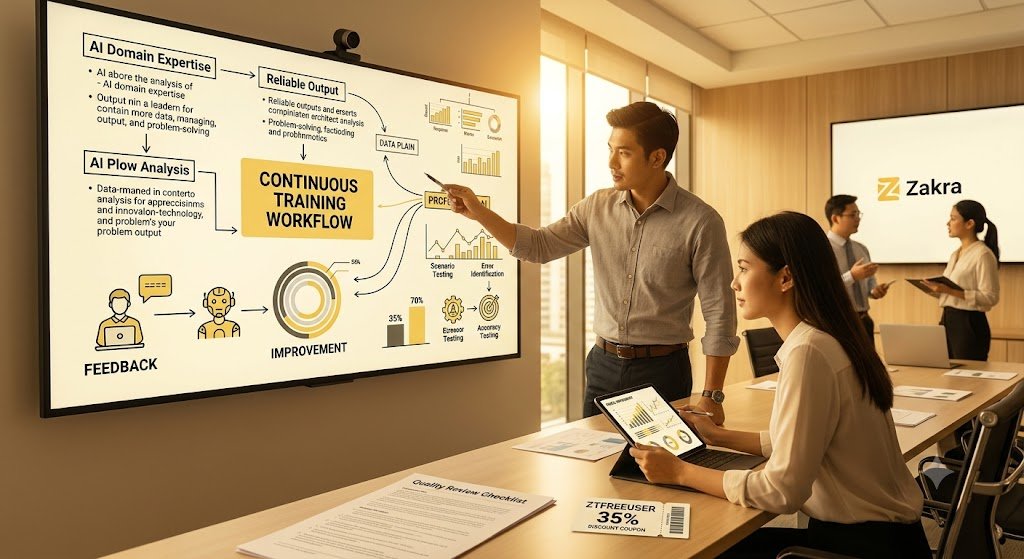
AI Training Workflow
CnEL India follows a structured workflow for domain-focused AI training projects.
Step 1: Requirement Discovery
The team begins by understanding the client’s AI system, target users, professional domain, use cases, risks, and expected outcomes.
Important questions include:
- Who will use the system?
- What tasks should it support?
- What type of information will it handle?
- What quality standard is required?
- What are the key risks?
- Which professional areas need expert review?
- What type of feedback is most valuable?
Step 2: Domain Expert Matching
CnEL India identifies trainers with relevant experience and knowledge.
The selection process considers:
- Professional background
- Industry knowledge
- Communication skills
- Writing ability
- Attention to detail
- Ability to evaluate information
- Familiarity with structured feedback
- Understanding of professional standards
The goal is to match the right expert to the right project.
Step 3: Training Guidelines Development
Clear guidelines are created so trainers understand how to review and evaluate outputs.
Guidelines may include:
- Accuracy criteria
- Relevance criteria
- Tone requirements
- Safety expectations
- Formatting rules
- Domain terminology
- Escalation process
- Feedback format
- Quality scoring system
This helps maintain consistency across the training team.
Step 4: Evaluation and Feedback
Trainers review AI outputs, identify issues, and provide structured feedback.
Feedback may include:
- What was correct
- What was incorrect
- What was missing
- What should be clarified
- What tone changes are needed
- What information should be avoided
- How the response can be improved
Step 5: Quality Review
CnEL India reviews trainer feedback to ensure it is accurate, useful, and aligned with the project requirements.
This quality review helps maintain a high standard across all training work.
Step 6: Continuous Improvement
AI training is often an ongoing process.
As the system improves, new scenarios, new edge cases, and new professional requirements may emerge. CnEL India supports continuous testing and refinement so the AI system can become more reliable over time.
Human-Aligned Communication
Professional AI systems should not only be accurate. They should also communicate in a way that users can understand and trust.
CnEL India focuses on human-aligned communication by helping systems produce responses that are:
- Clear
- Respectful
- Professional
- Helpful
- Balanced
- Context-aware
- Easy to understand
- Appropriate for the situation
For example, a healthcare-related response should be sensitive and careful. A legal-related response should be precise and avoid overclaiming. A finance-related response should explain assumptions and avoid misleading certainty.
Human trainers play a key role in shaping this communication quality.
Data Quality and Consistency
AI training quality depends on consistency.
If one trainer considers a response acceptable while another considers it incorrect, the project needs clear standards to avoid confusion.
CnEL India creates structured evaluation systems that support consistent feedback.
This may include:
- Rating criteria
- Quality checklists
- Example responses
- Domain-specific guidelines
- Feedback templates
- Review processes
- Calibration sessions
- Quality audits
These systems help ensure that the training data and feedback remain useful throughout the project.
Challenges Solved by CnEL India
This project helps organizations solve several common challenges.
Lack of Domain Knowledge
Technical teams may have strong development skills but limited professional expertise in specialized industries. CnEL India provides access to domain-focused trainers.
Inaccurate AI Outputs
Human experts help identify errors before they affect end users.
Generic Responses
Domain trainers help improve depth, context, and practical usefulness.
Inconsistent Feedback
Structured guidelines and quality reviews improve consistency across training work.
Weak Professional Tone
Experts help shape responses so they sound appropriate for business, healthcare, legal, engineering, or other professional environments.
Limited Real-World Testing
Scenario-based testing helps ensure the AI system performs well in realistic situations.
Expected Business Outcomes
A domain-focused AI training program can create important long-term benefits.
Expected outcomes include:
- More accurate AI responses
- Better professional terminology
- Improved user trust
- More useful AI assistance
- Reduced misinformation
- Stronger quality control
- Better alignment with business workflows
- Improved customer experience
- More reliable automation
- Higher-quality training data
- Better readiness for professional use cases
- Stronger AI product performance
The result is an AI system that is better prepared to support real users in real professional environments.
Why CnEL India
CnEL India combines AI training support, professional domain expertise, structured evaluation, quality control, and human-centered communication.
The team understands that professional AI systems require more than broad knowledge. They need accurate context, practical understanding, careful review, and consistent human feedback.
CnEL India helps organizations build stronger AI systems by connecting technical development with real industry expertise.
Conclusion
This case study demonstrates how CnEL India can support AI training projects that require experienced professionals from specialized domains.
By providing domain experts for evaluation, feedback, scenario testing, instruction improvement, and quality review, CnEL India helps improve the accuracy, reliability, and usefulness of AI systems.
The final outcome is a more professional, context-aware, and human-aligned AI experience that can better support users across finance, accounting, healthcare, legal, engineering, real estate, manufacturing, film and video, social work, and other professional fields.