
Case Study by CnEL India
Introduction
In the direct-to-consumer health and beauty market, creative advertising is often one of the biggest growth drivers. A strong product alone is not enough to build a successful brand. Customers need to understand why the product matters, how it fits into their routine, what problem it solves, and why they should trust it over other options.
For a men’s haircare brand operating in Mexico, the challenge is even more specific. The brand needs to speak to male consumers in a way that feels relevant, confident, culturally aware, and emotionally convincing. Haircare can be a sensitive category because it connects with self-image, confidence, grooming habits, aging concerns, appearance, and personal identity. The advertising must therefore be clear, relatable, premium, and conversion-focused without feeling generic or overly promotional.
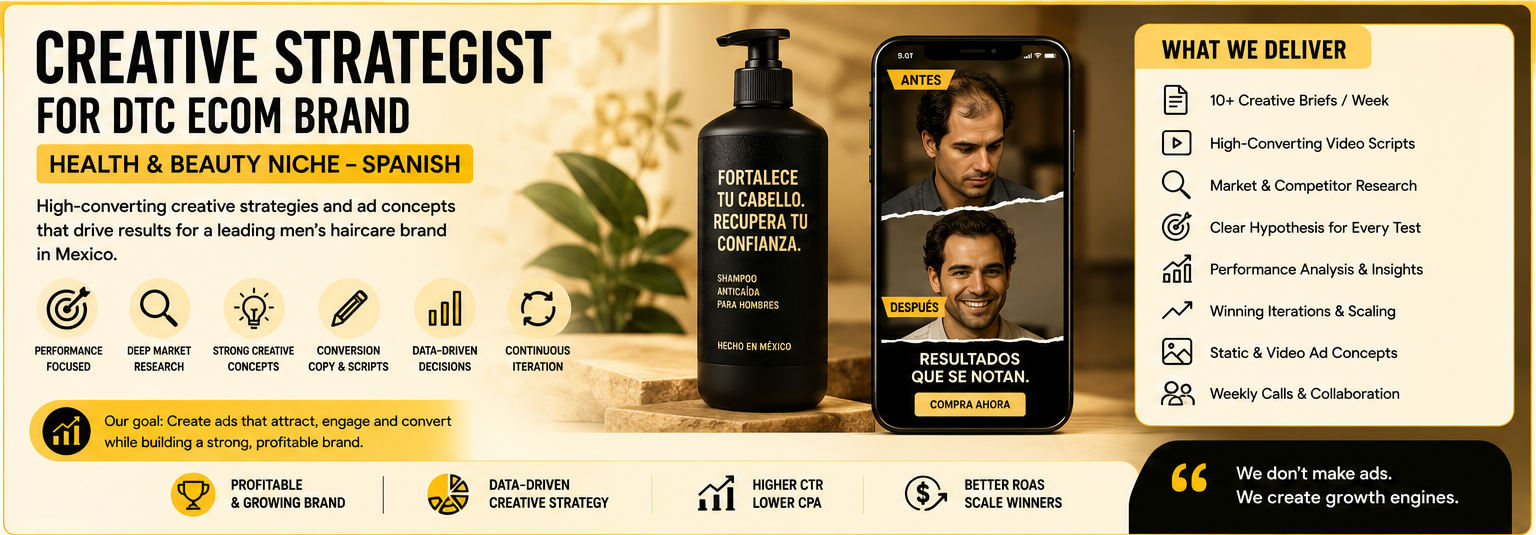
This case study explains how CnEL India can support an established direct-to-consumer men’s haircare brand with creative strategy, advertising research, video script development, performance analysis, testing frameworks, and campaign iteration.
The goal is to create advertising that does more than look attractive. Every creative concept should have a reason to exist, a defined audience insight, a clear testing hypothesis, and a measurable business purpose.
The project focuses on developing high-volume, high-quality advertising concepts that can be tested, improved, scaled, and refreshed over time.
Business Background
The men’s health and beauty industry has grown rapidly in recent years. Men are becoming more aware of grooming, skincare, haircare, wellness, fitness, and personal presentation. This has created strong opportunities for brands that can communicate effectively with modern male consumers.
However, the market is highly competitive. Customers are exposed to many similar products, promises, discounts, influencer videos, before-and-after visuals, and promotional advertisements every day. A haircare brand must stand out by building trust and creating creative content that captures attention quickly.
The brand in this case is already profitable and growing. It has a product-market fit, an active advertising budget, and a need for stronger creative systems. The business is not looking for basic ad variations that copy competitors. It needs a strategist who can understand customer psychology, identify market opportunities, create persuasive scripts, and continuously improve creative performance.
CnEL India approaches this type of project as a complete creative growth system rather than a simple content production task.
Project Objectives
The primary objective is to develop high-performing advertising creative for a men’s haircare brand in Mexico.
The creative strategy should support the following goals:
- Increase conversion-focused advertising output
- Develop strong video ad scripts
- Create fresh creative concepts every week
- Identify winning advertising angles
- Improve paid campaign performance
- Reduce creative fatigue
- Develop scalable testing systems
- Improve understanding of customer motivations
- Build a strong creative research process
- Create better briefs for editors and designers
- Develop static and video advertising concepts
- Improve the connection between creative performance and future testing
The project is designed to support long-term growth, not only short-term content delivery.
Understanding the Target Customer
A successful creative strategy begins with understanding the customer.
For a men’s haircare brand, the target audience may include customers who are concerned about hair thinning, hair loss, scalp health, hair appearance, styling, confidence, grooming routines, or aging.
However, not every customer thinks about these concerns in the same way.
Some customers may be actively looking for a solution because they have noticed changes in their hair. Others may want to maintain their current appearance. Some may be motivated by confidence, dating, career, social image, or lifestyle. Others may simply want a better grooming routine.
CnEL India studies the customer journey by looking at:
- Customer pain points
- Common objections
- Product expectations
- Buying triggers
- Emotional motivations
- Lifestyle habits
- Competitor positioning
- Review language
- Social media conversations
- Frequently asked questions
- Product benefits
- Cultural relevance
This research helps create advertising that speaks directly to the real reasons customers consider buying the product.
Creative Research Framework
Creative research is a continuous process.
CnEL India develops a weekly research framework that identifies opportunities across the health, beauty, grooming, lifestyle, and direct-to-consumer market.
The research process may include:
- Competitor advertising analysis
- Customer review analysis
- Product review analysis
- Social media trend observation
- Cultural moment tracking
- Audience comment analysis
- Advertising format analysis
- Hook research
- Visual trend research
- Market positioning review
- Customer language collection
- Offer and pricing analysis
The purpose is to identify patterns that can be turned into original creative concepts.
For example, if customers repeatedly discuss the fear of noticing thinning hair in photos, a campaign angle could focus on confidence in social moments. If customers are concerned about complicated routines, a creative concept may focus on simplicity and convenience.
The strongest ads often come from real customer emotions and real market insights.
Creative Concept Development
CnEL India develops creative concepts based on a clear strategic foundation.
Each concept is built around a creative thesis. A creative thesis explains why the ad should work, who it is designed for, what problem it addresses, and what response it aims to create.
A strong concept may include:
- Target audience segment
- Customer insight
- Core problem
- Main benefit
- Emotional trigger
- Hook direction
- Video format
- Visual approach
- Script structure
- Call to action
- Testing hypothesis
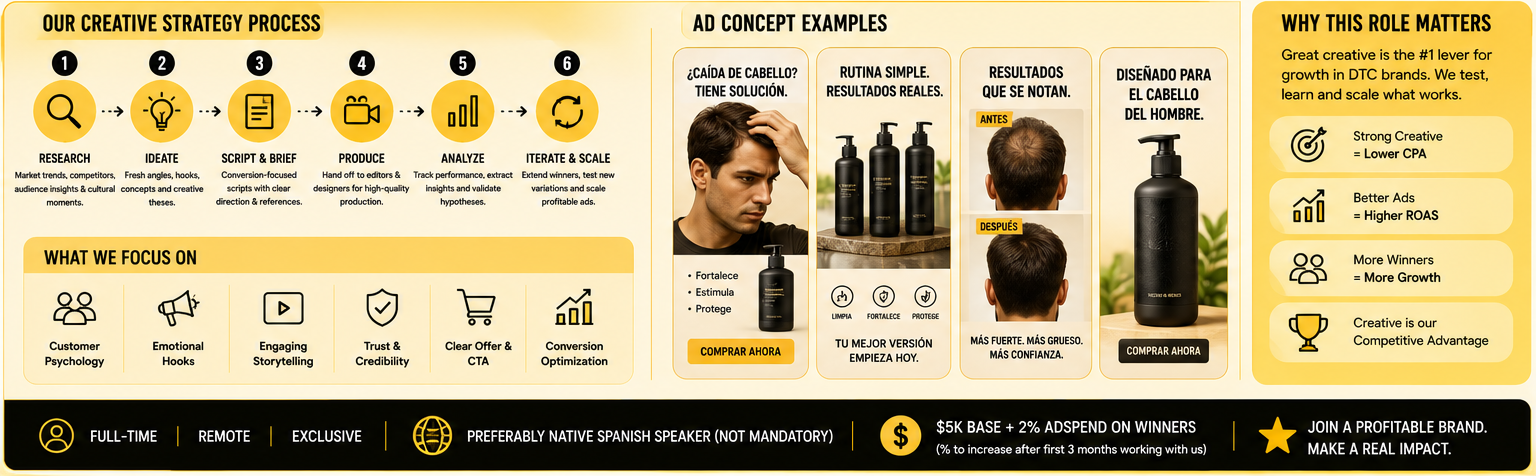
For example, one creative concept may focus on a customer who feels frustrated after trying multiple haircare products without results. Another may focus on a simple grooming routine for busy professionals. Another may use social proof and transformation storytelling.
Each concept should be different enough to test a new angle while still remaining aligned with the brand.
Video Script Development
Video scripts are one of the most important parts of performance advertising.
CnEL India writes conversion-focused scripts that are clear, natural, persuasive, and suitable for short-form video.
A strong video script usually includes:
- A strong opening hook
- A relatable problem
- A clear product introduction
- Product benefit explanation
- Proof or credibility element
- Emotional connection
- Visual direction
- Objection handling
- Clear call to action
The opening seconds are especially important. The viewer must immediately understand why the video is relevant to them.
For a men’s haircare brand, opening hooks may focus on confidence, grooming mistakes, daily routines, common hair concerns, personal transformation, or lifestyle situations.
The script should avoid overly complicated language and should not feel like a generic sales message. It should sound natural, relevant, and believable.
Creative Brief Development
A creative brief helps editors, designers, and production teams understand exactly what needs to be created.
CnEL India develops detailed briefs that include:
- Campaign objective
- Target audience
- Creative angle
- Key message
- Script
- Visual references
- Scene suggestions
- Product placement guidance
- Text overlay direction
- Editing pace
- Music or mood direction
- Required product shots
- Call to action
- Testing hypothesis
A clear brief reduces confusion and helps the production team create content that matches the original strategy.
It also makes the workflow more efficient because editors and designers do not need to guess the purpose of the advertisement.
Video Advertising Formats
Different formats work for different audiences and campaign goals.
CnEL India develops a mix of video advertising formats, including:
- Customer testimonial style videos
- Founder-style videos
- Problem-and-solution videos
- Product demonstration videos
- Transformation videos
- Routine-based videos
- Educational videos
- Comparison videos
- Lifestyle videos
- Trend-based videos
- Storytelling videos
- Fast-paced social media videos
- Product-focused videos
Testing different formats helps identify which type of content performs best for the brand’s audience.
Static Advertising Concepts
Although video is often a major focus, static advertising remains valuable.
CnEL India creates static advertising concepts that can be used for campaign testing, retargeting, product education, and offer communication.
Static concepts may include:
- Product benefit graphics
- Before-and-after visuals
- Customer review visuals
- Routine breakdowns
- Problem-solution graphics
- Ingredient or feature highlights
- Limited-time offer designs
- Comparison visuals
- Educational carousel concepts
- Lifestyle product images
Static ads can be especially effective when the message is simple and visually clear.
Testing Strategy
A high-performing creative system depends on structured testing.
CnEL India develops a testing plan that avoids random content production.
Each creative is connected to a specific hypothesis.
For example:
- Will a confidence-based hook perform better than a product-benefit hook?
- Will a routine-focused video attract more customers than a transformation video?
- Will a customer story create more trust than a direct product demonstration?
- Will a fast-paced visual style perform better than a slower premium style?
- Will a social proof angle improve conversion rates?
Testing allows the brand to learn from audience behavior and make better decisions.
Instead of guessing what customers want, the team can use performance data to identify what messaging, formats, and creative directions are most effective.
Performance Analysis
Creative strategy does not end when an advertisement is launched.
CnEL India reviews performance data to understand what is working and why.
Key areas of analysis may include:
- Click-through performance
- Engagement rate
- Video watch time
- Conversion rate
- Cost per acquisition
- Customer acquisition trends
- Audience response
- Creative fatigue
- Hook performance
- Offer performance
- Landing page alignment
- Product message clarity
The goal is to turn performance data into better creative decisions.
For example, if a particular hook creates strong attention but low conversions, the issue may be that the script does not clearly explain the product benefit. If a video has high engagement but weak sales, the creative may be entertaining but not persuasive enough.
This analysis helps the brand improve future campaigns.
Iteration of Winning Creative
When a creative concept performs well, it should not simply be repeated without change.
CnEL India identifies the strongest parts of winning ads and creates strategic iterations.
Possible iteration opportunities include:
- New hooks
- New opening visuals
- Different customer stories
- Different product demonstrations
- New text overlays
- New calls to action
- Different editing pace
- Alternative visual styles
- New audience segments
- New offers
- Fresh lifestyle settings
The goal is to extend the life of successful creative while avoiding audience fatigue.
A winning concept may have many useful variations if it is approached strategically.
Creative Fatigue Management
Creative fatigue happens when audiences see the same message or visual style too often.
This can lead to declining performance, lower engagement, and higher advertising costs.
CnEL India helps manage creative fatigue by maintaining a balanced creative pipeline.
The pipeline includes:
- Fresh creative concepts
- Iterations of winning ads
- New hooks
- New visual formats
- Seasonal content
- Cultural moment opportunities
- New customer insights
- Product-focused content
- Lifestyle content
- Static ad variations
This approach ensures that the brand always has new creative material available for testing.
Cultural Relevance and Spanish Market Positioning
For a men’s haircare brand in Mexico, cultural relevance is important.
The messaging should feel natural for the audience and should reflect local communication styles, lifestyle references, beauty standards, and customer expectations.
CnEL India can support the development of creative directions that are suitable for Spanish-speaking audiences while maintaining the brand’s identity.
This may include:
- Localized messaging
- Natural Spanish-language script direction
- Regionally relevant lifestyle scenes
- Appropriate humor or tone
- Local cultural moments
- Audience-specific objections
- Market-aware product positioning
The goal is to create content that feels familiar and trustworthy rather than translated or generic.
Collaboration With the Creative Team
Creative strategy works best when there is strong communication between strategists, editors, designers, media buyers, and brand leaders.
CnEL India supports a collaborative workflow where creative ideas are clearly communicated and performance insights are shared regularly.
Weekly collaboration may include:
- Reviewing campaign performance
- Discussing winning concepts
- Identifying new test opportunities
- Reviewing competitor activity
- Planning the creative pipeline
- Refining scripts
- Improving briefs
- Discussing production challenges
- Prioritizing high-impact creative work
This creates a feedback loop where every campaign improves the next one.
Weekly Creative Production System
A reliable creative system requires structure.
CnEL India can support a weekly process that includes:
- Researching the market
- Reviewing customer insights
- Analyzing competitor activity
- Identifying trends
- Developing creative concepts
- Writing scripts
- Preparing production briefs
- Reviewing performance
- Creating iterations
- Planning future tests
The goal is to consistently deliver more than ten well-developed creative briefs each week while maintaining quality and strategic purpose.
High output should not mean low-quality work. Each brief should be grounded in a clear insight and testing hypothesis.
Challenges Solved by CnEL India
This project helps solve several major challenges for direct-to-consumer brands.
Generic Advertising
Many brands produce ads that look similar to competitors. CnEL India develops original concepts based on customer psychology, product value, and market insight.
Weak Creative Testing
Random creative production makes it difficult to learn what works. A structured testing system helps the brand make smarter decisions.
Slow Iteration
When a winning ad is identified, brands need to act quickly. CnEL India helps create variations before performance declines.
Lack of Clear Briefs
Editors and designers need clear direction. Detailed briefs improve execution and reduce wasted production time.
Creative Fatigue
A consistent pipeline of new concepts and iterations helps keep advertising fresh.
Disconnection Between Data and Creative
Performance metrics should influence future creative decisions. CnEL India connects analysis with strategy and production.
Expected Business Outcomes
A strong creative strategy can support meaningful business growth.
Expected outcomes include:
- Improved ad conversion performance
- Better creative testing results
- Stronger customer engagement
- More effective video scripts
- Higher-quality production briefs
- Faster iteration on winning ads
- Better understanding of customer motivations
- Reduced creative fatigue
- Stronger brand positioning
- More efficient collaboration between teams
- Increased advertising scalability
- Better long-term creative performance
The goal is to create a system where creative becomes a predictable growth engine for the business.
Why CnEL India
CnEL India brings together creative research, advertising strategy, customer psychology, scriptwriting, performance analysis, brand storytelling, and production planning.
The approach is focused on real business outcomes. Every creative concept is developed with a clear purpose, audience insight, and testing hypothesis.
Rather than producing content simply to fill a content calendar, CnEL India helps brands build advertising systems that learn, improve, and scale.
Conclusion
This case study demonstrates how CnEL India can support a growing men’s haircare brand with high-quality creative strategy and performance-focused advertising development.
By combining market research, customer insight analysis, scriptwriting, creative briefs, testing frameworks, performance review, and strategic iteration, CnEL India helps create advertising that is relevant, persuasive, and built for growth.
The final result is a structured creative system that gives the brand stronger ideas, better execution, more useful performance insights, and a consistent pipeline of advertising concepts designed to convert.