

Introduction
Data modeling projects become significantly more complex when rules are layered, overlapping, and dependent on historical behavior rather than static calculations. Traditional filtering systems usually operate on direct inputs and predictable outputs, but custom coordinate frameworks introduce a different category of challenge—one where a single value can exist in multiple logical states simultaneously.
This case study explains how CnEL India can design and deliver a standalone command-line analytical platform for a custom coordinate mapping and combination filtering system that transforms historical datasets into ranked candidate outputs through structured signal evaluation.
The project is not a standard calculation engine.
It combines:
- Coordinate mathematics
- Multi-coordinate relationships
- Historical signal evaluation
- Combination generation
- Constraint filtering
- Ranking logic
- Statistical interpretation
- Modular extensibility
The objective is to create a maintainable analytical environment capable of processing historical draw datasets, generating coordinate intelligence, and producing transparent decision outputs.
CnEL India approaches this as a mathematical workflow engineering and system architecture challenge.
Understanding the Business Requirement
The requested system revolves around transforming numbers into coordinate representations and applying layered analytical rules.
The complete environment must support:
- Coordinate assignment
- Overlapping coordinate detection
- Signal scoring
- Combination generation
- Filtering operations
- Ranked output generation
Unlike traditional lookup systems, this architecture requires dynamic interpretation.
The Central Complexity: Multi-Coordinate Numbers
At the core of this project lies overlapping coordinate logic.
Because columns overlap, a single number may belong to more than one coordinate simultaneously.
This creates:
- Multiple valid coordinate identities
- Alternative scoring paths
- Historical dependency calculations
- Expanded signal evaluation
CnEL India treats coordinate identity as a first-class object rather than a simple numeric value.
Handling Dual Coordinate Mapping
One of the most important architectural decisions involves preserving overlapping relationships.
CnEL India approaches this problem by ensuring numbers maintain independent coordinate states.
Instead of forcing a single coordinate assignment, the system preserves all valid coordinate mappings throughout the pipeline.
Each number carries:
- Original value
- Coordinate list
- Offset calculations
- Relationship metadata
This prevents information loss.
As filtering and scoring execute, all coordinate identities remain accessible.
This ensures dual-coordinate numbers continue participating correctly in:
- Signal analysis
- Combination generation
- Ranking calculations
The system avoids collapsing multiple states into one.
Designing the Coordinate Mapping Engine
The coordinate engine becomes the foundation of the platform.
Its responsibilities include:
Input Processing
Accept user row values.
Range Validation
Verify coordinate eligibility.
Coordinate Assignment
Generate all valid coordinate pairs.
Offset Computation
Apply defined positional rules.
Relationship Storage
Preserve overlapping mappings.
This creates a reusable coordinate layer.
Building Coordinate Abstraction
Coordinate logic should remain independent from scoring logic.
CnEL India separates:
- Coordinate definitions
- Mapping calculations
- Signal evaluation
- Combination generation
This modular architecture improves maintainability.
Historical Draw Processing
Historical datasets introduce time-dependent behavior.
CnEL India creates ingestion workflows capable of:
- Reading historical sequences
- Preserving chronological order
- Preparing analytical datasets
- Supporting future expansion
Historical behavior becomes a reusable analysis asset.
Signal Analysis Framework
Signals provide decision intelligence.
CnEL India structures signals into independent analytical modules.
Each signal contributes weighted influence without creating hard dependencies.
This architecture improves transparency.
Column Drought Intelligence
Column drought identifies prolonged inactivity.
CnEL India calculates:
- Consecutive absence periods
- Historical recurrence patterns
- Recovery probability indicators
This creates contextual scoring.
Row Persistence Analysis
Persistence tracks continuity.
The system measures:
- Active duration
- Absence duration
- Stability patterns
Persistence becomes a predictive factor.
Row Displacement Evaluation
Dual-coordinate numbers introduce displacement behavior.
CnEL India calculates:
- Coordinate separation
- Positional movement
- Historical recurrence relationships
Displacement becomes measurable intelligence.
Row Adjacency Interpretation
Neighbor relationships frequently influence candidate generation.
CnEL India supports:
- Near-row detection
- Cross-column comparison
- Local movement analysis
Adjacency becomes a dynamic signal.
Migration Pattern Detection
Historical transitions often reveal patterns.
CnEL India tracks:
- Coordinate movement
- Sequential relationships
- Cross-period transitions
Migration analysis expands predictive capability.
Stair Step Progression Logic
Sequential row behavior introduces another analytical dimension.
CnEL India evaluates:
- Descending movement
- Progressive alignment
- Continuity scoring
These patterns enrich ranking decisions.
Designing the Scoring Engine
Signals alone do not create value.
CnEL India combines signals into a unified scoring framework.
The scoring system supports:
- Weighted influence
- Independent contribution
- Configurable thresholds
Users maintain control.
Combination Generation Framework
Combination creation becomes computationally intensive.
CnEL India structures generation through layered constraints.
The engine supports:
- Controlled generation
- Early elimination
- Rule prioritization
Efficiency remains central.
Odd and Even Pattern Filtering
Pattern analysis introduces structural balance.
CnEL India enables:
- Position-sensitive evaluation
- Pattern enforcement
- Combination validation
Only qualified outputs continue.
Group-Based Filtering
Group membership introduces categorization.
CnEL India supports:
- Group allocation
- Distribution balancing
- Constraint enforcement
This narrows result spaces.
Coordinate Constraint Enforcement
Coordinate intelligence directly influences filtering.
Users may define rules such as:
- Mandatory coordinate inclusion
- Column distribution limits
- Relationship restrictions
Filtering remains configurable.
Cooldown and Exclusion Logic
Historical exclusion prevents repetition.
CnEL India implements:
- Draw exclusion windows
- Cooldown periods
- Historical suppression rules
This creates cleaner outputs.
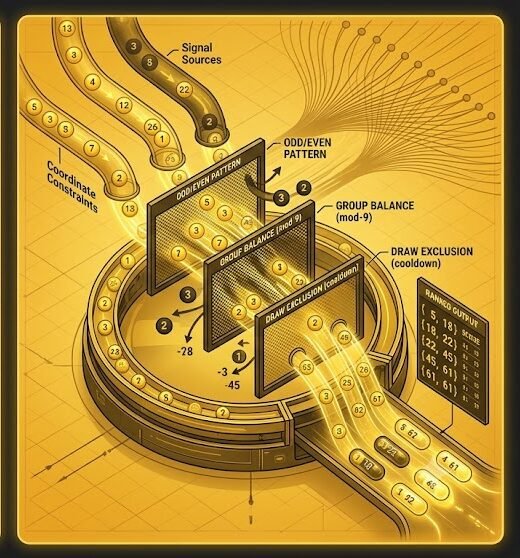
Output Transparency System
Users should understand why results appear.
CnEL India generates ranked outputs with explanations.
Each candidate includes:
- Final score
- Signal contributions
- Coordinate relationships
- Qualification reasoning
Transparency improves trust.
Command-Line User Experience
Although designed for advanced analysis, usability remains important.
CnEL India structures interaction through:
- Clear inputs
- Readable outputs
- Parameter flexibility
- Repeatable execution
This reduces complexity.
Modular System Architecture
Future expansion must remain practical.
CnEL India separates:
- Mapping engine
- Signal modules
- Combination engine
- Output layer
This supports evolution.
Validation and Testing Strategy
Logic-heavy projects require extensive validation.
CnEL India validates:
- Coordinate accuracy
- Edge conditions
- Historical consistency
- Filter correctness
Confidence comes through repeatable testing.
Performance Optimization
Large combination spaces require efficiency.
CnEL India optimizes:
- Candidate pruning
- Signal execution
- Memory utilization
- Iteration strategy
Performance supports scalability.
Documentation and Maintainability
The project emphasizes readability.
CnEL India structures deliverables for:
- Easy modification
- Clear understanding
- Future enhancement
Maintainability becomes part of delivery.
Delivery Methodology
Implementation follows structured phases.
Phase 1 — Requirement Validation
Confirm rules.
Phase 2 — Coordinate Modeling
Build coordinate engine.
Phase 3 — Signal Development
Implement scoring.
Phase 4 — Combination Logic
Build filtering workflows.
Phase 5 — Testing
Validate outputs.
Phase 6 — Final Delivery
Prepare production version.
Challenges Solved by CnEL India
This system addresses:
- Overlapping coordinate complexity
- Historical signal interpretation
- Combination explosion
- Rule conflict management
- Transparent ranking
The architecture prioritizes correctness and extensibility.
Business Outcomes Delivered
Through this implementation, users gain:
- Faster analysis
- Better repeatability
- Transparent decision logic
- Expandable workflows
- Reduced manual evaluation
The result becomes a reusable analytical platform.
Why CnEL India
CnEL India combines:
- Logical system design
- Mathematical workflow architecture
- Structured analytics thinking
- Scalable implementation strategy
- Long-term maintainability focus
The objective is building systems that remain valuable beyond initial delivery.
Conclusion
This case study demonstrates how CnEL India can design and implement a custom coordinate mapping and combination analysis platform capable of handling overlapping coordinates, historical signal evaluation, structured filtering, and transparent ranked outputs.
Rather than creating a simple calculation utility, the solution establishes a scalable analytical framework that preserves complexity while remaining understandable and extensible.
By combining coordinate intelligence, modular processing, signal-driven evaluation, and maintainable architecture, CnEL India enables advanced data interpretation through a robust standalone analytical system.