
Introduction: A Website Alone Is Not Enough Anymore
In today’s digital-first marketplace, local businesses face intense competition online.
Whether it’s a plumber, roofing company, dental clinic, law firm, or cleaning service—customers are searching on Google before making decisions.
And most businesses are fighting for visibility in two critical places:
- Google Organic Search Results
- Google Business Profile (Google Maps) Rankings
The problem is that many local business websites look good visually but fail to rank effectively.
They often lack:
- SEO-focused structure
- Proper service pages
- Location targeting
- Internal linking strategy
- Optimized content
- Conversion-focused layouts
As a result, businesses struggle to generate consistent leads even after investing in website development.
This is where CnEl India delivered a completely different approach.
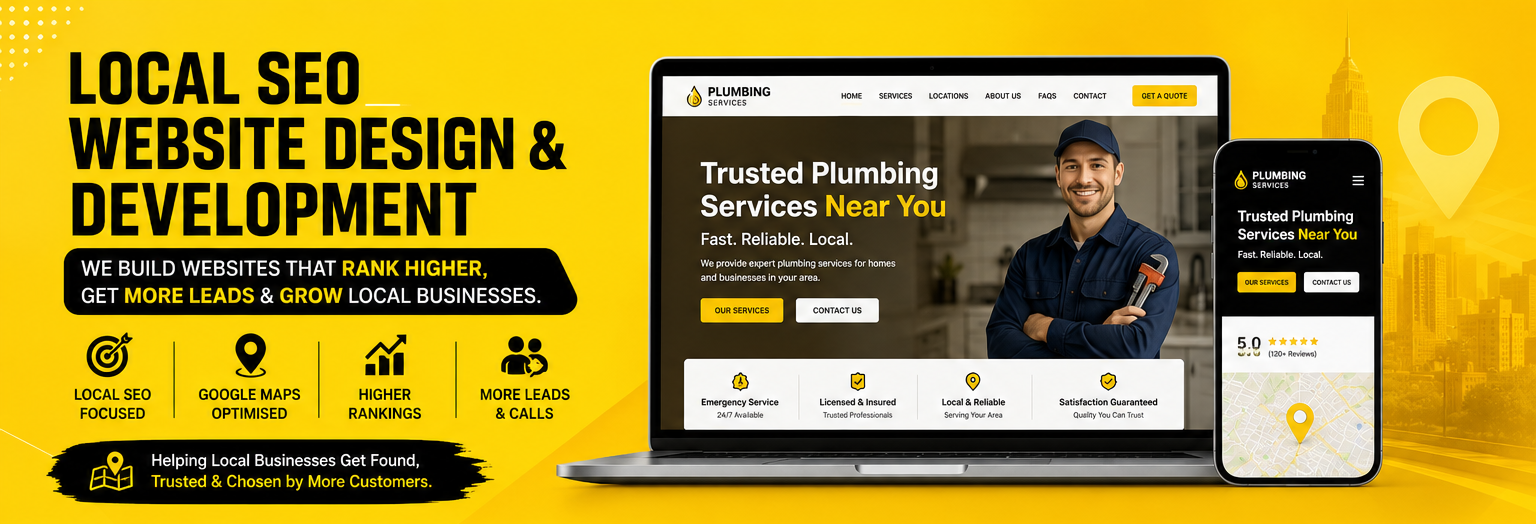
Instead of simply building websites, we developed local SEO-focused digital assets designed specifically to improve visibility, rankings, and lead generation for local service businesses.
The Client’s Core Objective
The client wanted more than a modern website.
Their primary goal was:
“Build websites that rank locally and generate business.”
They needed scalable local SEO websites capable of supporting:
- Organic search rankings
- Google Maps visibility
- Service-based keyword targeting
- Location-based SEO
- Lead generation optimization
The project required a deep understanding of both website development and local search behavior.
This was not just a design project.
It was a visibility and growth strategy.
The Real Industry Problem
Most local business websites fail because they focus only on appearance.
They ignore how search engines evaluate local relevance.
Common problems include:
- Thin content
- Generic service pages
- No city/location optimization
- Weak internal linking
- Poor keyword targeting
- Slow-loading pages
- Weak call-to-actions
- Poor mobile experience
Even worse, many websites are built without considering Google Business Profile support.
This disconnect reduces local ranking potential significantly.
The client needed a systemized solution that solved these problems at scale.
Our Strategy: Building “Local SEO Engines”
At CnEl India, we approached the project differently.
We did not treat the websites as digital brochures.
We treated them as:
Local SEO acquisition systems.
Every section, page, keyword, and layout decision was designed to support:
- Search visibility
- User trust
- Local authority
- Conversion optimization
The objective was not simply traffic.
The objective was qualified local leads.
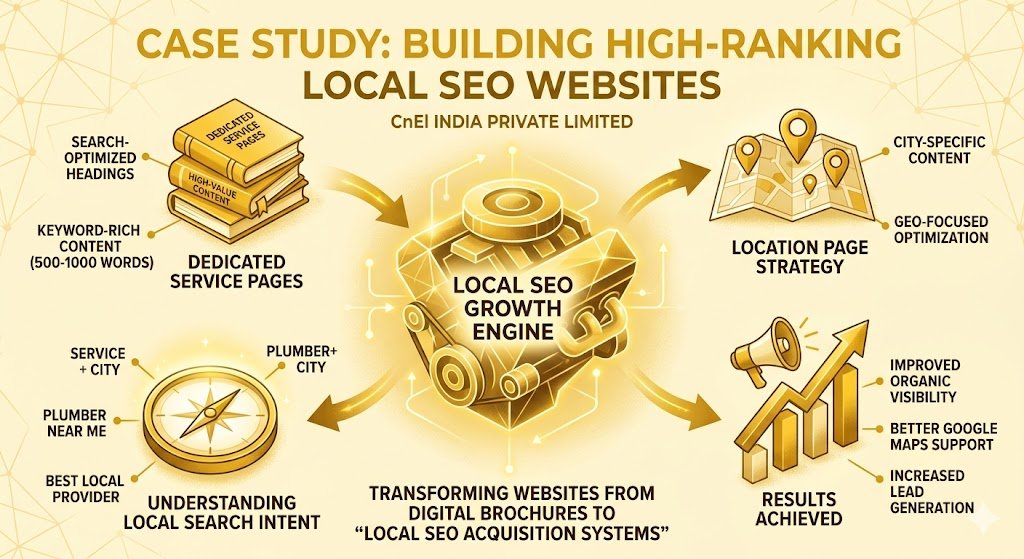
Phase 1: Understanding Local Search Intent
Before development began, we analyzed how users search for local services.
Local search behavior is highly intent-driven.
People search using combinations like:
- Service + City
- Service + Near Me
- Emergency + Location
- Best Local Provider
Understanding this behavior allowed us to structure websites around real-world search patterns.
This became the foundation of the entire SEO architecture.
Phase 2: Building Service-Focused Website Architecture
Instead of creating a few generic pages, we built structured website ecosystems.
Each website included:
- Dedicated service pages
- Location-specific pages
- Industry-relevant content
- SEO-focused page hierarchy
This improved topical relevance and keyword targeting significantly.
Every page had a clear ranking purpose.
Phase 3: Creating High-Value Service Pages
Service pages became one of the most important ranking assets.
Each page was carefully structured to include:
- Clear service descriptions
- Local relevance
- Search-optimized headings
- Keyword-rich content
- User-focused information
- Trust-building elements
- Strong calls-to-action
We ensured every page felt valuable to both:
- Search engines
- Real users
This balance was critical.
Phase 4: Location Page Strategy
One of the biggest ranking opportunities in local SEO is location targeting.
We created dedicated location pages for service areas to increase visibility across multiple regions.
Each location page included:
- Area-specific content
- Service relevance
- Local keywords
- Geo-focused optimization
- User-friendly information structure
This helped the websites appear more relevant for regional searches.
Phase 5: SEO Content Development
Many local websites fail because their content lacks depth.
We focused heavily on creating meaningful, search-friendly content.
Each page included:
- 500–1000 words of optimized content
- Naturally integrated keywords
- Readable formatting
- User-focused explanations
- Informational value
Instead of keyword stuffing, we focused on topical authority and readability.
This improved both SEO performance and user engagement.
Phase 6: Internal Linking System
Internal linking is one of the most overlooked parts of local SEO.
We developed strategic internal linking structures that helped:
- Connect related pages
- Improve crawlability
- Distribute ranking authority
- Enhance user navigation
This created stronger website structure and improved indexing efficiency.
Phase 7: Google Maps & Local Trust Signals
To strengthen local relevance, we integrated elements that support local trust and Google Business Profile visibility.
This included:
- Embedded Google Maps
- Location-specific references
- Service-area consistency
- Contact visibility
- Clear business information
The goal was to reinforce local authority signals across the website.
Phase 8: Conversion-Focused Layout Design
Traffic alone does not generate business.
Conversions do.
We designed websites with strong user engagement strategies, including:
- Clear calls-to-action
- Mobile-friendly layouts
- Fast-loading pages
- Easy navigation
- Contact-focused sections
- Trust-building design elements
Every layout was built to encourage user action.
Phase 9: Mobile Optimization
Most local searches now happen on mobile devices.
We ensured all websites delivered:
- Fast mobile performance
- Responsive layouts
- Easy navigation
- Touch-friendly design
This improved both user experience and search performance.
The Transformation
Before implementation:
- Websites lacked local visibility
- Service targeting was weak
- Google Maps support was limited
- User engagement was low
- SEO structure was inconsistent
After implementation:
- Websites became locally optimized
- Service pages ranked more effectively
- Location visibility improved
- User experience became stronger
- Lead generation increased
The websites evolved from simple online pages into powerful local marketing systems.
Results Achieved
1. Improved Organic Visibility
The optimized structure increased local search relevance significantly.
2. Better Google Maps Support
Location-focused optimization strengthened local presence.
3. Increased Lead Generation
Conversion-focused layouts improved inquiry rates.
4. Stronger User Engagement
Visitors spent more time exploring the websites.
5. Higher Content Relevance
SEO-focused content improved keyword targeting.
6. Scalable Website Framework
The system allowed efficient scaling across multiple businesses and locations.
What Made This Project Different
Many agencies build websites.
We built local ranking ecosystems.
What made CnEl India Private Limited unique:
- Deep local SEO understanding
- Search-intent-based architecture
- Structured service & location strategy
- SEO-focused content systems
- Conversion-first design thinking
- Long-term scalability planning
We didn’t just build websites.
We built digital growth engines.
Key Insight from the Project
One important lesson became very clear:
“Local SEO success is not created by design alone.
It is created by relevance, structure, and user intent alignment.”
Businesses that understand this outperform competitors consistently.
Long-Term Growth Potential
The framework created through this project supports future expansion, including:
- Additional service areas
- New SEO landing pages
- Advanced content scaling
- Enhanced conversion optimization
- Ongoing ranking improvements
The websites are now positioned for continuous growth rather than short-term visibility.
Conclusion
Local businesses no longer compete only through referrals or advertising.
They compete through search visibility.
Through strategic local SEO architecture, content optimization, conversion-focused design, and scalable website development, CnEl India Private Limited successfully transformed traditional local business websites into high-performing digital acquisition systems.
The result was not just better websites.
It was stronger visibility, improved trust, and consistent lead generation.
Because in local search, the businesses that rank are the businesses that grow. 🚀