
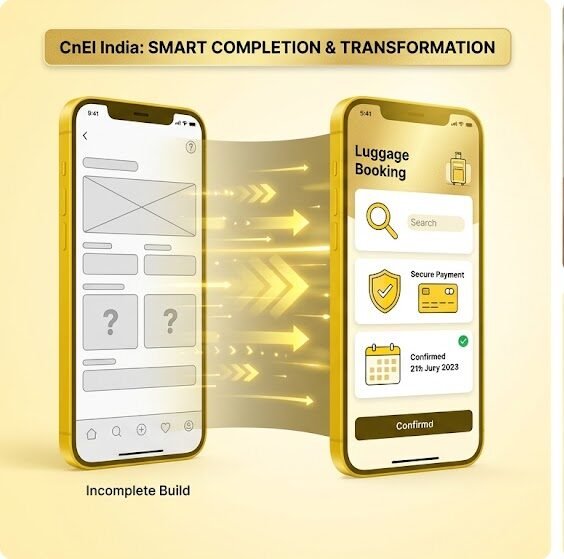
Introduction: Turning an Incomplete Product into a Reliable Business Platform
In today’s travel and hospitality industry, convenience drives customer decisions. Travelers expect fast, simple, and secure digital solutions for everyday problems—especially when it comes to luggage storage.
Whether it is tourists arriving early before hotel check-in, business travelers between meetings, or international visitors with long layovers, the need for short-term luggage storage has become a major service opportunity.
Our client had already started building a luggage storage web application designed to connect users with secure luggage storage locations. The vision was strong, but the project remained incomplete. Core workflows were partially developed, system logic was inconsistent, and several important features were unfinished.
The client needed an experienced development partner who could work with the existing structure, understand the unfinished architecture, and bring the platform to full operational readiness.
This case study explains how CnEl India successfully transformed a partially developed luggage storage web app into a stable, scalable, and user-friendly business platform.
The project was not about starting from zero—it was about finishing correctly.
Client Background
The client was building a digital platform for luggage storage services where users could:
- Search nearby luggage storage locations
- View pricing and availability
- Book secure short-term storage
- Make online payments
- Receive booking confirmation
- Manage reservations easily
The business model focused on simplifying travel experiences while creating partnerships with local hotels, shops, and service providers who could offer secure luggage storage spaces.
The market opportunity was strong, but the platform itself was incomplete.
Several features existed in partial form, but the overall system lacked stability, consistency, and readiness for real customer use.
The client needed a professional team to complete the platform without disrupting the existing development structure.
The Core Challenge
Unlike building a new project, completing an existing one presents unique challenges.
The client was not asking for a fresh development process.
They needed:
- Existing code analysis
- Incomplete feature completion
- Workflow correction
- User experience improvement
- Performance stabilization
- Payment and booking flow reliability
- Future scalability without system rebuilds
The challenge was deeper than development.
It required understanding unfinished logic created by previous work and transforming it into a production-ready platform.
This is where many projects fail—because fixing partial systems is often harder than building new ones.
CnEl India’s Strategic Approach
At CnEl India Private Limited, we approached the project using a completion-first strategy.
Our focus was not just writing code—it was restoring clarity.
We built the project around five stages:
Audit
Understand what exists and what is missing
Repair
Fix broken flows and unstable logic
Complete
Develop missing features with consistency
Optimize
Improve speed, reliability, and user experience
Prepare
Make the platform ready for launch and future scaling
This ensured the platform became stronger, not simply “finished.”
Phase 1: Full Project Audit
Before touching development, we performed a complete technical and business audit.
This included:
- Reviewing existing project structure
- Understanding previous development logic
- Identifying incomplete modules
- Mapping broken user flows
- Checking database relationships
- Reviewing booking and payment processes
- Evaluating admin-side functionality
- Identifying performance and security risks
This stage was critical.
Without understanding the unfinished foundation, adding new work would only create future problems.
Good development starts with clarity.
Phase 2: User Journey Reconstruction
The biggest issue was not missing code—it was broken user experience.
Users should be able to move smoothly from search to booking without confusion.
We rebuilt the journey step by step:
Search → Select → Book → Pay → Confirm
Every stage needed to feel natural and reliable.
We focused on:
- Simpler booking flow
- Clear location selection
- Easy date and time handling
- Transparent pricing visibility
- Strong confirmation process
- Reduced user friction across mobile and desktop
If users feel confused, they abandon bookings.
Clarity improves revenue.
Phase 3: Completing Booking and Reservation Logic
The booking engine is the heart of a luggage storage platform.
This area required major improvements.
We completed and stabilized:
- Slot availability logic
- Real-time reservation handling
- Booking confirmation workflows
- Booking status updates
- Reservation history tracking
- Customer-side booking management
- Partner-side storage handling
This ensured no duplicate bookings, missed reservations, or unreliable confirmations.
Trust in the platform depends on booking reliability.
Phase 4: Payment Flow Stabilization
Incomplete payment handling creates major business risk.
We improved:
- Secure payment flow continuity
- Booking-to-payment connection logic
- Confirmation after successful payment
- Failure handling for interrupted transactions
- Refund and cancellation logic preparation
- Customer trust during payment steps
Users must feel safe while paying.
A weak payment experience destroys confidence immediately.
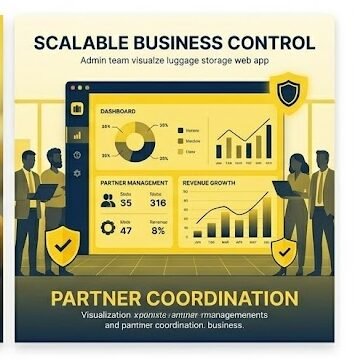
Phase 5: Admin Panel and Business Control
The platform also required stronger operational control for the business owner.
We improved the admin environment to support:
- Booking visibility
- Location management
- Pricing control
- Partner management
- Customer tracking
- Reservation status monitoring
- Business reporting visibility
A strong customer platform needs an equally strong business control system.
Operations should be manageable, not chaotic.
Phase 6: Partner Management Structure
Storage providers such as hotels, shops, and local businesses were critical to the business model.
We created smoother partner-side workflows for:
- Listing storage availability
- Managing reservation requests
- Tracking customer drop-offs and pickups
- Updating booking status
- Operational coordination with the main platform
Without partner efficiency, customer experience breaks.
This phase strengthened both sides of the marketplace.
Phase 7: Performance and Stability Optimization
Many partially built platforms suffer from slow performance and hidden instability.
We optimized:
- Page loading speed
- Booking request handling
- Database performance
- Mobile responsiveness
- Search speed for locations
- Form submission stability
- Session reliability for active users
Users should trust speed.
Slow systems create hesitation.
Fast systems create confidence.
Phase 8: Security and Reliability Review
Because the platform handled customer details and payment-related workflows, security was essential.
We improved:
- User access control
- Data handling reliability
- Safer session management
- Secure reservation workflows
- Better protection against operational errors
- Reduced system vulnerability risks
Security should feel invisible—but always present.
Phase 9: Final Testing and Launch Preparation
Before launch readiness, we conducted complete business simulation testing.
This included:
- Real booking journey testing
- Payment success and failure scenarios
- Reservation cancellation handling
- Admin workflow testing
- Partner-side operational validation
- Mobile responsiveness checks
- High-traffic behavior simulation
The goal was simple:
The system should work smoothly for real people—not just in development environments.
Launch preparation matters as much as development itself.
The Business Transformation
The final result was not just a completed app.
It became a launch-ready business platform.
Results Achieved
Stronger Booking Reliability
Users could now book luggage storage smoothly without confusion or technical failures.
Higher Customer Trust
Clear flows and stable payments improved booking confidence significantly.
Better Partner Coordination
Storage providers could manage operations more efficiently.
Improved Admin Control
Business owners gained stronger visibility and operational management.
Faster Platform Performance
The app became more responsive and user-friendly across devices.
Future Scalability
The system was now prepared for expansion into new cities and service partners.
What Made This Project Different
Many developers focus only on completing missing features.
This project required rebuilding trust inside the system.
What made CnEl India Private Limited different:
- Existing code understanding before development
- Business logic correction before feature addition
- User journey optimization before visual improvements
- Stability before speed
- Scalability before launch
We did not just complete development.
We completed the business model.
Key Lessons from the Project
This project reinforced several important principles:
Finishing is Harder Than Starting
Incomplete systems require deeper understanding than new builds.
Booking Platforms Depend on Trust
Users stay only when the process feels reliable.
Admin Control Matters as Much as User Experience
Business operations must be simple behind the scenes.
Payment Flow is a Conversion Engine
A weak payment process damages both trust and revenue.
Scalability Must Be Planned Early
Future expansion depends on strong foundations.
Long-Term Value Delivered
The client now benefits from:
- A fully functional luggage storage platform
- Reliable booking and payment workflows
- Stronger customer trust
- Better operational visibility
- Improved partner management
- Faster business readiness for launch
- A scalable platform prepared for future growth
The business moved from partial development uncertainty to launch confidence.
Conclusion
A great product is not defined by how it starts—but by how well it finishes.
Through structured analysis, workflow reconstruction, and strategic completion, CnEl India successfully transformed an unfinished luggage storage web app into a dependable business platform.
This project proved that development is not just about writing code.
It is about creating trust, removing friction, and making the business ready for the real world.
Because in digital products, completion is where real success begins.